
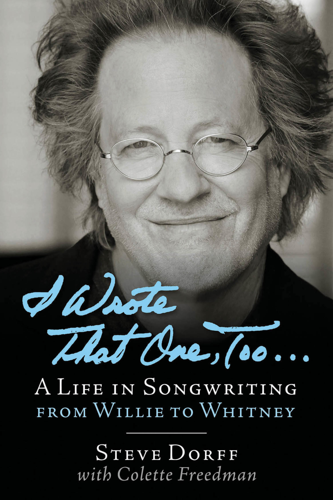
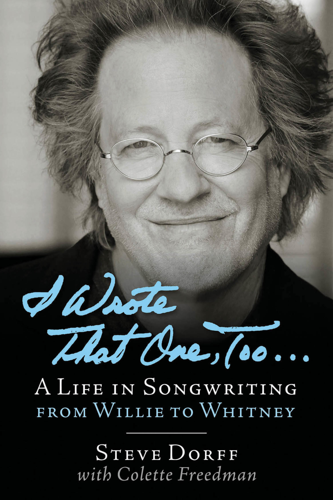

In the opening chapters of his new memoir, I Wrote That One, Too … A Life in Songwriting From Willie to Whitney, songwriter and composer Steve Dorff — along with co-writer Colette Freedman — describes having an unusual power of perception:
Whenever I hear music — as an infant, a child, a teen, or even sometimes still today — it is often accompanied by shapes of color that I see if I close my eyes. The best way I can describe these shapes is that they move in depth, as opposed to left to right. The first time I ever saw a lava lamp as a teenager, I remember thinking. “Ah, someone else figured out how to bottle these crazy things!”
Dorff then draws a connection between this mild form of the perceptual phenomenon known as synesthesia and his own fascination with music. Even as a child he exhibited an almost instinctive understanding of the elements of music theory — chord structure, intervals, time signatures — and that ability eventually pushed him toward a career as a songwriter, composer and arranger.
A native of Brooklyn, Dorff began his career in the 1960s, playing in a high school rock ’n’ roll band until he realized that songwriting held far more appeal for him than performing. After selling his first song to a New York music publisher when he was just 16, Dorff embarked on a career of composing for others, racking up more than 20 Top 10 hits for pop and country artists around the world. He’d ultimately go on to write songs for Barbra Streisand, Celine Dion, Blake Shelton, Smokey Robinson, Kenny Rogers, Ray Charles, Anne Murray, George Strait, Dolly Parton, Judy Collins, Cher, Dusty Springfield, Ringo Starr, Garth Brooks, Willie Nelson and Whitney Houston. He also composed theme songs for TV shows, including Growing Pains, Murphy Brown, Murder She Wrote and Reba, as well as music for feature films like Every Which Way But Loose, Honkytonk Man and Pure Country.
Dorff’s story unfolds through a series of short, simply told chapters that mostly follow a chronological order — though he occasionally jumps ahead or falls back in time for anecdotes about specific artists, songwriters and music publishers. The result is an interesting look at the foundational, creative side of the music business — writing music to order for specific projects, tailoring music for particular artists and more. Dorff also explores moments of pure chance and unexpected turns that led him to success.
These are not the kind of bad-behavior recollections so often associated with rock and country memoirs. But Dorff’s stories are nevertheless lively, especially when he writes about the many volatile personalities he’s worked with over the years. Whether he’s describing British singer Dusty Springfield throwing a chair in the recording studio or a tennis match between talk-show host Merv Griffin and actor Clint Eastwood (an event that eventually led to the No. 1 country song “Barroom Buddies,” which Dorff wrote for Eastwood’s film Bronco Billy), I Wrote That One, Too conveys these incidents with wit and self-effacing charm.
Dorff also devotes a healthy portion of the book to his own trials and personal heartaches: his dysfunctional childhood in the care of alcoholic parents, the loss of his first wife to cancer and the death of his son Andrew, a fellow songwriter who died in 2016 at age 40. For Dorff, these tragedies offer the chance to discuss the lessons he’s learned and the way he sees music as a metaphor for life, a mix of both high and low notes.
Although Dorff frequently indulges in hyperbole in his praise of fellow artists, he maintains a healthy sense of humility and humor about his own work. That down-to-earth quality makes I Wrote That One, Too an engaging peek at a less flashy but still intriguing side of the music business, taking readers on a journey through a colorful life devoted to the creation of music.
For more local book coverage, please visit Chapter16.org, an online publication of Humanities Tennessee.
Email arts@nashvillescene.com



