
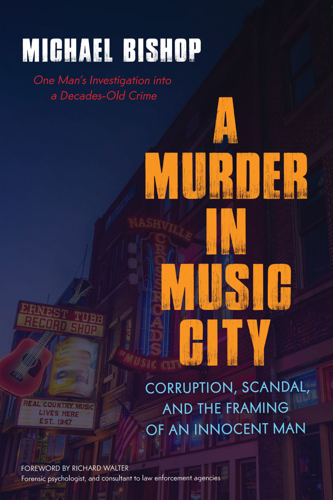


In the first 50 pages of A Murder in Music City, first-time author Michael Bishop chronicles the history of one of Nashville’s most tragic and notorious murders — a crime that scandalized and terrorized the growing city in the late winter and early spring of 1964. On a chilly Saturday night in February, 18-year-old college freshman Paula Herring was found murdered in her mother’s living room, battered and bruised, with two shots fired through her heart. When she was found, her 6-year-old brother was sleeping undisturbed in an adjacent bedroom.
Bishop details the events that unfolded during the next seven months — the police investigation, the questioning of suspects, the neighborhood patrols of vigilantes who feared another attack on the young women of Nashville, the arrest of the primary suspect and the criminal trial that led to the conviction of 39-year-old John Randolph Clarke. Clarke, the shiftless son of a former Tennessee general sessions judge and state senator, was known to be a heavy drinker and philanderer who had been briefly involved with the victim’s mother. While the evidence against him was circumstantial, the jury was convinced of his guilt.
With the crime seemingly solved and relegated to history, Bishop’s narrative jumps ahead 33 years. In 1997, Bishop himself was a sales executive with a Nashville-based health care education company. He had never heard of the Paula Herring murder. A friend who was researching infamous Nashville murders mentioned the case. Shortly thereafter, Bishop volunteered to assist in cataloging routine administrative police records for the Metro Nashville Archives, and a chance discovery led back to the Paula Herring case.

“On my third visit,” Bishop writes, “I reviewed one of the final boxes in the stack. After a quick scan for spiders, I retrieved a file that seemed out of place among the attendance reports. Inside a manila folder labeled ‘Paula Herring,’ I found a disturbing set of black-and-white photographs, along with telegrams, personal notes, and letters to Hubert Kemp, chief of police, Metropolitan Nashville.”
Curious about a high-profile but long-since-forgotten murder and struck by the oddity of finding a crime-investigation file tucked within some mundane paperwork, Bishop was also intrigued by the fact that Herring’s 6-year-old brother seemingly slept through the entire violent incident. Bishop’s curiosity launched a personal quest to find more about the case. As he investigated, it became clear to him that there were grave problems with the officially issued explanation for the crime. A variety of possible suspects was ignored, standard police procedures were often violated, and suspicious circumstances regarding the investigation abounded.
Bishop chronicles his investigation over the course of several years, tracking down surviving witnesses and others connected to the case and using his skills as a salesman to prompt them to tell their stories. In his telling, the mystery of what really happened on that February night and Bishop’s obsession with uncovering the truth deepen with each interview. The narrative unfolds in a straight-ahead, novelistic style, with sharp details and just a hint of drama.
The tale Bishop uncovered through hours of interviews and research involves sex, drugs, a testy mother-daughter relationship and a possible connection with a previous murder. It’s a tangled web of deception, cover-ups and unforgiven sins that reached the highest levels of Nashville’s political power structure in the early 1960s.
Just as fascinating is Bishop’s own journey from mildly inquisitive private researcher to dogged cold-case investigator. While the synchronicity and odd twists he encountered throughout his investigation might spark incredulousness in some readers, it would be wise to remember Mark Twain’s observation that “the only difference between reality and fiction is that fiction needs to be credible.” A Murder in Music City is a fascinating and gripping tale of high passion and dark deeds, a forgotten chapter of Nashville’s history, a quest for justice, and a personal memoir of one man’s persistent pursuit of the truth.
For more local book coverage, please visit Chapter16.org, an online publication of Humanities Tennessee.
Email arts@nashvillescene.com



