
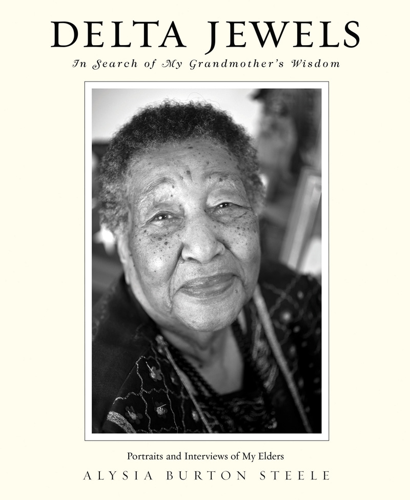
To call Alysia Burton Steele's thoughtful and thought-provoking book Delta Jewels by its full title, one must write: Delta Jewels: In Search of My Grandmother's Wisdom: Portraits and Interviews With My Elders. That's quite a few words. And not one too many.
Steele has been a photographer for a quarter-century and was part of a team that won a 2006 Pulitzer Prize for documenting Hurricane Katrina. Delta Jewels interweaves the story of Steele's early life in Pennsylvania and Mississippi with large black-and-white photographs, some spanning two pages, of 54 sage black women. Accompanying each portrait is a first-person account of each woman's life and her signature.
Delta Jewels is quite obviously part autobiography, part biography, part photography book and part autograph book. But it is the less obvious parts — Steele's critique of prevailing beauty aesthetics and her exploration of the intimate lives of long-lived black women — that dazzle.
In black English the word "funeralize" means to bury with due pomp and circumstance; it means to honor the worthy with a worthy and honorable act of your own. To introduce Alysia Burton Steele and Delta Jewels I am creating a new word: "portraitsize." It means to create a worthy and honorable portrait that celebrates both viewer and viewed. Steele has portraitsized her Delta jewels. In doing so she doesn't merely challenge the prevailing American standards of beauty — she destroys them.
Prior to her appearances in Memphis and Nashville, Steele recently answered questions via email:
Which of the women you photographed is most like the grandmother who raised you?
I found a little something about my grandmother in most of the women. Perhaps it's the Southern culture or their generation, but I would say that Mrs. Lela Bearden reminded me most of Gram. Mrs. Bearden bought her husband's clothes for much of their marriage, as did my Gram for Pop-Pop. Fond memories for me are remembering Gram buying Pop-Pop a baby-blue suit that matched his eyes and how she would bring home clothes and shoes for him to try on. I especially connected with Mrs. Bearden because her stories took me back to a good place in my childhood.
Is there any sense that Delta Jewels is about mother loss as well as grandmother loss?
Absolutely. For me, it was about a grandmother's loss, but I recognize for many it may be about the loss of a mother, grandmother, aunt, sister, teacher — any woman who has helped raise, encourage and support us. I believe many who take the time to read my book will see themselves and a woman who they love. It goes across race, too. It's about remembering old times and learning from our elders — appreciating our oral history and remembering all the quirks, old sayings, and mannerisms that helped shape us into who we are today.
You do a powerful job of capturing the particular beauty of every single woman you photograph in Delta Jewels. What do you look for to find the beauty in the person who is sitting for you?
Thank you for saying this because it means a lot to me. As a photojournalist, I am very aware of my surroundings. I am a visual person and watch people. When I sat down with the women, I preferred to interview and talk with them first and then take their photograph. That was done by design. I believe you have to connect with your subject first. I needed to make eye contact and listen to them — I mean, really listen to them. Oftentimes I had to dig deeper and ask many follow-up questions.
I watched their mannerisms, how they held their heads, how they sat with their hands. I did this because I wanted to see what features spoke the most to me. That's how I decided to take their photographs. For example, Mrs. Velma Moore has incredibly high, beautiful cheekbones. I knew I had to highlight them. How to do that? Take a profile photo. Ms. Bessie Thompson has striking, piercing eyes. How to highlight them? Get extremely close to her — front and center and get right to the point — her eyes. I went with the flow and highlighted what spoke to me. Some women were extremely uncomfortable, but I tried my best.
And you know, as a black woman, I get very irritated when photojournalists show black people in such a negative light. I get tired of seeing stories about athletes, drugs, unwed mothers — like that's all we are. Can someone show me some proud black women? We need more of it. I believe our culture is thirsty for it. And I just tried to do my grandmother and these wonderful grandmothers justice.
Do you consider yourself to be a beautiful woman?
Yes, I am a beautiful woman. Do I wish I were thinner? Yes. Do I wish I didn't have as much gray hair? Yes. At 45, I'm a work in progress. But what I love about myself? I have a generous, giving heart. I feel for people. I sometimes think after I do. I cry easily, am emotional and passionate about everything, and I try to do the right thing. It's not always easy, but I think those qualities make me even more beautiful — at least I hope they do.
For more local book coverage, including a longer version of this interview, please visit Chapter16.org, an online publication of Humanities Tennessee.
Email arts@nashvillescene.com



