

Hinduism traces its roots to the Vedic religion of the Iron Age and is considered to be the world's oldest living faith. A new exhibit at the Frist Center is the first major museum exhibition to focus on the Hindu deity Vishnu, offering a taste of Indian culture, an abbreviated history of Indian art, and an insightful look into Hindu traditions and philosophies. Vishnu: Hinduism's Blue-Skinned Savior was organized by the Frist Center along with Joan Cummins, Asian Art curator at the Brooklyn Museum, putting the Frist in league with one of the most important art institutions in the nation.
Five years in the making, Vishnu encompasses a complex spectrum of regions, periods and traditions. Including 170 sculptures, paintings and objects from as early as the fourth century, the exhibit displays work from over 40 lenders worldwide, boasting a number of pieces that have never been exhibited. The show introduces the major aspects of Hindu religion and highlights the aesthetics of Indian art through what Cummins refers to as "the purest and rarest examples available."
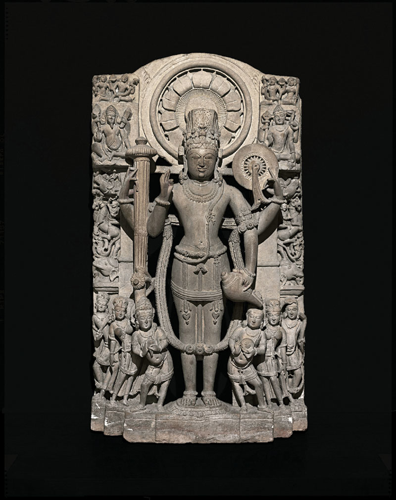
In the show's first section, viewers are introduced to Vishnu and his attributes. Known as Vishnu the Preserver, the god plays a role in keeping the universe in peaceful balance. While many deities are represented as swaying and dancing figures in Hindu art, Vishnu is typically presented standing straight up, usually adorned in a high crown and princely garb. Vishnu's many arms represent his power and allow him to wield various weapons and emblems: a conch shell, a lotus, a mace and a small spiked throwing disc called the Sudarshana Chakra.
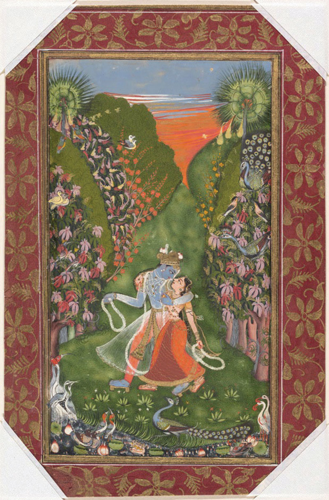
These objects themselves are often presented in anthropomorphic forms. One piece on loan from Berlin's Museum of Asian Art depicts the multi-armed, fiery headed personification of Vishnu's throwing disc. The piece dates to the 1300s, and scholars contend that the bronze sculpture is the oldest of its kind from southern India. This section of the exhibit also includes paintings and sculptures of Vishnu with his wife Lakshmi and various female consorts. Playful, erotic and romantic, these stylized depictions are as compelling as one would expect from the culture that gave the world the Kama Sutra.
The show's large middle section presents the various avatars of the blue-skinned Vishnu. The avatars of Vishnu are earthly manifestations of the god, embodying specific aspects of the deity's nature. "Think of it like a hand reaching down from heaven," explains Cummins. "The avatars are Vishnu, but not Vishnu in full."
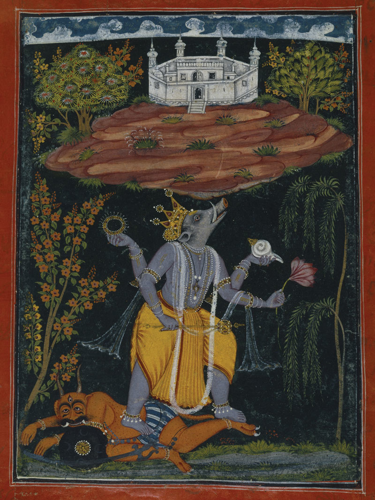
Paintings and sculptures depict various forms of Vishnu's avatars: a fish, a turtle, a boar, a man/lion and a dwarf. Varaha the boar is one of the show's best represented avatars. A number of paintings depict an anthropomorphic Varaha acting out various stories and legends. A beautiful basalt sculpture finds Varaha in theriomorphic form, engraved with figures that represent deities and other heavenly beings. Such sculptures of Varaha are very rare, and the symbols serve as a reminder that the avatar is the embodiment of what the exhibition catalog calls "the true, vast, all-encompassing nature of the divine."
An entire gallery is devoted to Krishna, the Vishnu avatar with the most complete backstory and whom many believers consider to be a god in his own right. Numerous paintings in this section find Krishna slaying any number of demons, including the giant serpent Aghasura.
The paintings throughout the show are stunning, their minute, exquisite detailing applied to paper and cloth with opaque watercolor, silver and gold. Most of them date from the 1700s, and many are pages from illustrated manuscripts. These pieces are the highlight of the show, and the depictions of Vishnu's avatar Rama leading an army of bears and apes against a phalanx of demons are jaw-dropping displays of precision, color and energy.
The exhibit's final section explores the worship of Vishnu and includes images of temples and ritual objects. The last gallery presents the Hindu Home Shrines show-within-a-show, taking viewers on a tour of sacred spaces in Hindu households — including a number from right here in Nashville.
The scope of the show is vast, covering an epic sweep of the religious and cultural spectrum of Hinduism. This is not an exhibit that will sink in with casual glances. To really grasp its essence, Cummins offers this deceptively simple suggestion: "Pick a painting and spend some time with it."
Email arts@nashvillescene.com.



