
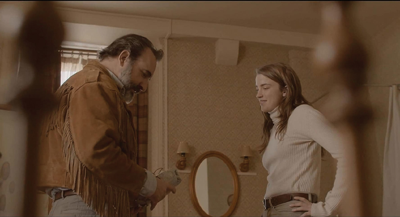


French director Quentin Dupieux’s absurdist conceptual comedies, like Rubber and Wrong, have found an international cult audience. When he first started making films in 2002, he was better known for producing dance music under the name Mr. Oizo, but his commitment to cinema proved to be more than mere hobbyism. His latest film, Deerskin, cuts deeper than his usual goofs. He has described it as his first realistic film.
On the surface, Dupieux’s claim is an odd one. After all, Deerskin is about a man, Georges (Jean Dujardin), who buys a deerskin jacket and becomes pathologically obsessed with it — to the point that he wants to eliminate every other jacket from the planet, ultimately becoming a serial killer to execute his plan. But if comedy lies in playing out ridiculous scenarios with a straight face, as video essayist Renegade Cut has recently argued, Deerskin succeeds at it. Dujardin’s performance shows no signs of irony; there’s no smirking. Dupieux’s direction treats the narrative at face value, never indulging in stylistic excess. Everyone digs wholeheartedly into the film, as bizarre as its concept is.
Deerskin opens with a brief scene featuring young people who approach the camera to say, “I swear I will never wear another jacket as long as I live.” They then throw piles of jackets in a car trunk. As Georges looks at himself in his car windshield, attentive viewers will notice that he seems much more interested in his clothes than his looks. He tries to flush his jacket down the toilet, going on to buy a deerskin one. He begins to hallucinate that it talks to him, and around the same time, he decides that he wants to become a filmmaker. His plan is aided by his encounter with Denise (Adèle Haenel), a friendly bartender who also works as a film editor. On the outs with his wife, Georges struggles with poverty.
Deerskin works on two levels: as a hilarious and creepy pitch-black comedy, and also as a film rich in allegorical meaning. It carefully plots out Georges’ startling descent into violence, which is tied to his narcissism. To him, looking good has nothing to do with his own body — with his dad bod and graying beard, Dujardin is handsome but certainly looks his age. His self-image depends on the products he buys. Fashion becomes a zero-sum game, wherein if anyone else can buy the same jacket — or even any other kind of jacket — he loses.
Despite some major aesthetic and tonal differences, Deerskin pursues a nightmarish vision of violence in France’s backwaters — a universe away from Parisian glamour — that recalls New French Extremity horror films like Sombre. The film’s colors are muted earth tones, taking inspiration from Georges’ jacket. Unlike the goofy gore in early Dupieux films, Deerskin’s sense of humor does not detract from the impact of its violence. Instead, the deadpan way in which the film manages to swerve from comedy to gore makes the latter all the more disturbing. You might giggle when Georges’ jacket talks to him, but he has no idea how dangerous his behavior has become. It’s impossible to draw the line between ordinary narcissism and the process of becoming a serial killer. That raises questions about the impact of more socially acceptable forms of narcissism.
Dupieux does not spare himself from critique — there are plenty of parallels between Georges’ filmmaking and his own (not to mention the physical similarities between the character and the director). But Denise’s ambitions eventually stake a claim on Georges’ self-obsessed world, suggesting an escape route. The story of Deerskin may be absurd, but it signifies very real traps that ensnare, just like the deer who are turned into jackets.



