


There’s a delightful moment in the 1995 documentary series The Beatles Anthology when Paul McCartney responds to criticism that his band’s legendary 1968 double album was too long, that it was overstuffed with too much material and too many ideas. “What do you mean?” says Macca. “It was great, it sold, it’s the bloody Beatles’ White Album. Shut up!” McCartney’s particular brand of casual smarminess aside, he has a point. How can one of the best albums in the history of recorded music be too full of too much good material? How many ideas are too many ideas when it comes to fully realized works of art by masters of their craft?
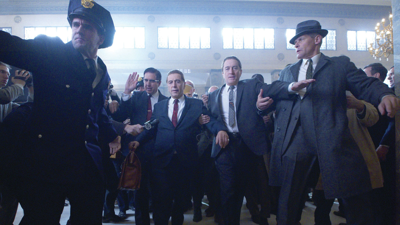
Martin Scorsese’s 209-minute crime epic The Irishman covers the better part of a century in the life of Teamster and mafia hitman Frank Sheeran (Robert De Niro). Adapted by Oscar-winning screenwriter Steve Zaillian from Charles Brandt’s 2004 work of narrative nonfiction I Heard You Paint Houses — which Scorsese uses here as his on-screen title, “painting houses” being a mob-world euphemism for committing murder — The Irishman follows Sheeran’s rise within both the International Brotherhood of Teamsters and the Bufalino Crime Family.
The film’s narrative framework is something like a set of Russian nesting dolls, the largest being Sheeran’s direct-to-camera narration as a wheelchair-bound old-timer in a nursing home in the early Aughts. It’s from that state he tells us of a fateful 1975 road trip with Russell Bufalino (Joe Pesci) and the men’s wives to a family wedding. Outside of those two set pieces, the narrative bounces around from Sheeran’s service in World War II, to his first meeting with Bufalino, to his subsequent relationships with Teamsters President Jimmy Hoffa (played by an increasingly irritated Al Pacino) and Philly mob boss Angelo Bruno (Harvey Keitel), to Sheeran’s twilight years. The Irishman famously makes heavy use of digital de-aging — primarily on Pesci and De Niro — as the narrative jumps back and forth in time. (In short, yes, the technique works here, as its incorporation is light-years more seamless than it was in creating Rogue One’s unblinking Princess Leia or Tron: Legacy’s dead-tongued Clu.)
As we meet various real-life gangland figures, the violent demise each will ultimately face flashes across the screen — this one will be shot three times in the face in 1978, that one will be blown up in his car in 1981. The whole film points toward the emptiness and depravity of violence and crime — the meaninglessness of it all. Sheeran’s daughter Peggy (played by Lucy Gallina in childhood and stoically by Anna Paquin in adulthood) is the conscience of the film, brooding from the sideline as her father chooses darkness. Sheeran goes so far as to crush a shop owner’s fingers right in front of Peggy because the man dared to lay a hand on her. The psychological impact of witnessing that moment hovers over Peggy like a storm cloud for the rest of the film.
You wouldn’t want to call it “fat,” but sure, there are moments in The Irishman that could ostensibly be trimmed to make it a solid 120- or 140-minute movie. We don’t have to see shots of this private plane taking off and landing, or of every single machination taking place throughout the Teamsters’ relationship with the mob. And yeah, just past the two-hour mark, the ongoing game of telephone between Hoffa, Sheeran, Bufalino and Anthony “Fat Tony” Salerno could be more succinct. But why not luxuriate? More so than he did with his crime-world features Mean Streets, Casino and even Goodfellas, Scorsese here shows us in vivid detail the lasting fallout of destruction and violence, and he does so using a murderers’ row of world-class performers. Crime may pay in the short term, but in the end, it leaves even its “winners” with absolutely nothing — just the gaping maw of existential meaninglessness. This is a master craftsman putting a bullet in the head of the genre he perfected. There’s nothing left to say, no territory left to explore.
Much ado has been made over Scorsese’s recent statement and subsequent New York Times editorial about Marvel films not being true cinema — that they’re more akin to theme parks. The resulting backlash and debate over the auteur’s statements have grown wearisome on the corner of the internet that refers to itself as Film Twitter, and frankly it doesn’t really matter. You’re allowed to like both Ant-Man and The Aviator, or Ironman but not Silence, or neither Kundun nor Captain Marvel. The fact of the matter is, Scorsese makes crime films as well as or better than anyone has since the idiom first came to life with movies like Scarface, Little Caesar and The Public Enemy in the early 1930s. With The Irishman, he has brought the gangster film to its logical conclusion. Yeah, it’s long, and bursting with masterfully executed ideas. But it’s no bloated victory lap. It’s bloody Martin Scorsese’s The Irishman! Shut up!



