
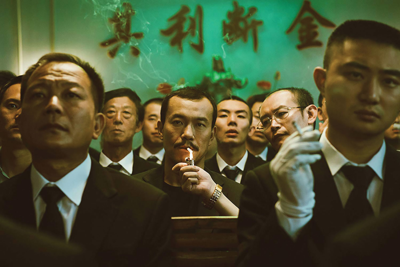


If global politics in the 21st century belongs to China, cinema in the 21st century belongs to Jia Zhangke. For the past 20 years, the Chinese filmmaker has used fiction to document the upheavals of Chinese society. His latest film, Ash Is Purest White, continues that objective.
Jia’s work is predominantly located far from the often-filmed city centers of Beijing and Shanghai, in the rural, hard-scrabble regions of the country where societal transformation is at its most surreal. This is a land where Maseratis drive the same streets as mules, and multimillionaires live alongside coal miners. State-of-the-art buildings tower over the harsh landscape, the skeletal outlines of a planned future.
As China has mutated, so has Jia’s filmmaking. His first films — including 1997’s Xiao Wu and 2000’s Platform — were the very definition of underground, produced without the consent of state censors, screened at international film festivals, and distributed in China on bootleg DVD and video. Now Jia works on a more commercial scale, with something close to state approval — his most recent project was a short film for Apple, and his next feature is a historical epic produced by Hong Kong crime-film auteur Johnnie To.
Though some Western critics seem troubled by the warming up of Jia’s relationship with the Xi Jinping administration, Ash Is Purest White is nevertheless politically concerned. Like Jia’s previous feature, 2015’s Mountains May Depart, Ash has a clear triptych structure. The first act takes place at the turn of a hopeful millenium, the second in 2006, and the last more than a decade later, in 2018. That sweeping period is rendered in the personal rather than the abstract — Ash Is Purest White is more of a performance-driven character study than anything Jia has previously attempted.
The character in question, Zhao Qiao, is played by Zhao Tao, who has played the lead in almost every Jia film since Platform. Qiao and her lover Bin (Liao Fan) belong to the jianghu, a word that once referred to the heroes of Chinese martial-arts legends but now describes members of China’s criminal underworld. On the threshold of a new century, they hope to leave their extralegal origins behind and become legit. Jia signifies the aspirations of an era with an English-language pop song: Village People’s “YMCA.”
As that much-maligned disco outfit instructs, “No man does it all by himself,” and that’s a pretty apt plot summary of Ash Is Purest White. Qiao plays an invaluable part in Bin’s success, but that success makes him a target. When he’s attacked by a mob, Qiao sacrifices herself: To scare off the gang, she flashes Bin’s illegally obtained handgun, the mere possession of which earns her time in prison. When she’s released years later, Bin is nowhere to be found, and she must turn to grifting and schemes to survive. The couple eventually reunite, but the new China has little space left for people like them.
The film’s extended time range requires Zhao to undergo not only subtle physical changes but emotional ones. She’s as believable as a confident career woman as she is as a down-and-out scam artist. Zhao’s performance is built out of fleeting gestures, and she expresses a lifetime of pain with a lightness of touch. Jia is fascinated by gesture, and his camera often lingers on commodities as they change hands: weapons, suitcases of money, boxes of cigars. Every exchange tells a story. Qiao is forced to attach herself to men to survive, but she also takes advantage of their gullibility, lending Ash an unexpected feminist edge.
The film’s almost mythic-sounding English-language title comes from a conversation between Qiao and Bin in which she tells him that the hottest volcano fires produce the whitest ash. That’s a clear metaphor for Qiao, whose quiet power grows with every hardship. But it also says something about China, a country that has been through the fire in the past century and come out even stronger. Jia Zhangke has established himself as the poet laureate of that superheating process, and Ash Is Purest White is another fine verse in his saga.



