
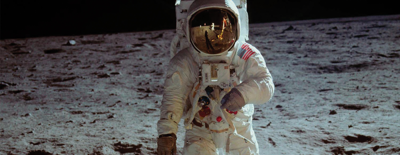


It’s been 50 years since Neil Armstrong and Buzz Aldrin slipped the proverbial surly bonds and got up-close-and-personal with the face of God. The story is well-known — we’ve heard Kennedy’s speech promising to put a man on the moon, we know about how Armstrong flubbed his big line, we’ve tasted the ice cream astronauts eat in space. But it’s an experience most of us will only ever understand in the abstract. The abject silence of space, the sandy particles on the surface of the moon — these are things can only ever be recounted to us. Todd Douglas Miller’s new documentary Apollo 11, which is receiving a weeklong IMAX run at Opry Mills before a nationwide release, gets us one small step closer to really understanding what it feels like to leave the Earth behind.
Like last year’s hit documentary Free Solo, Apollo 11 is a testament to the endurance and abilities of humankind. Unlike the former, it not only pays tribute to the extraordinary accomplishments of individuals, but to a legion of unknown workers less celebrated than the men who actually set foot on the moon. Above all else, Apollo 11 is a tribute to researchers — the researchers who made space exploration possible, but also the researchers who uncovered the unseen 65 mm footage and uncatalogued 11,000 hours of audio recordings from which Apollo 11 is constructed.
That 65 mm footage, which has been carefully digitized and restored, is absolutely pristine and worth the price of IMAX admission — if anything was ever made for the large-size format, it’s the opening sequence of the Apollo 11 launchpad rolling into place atop mammoth tank treads. The newly discovered footage is so crisp and cinematic that moon-landing skeptics will no doubt see it as further evidence of fakery. It’s blockbuster-quality for a real-life story that’s better than any blockbuster.
Beyond visual spectacle, what Apollo 11 captures best is the weight of time felt by all parties involved: the decades of vision and foresight, the years of scientific research and development, the months of training, the days it took to reach the moon, the hours it took to even land on the Sea of Tranquility. There’s also the lesser-known fact that Armstrong, Aldrin and their crewmate Michael Collins had to spend 18 days in isolation after returning to Earth, an experience that seems even more harrowing to me than enduring the endless abyss of outer space. Small steps take seconds, but giant leaps take time. Apollo 11 may run only 93 minutes, but it’s a film 50 years in the making, and the footage it preserves will last lifetimes beyond our own.



Post a comment as anonymous
Report
Watch this discussion.
(0) comments
Welcome to the discussion.
Log In
Welcome to the discussion.
Keep it clean. Please avoid obscene, vulgar, lewd, racist or otherwise abusive language. Comments featuring hate speech or threatening or violent content will not be tolerated.
PLEASE TURN OFF YOUR CAPS LOCK.
Be truthful. Don't knowingly lie or mislead.
Be proactive. Use the “report” link on any comment that violates our comment policy.
Share with us. We'd love to hear your feedback.