

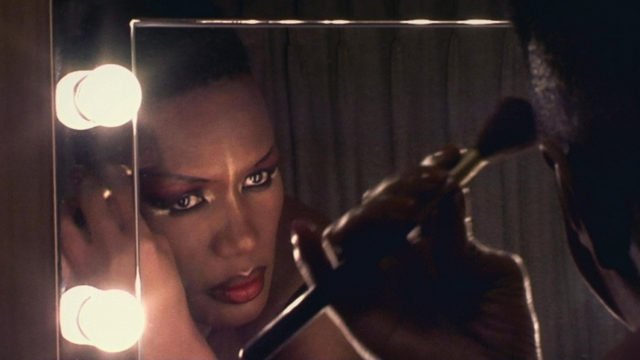
There is nothing conventional about Grace Jones. A film about the iconic artist, singer, writer, actress and model that aimed to follow the template we see for so many lives-made-into-documentaries would be dreadfully boring. Jones won’t fit a Procrustean editor’s standard timeline for struggle, success, downfall and redemption (hopefully before death, though not always) as other famous people vouch for their relevance, in unspoken terror that the favor might not be returned. Grace Jones has been many things during the course of her life, but she has never, ever been boring.
Jones has been an icon for more than 40 years, much of it removed from the traditional mechanism of fame — muse to Issey Miyake and Andy Warhol, LSD buddies with Timothy Leary, disco dominant with Sylvester and Duran Duran. To modern audiences, she seems anomalous; she hasn’t trotted out a flavor-of-the-month single, or grasped at whatever tendril seemed connected to the modern media consumer, or struggled to turn her iconic status into something viral and exploitable. She’s been famous for being herself, but built upon the page, the stage, the screen and even the disco sound system. Sophie Fiennes’ film Bloodlight and Bami follows Jones on a bifurcated path — in part as she travels around the world recording her first full-length in 19 years, 2008’s Hurricane, in part as she reconnects with her family members — and in an epic performance in Dublin, where she performs several of the songs that have become associated with her throughout the years.
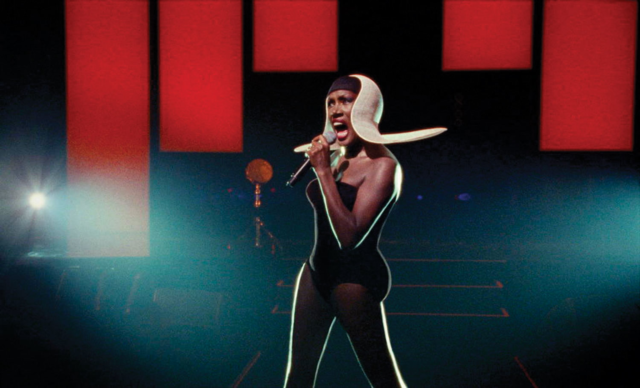
Most of us aren’t used to seeing someone become a grandmother and also party in a Moscow disco, but a lot of that is because we’re not used to seeing Grace Jones. When she partakes in a Champagne breakfast, nude but for a full-length fur coat, we Stan because she is amazing, but we also Stan because she’s doing things her way. She is someone we are all aware of culturally (as Black Panther acknowledged in its first five minutes). She is a black woman who has defined her career every step of the way, and she eschews bullshit in an incredibly refreshing way. Fiennes’ approach to her subject is enthralling. Without talking heads or chyrons or flashback footage, the film puts us on the same footing as Jones, fording the rivers of fame just by living. There’s always a recording session, or a TV appearance, or a concert to perform. It is an immersive and captivating experience, and I never wanted it to end.
The footage from Jones’ return to Jamaica, the island of her birth, is a revelation. We see her work ethic, her process, and how she develops her material, as well as navigating business decisions and deeply personal relationships. Her cellphone back-and-forth with legendary bassist Robbie Shakespeare illustrates the difficulties of dealing with old friends, especially regarding money and time, in a way that registers deeply. And as we spend time with Jones and her family, we see the shadow of Mas P, an abusive step-grandfather whose legacy haunts all the Jones children. While her parents were establishing a ministry in Syracuse, N.Y., Grace and her siblings lived in the house of a reactionary zealot who beat them mercilessly. And in the talk around the table, and with neighbors, and with friends, we see the toll that this has wrought, especially as she relates how seeing her late-’70s and early-’80s performances are rooted in the domineering and tough physicality of Mas P. One need only compare the version of “Warm Leatherette” from Bloodlight and Bami with the version Jones would open her One Man Show with in 1981. The latter is cathartic violence on multiple levels: the J.G. Ballard novel, the cold electronics of The Normal’s original version, Jones’ Brechtian speak-singing, and the mallets she uses to assault an array of cymbals arranged before her. The former is a new take, where Jones carries her own cymbals, making the song’s crashes into a further encapsulation of Ballard’s prose, where the crash becomes a fertile and artistic event.
Jones’ artistic partnerships continue to fascinate. We encounter her former lover and the father of her son Paolo, photographer Jean-Paul Goude, in a photo shoot for the American release of Hurricane, in which they talk of the past and the present in that particular way people who’ve known each other for ages do. Unseen in the film but well-represented are Jones’ costumers, the late Eiko Ishioka and the genius mad hatter Philip Treacy. Ishioka designed all of the outfits and staging for Jones’ Hurricane tour, and Treacy’s hats might as well be up for Best Supporting Oscars, whether it’s the disco-ball bowler that refracts green laser light throughout an entire venue during “Love Is the Drug,” the futuristic nun wimple that dominates much of the key art or the deconstructed xenomorph queen that Jones deploys on French television for “La Vie en Rose.” No one wears clothes like Grace Jones. But if you’ve heard her definitive take on “La Vie en Rose,” all rhythm box and accordion and acoustic guitar, you already know that no one does anything quite like she does.
Bloodlight and Bami is an essential experience for anyone who loves art, or music, or mystery, and though we are graced with a peek behind the curtain, it should come as no surprise that Jones — blood, breath and voice — delights in keeping us guessing.



