
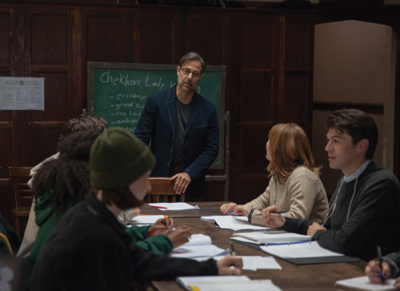


In Richard Levine’s Submission, creative writing professor Ted Swenson (Stanley Tucci) has been at his “short-term gig” for a decade, feebly drafting his second novel, which he hopes will deliver him from obscurity. Euston, the small liberal arts college in quaintest Vermont where Ted teaches, demands little of him. With six students and office hours he barely keeps, Ted oscillates between self-loathing and self-importance. Submission’s sardonic portrayal of liberal arts culture — students who are constantly offended, disengaged professors who barely manage to keep their eyes from rolling out of their heads — is at times funny and apt, and Tucci plays Ted with an air of frail arrogance, the character’s fear of failure pushing ever closer to the surface.
Ted’s life is charmed. But even though he has a doting wife (Kyra Sedgwick), admiring colleagues and plenty of time to write, he is preoccupied with his aging and his relevance, wondering whether, at age 47, his students still find him handsome. He’s ripe for a midlife crisis when student Angela Argo asks him if he’ll read the first pages of her “chapters in search of a novel.” He does, and he’s immediately swept away by the nymphlike freshman. The arc of their relationship is predictable: The affair heats up, Angela gets hurt, and Ted is brought before the firing squad in a sexual harassment suit. Based on Francine Prose’s novel Blue Angel, Submission is the undergrad version of Fatal Attraction, but it lacks the depth and relevance necessary to work for a contemporary audience.
In the film’s first act, Ted attends a party where a fellow faculty member bemoans his students’ naïveté — while studying Edgar Allan Poe, he explains, his class was shocked to learn that a 27-year-old Poe married his 13-year-old cousin. Cue groans from the English faculty. The wry moment turns serious when another professor says he never talks to a female student alone without his office door wide open and a recorder rolling in his drawer “in case things get dicey.” The sole objector is a female professor, portrayed as a prudish killjoy, who says she wants her students to come to her if they’re experiencing harassment. It’s safe spaces run amok at Euston, and Ted can take no more of it. “I have an idea,” he says. “I think that we’ve been giving in without a fight. That we’ve been knuckling under the most neurotic forces of repression and censorship.” He suggests — in a passive-aggressive tone that Tucci completely nails — that they try desensitizing their students by shouting curse words at them, letting loose a stream of profanities that ends in, “Throw in a couple of cunts while you’re at it!” Ted’s status as the department bad boy is cemented.
This all raises a question that’s being asked in liberal arts colleges all around the country: If we insulate our students from psychological stress, will they survive in the real world without us? Ted extends that further: “And if we decide not to insulate them, should we fuck them instead?” It’s a telling moment, and this is where the film peaks. The scene lets us into Ted’s head far more effectively than the stilted voice-over sequences bookending the film. But it’s also a red flag. The so-called “safe-space” debate, once a more abstract exercise, has taken on a new tone at a time when conservative students and professors have invited white supremacist provocateurs like Milo Yiannopoulos and Richard Spencer to speak at their universities. (According to the Anti-Defamation League, white supremacist activity tripled on college campuses in 2017.) The exercise gives Ted a justification for his later actions, but it also nudges the film toward irrelevance.
That’s not the only time Submission feels outmoded. Culturally speaking, the timing couldn’t be worse — the constant stream of outed sexual harassers has left little room for pandering to leering, wanton men, especially in Hollywood. Prose’s novel, published in 2000, may have found a more welcoming audience at the time. But time’s up, and Levine’s script misses the opportunity to get in the ring and wrestle with the messy place occupied by consensual but regrettable sex.
Submission takes the easy way out with no real reckoning. Despite a capable performance from Addison Timlin, Angela is unsubstantial. This isn’t to say that she’s unknowable in the way, for example, Lolita is unknowable as a real person existing outside the mind of Nabokov’s pervy Humbert Humbert. On the contrary, we know Angela too well — she’s the siren-turned-woman-scorned archetype, and the character’s superficiality does disservice not only to Angela, but also Ted. Unlikable protagonists can be great fun if they have a worthy adversary. Without one, Ted is just a pompous shithead who’s as psychologically immature as the undergrads he derides.
There are interesting topics afoot in Submission, to be sure: self-sabotage, ambition, idol worship, and the inanity of academia. The trouble is that in relying on lazy tropes, Levine forgest that he actually has the opportunity to say something.
Email arts@nashvillescene.com
A previous version of this review stated that Francine Prose co-wrote Submission's script with Levine. Levine wrote the screenplay alone. We regret the error.



