


A decade ago, Nashville’s Belcourt Theatre held a film-noir festival featuring many of the pulpy postwar genre’s black-and-white biggies, including The Maltese Falcon, The Big Sleep, Out of the Past and The Killing (the latter introduced by late, great Scene editor Jim Ridley). There were also ’70s-era crime flicks, like The Long Goodbye and The Taking of Pelham One Two Three, which I introduced rather disappointingly — but that’s another story.
But there were two films at the festival I discovered and was floored by — The Big Heat and In a Lonely Place — mainly because they both starred an actress I never heard of and who kept me riveted whenever she was on screen: Gloria Grahame. In both films, Grahame played dames who had morally murky pasts and were hopelessly attracted to volatile men. In Heat, directed by batshit auteur Fritz Lang, she was an abused moll, tired of getting hot coffee in the face from her thug boyfriend (Lee Marvin) and moved by Glenn Ford’s dashing detective to do the right thing for once. But it was In a Lonely Place, which showed at the Belcourt again in December, that made me fall for Grahame in all her sensual sincerity. In the film, directed by her then-husband Nicholas Ray, she played a woman in a doomed romance with Humphrey Bogart’s hotheaded, possibly homicidal screenwriter.
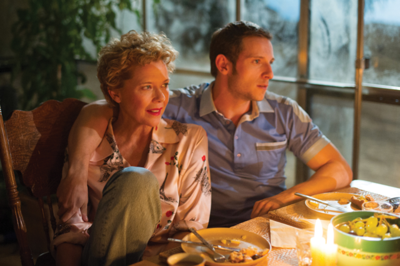
Despite having an impressive filmography (she also appeared in It’s a Wonderful Life and Oklahoma!) and a Best Supporting Actress Oscar under her belt (for her work in the 1952 film The Bad and the Beautiful), Grahame has mostly been forgotten in the film world. Near the end of her life, she was withering away from cancer in Liverpool, Britain. That’s according to her former lover Peter Turner’s 1986 book Film Stars Don’t Die in Liverpool, which has now been adapted into a movie of the same name. Annette Bening stars as Grahame, with Jamie Bell playing the much-younger Turner, who comes to Grahame’s aid when she becomes too sick to do a stage play. Turner takes Grahame to his family home, where his mum (Julie Walters) and the rest of the family look after her.
It’s definitely an interesting story. The book, which clocks in at 158 pages — 170 if you count the new, entirely unnecessary epilogue from Turner tacked on for the book’s re-release — is a quick, easy read. It doesn’t plumb deeply into Grahame’s history, though we do get the general bullet points, like how Ray was her second husband, and his son Anthony was her fourth. (You may have to track down Vincent Curcio’s out-of-print Suicide Blonde: The Life of Gloria Grahame, released three years after Liverpool, for the deep shit.)
The movie streamlines Grahame’s story even more, ditching characters and incidents from the book (that farcical moment when Turner gets an alcoholic vasectomy-clinic nurse to look after Grahame? Gone!), instead taking the form of a blandly orchestrated biopic/romance. While the book mostly presents an account of how Turner and his supportive working-class family took care of the ailing Grahame as if she were a blood relative, the movie mostly centers on the whirlwind May-December love affair between Grahame and Turner — kindred spirits who had too much in common (both actors were, according to the movie, bisexual) to let a little thing like age get in the way of having a good time.
The movie depicts Grahame as more fragile and overdramatic than she is in the book, ready to fly off the handle whenever Turner makes the slightest suggestion that she has, in fact, aged. Director Paul McGuigan and screenwriter Matt Greenhalgh characterize Grahame as someone still clinging to the glamorous glory days of her youth. According to Turner’s book, she just wanted to be taken seriously as a working stage actress, not an over-the-hill movie star still craving the spotlight.
While Bening — this must be her umpteenth time playing a high-strung creative type — and Bell do make a convincing pair of star-crossed lovers, Film Stars Don’t Die in Liverpool is a generic, sentimental attempt to pay tribute to one of the more intriguing femmes fatales to ever grace the silver screen.
An undersung star like Grahame deserves more.
Email arts@nashvillescene.com



Post a comment as anonymous
Report
Watch this discussion.
(0) comments
Welcome to the discussion.
Log In
Welcome to the discussion.
Keep it clean. Please avoid obscene, vulgar, lewd, racist or otherwise abusive language. Comments featuring hate speech or threatening or violent content will not be tolerated.
PLEASE TURN OFF YOUR CAPS LOCK.
Be truthful. Don't knowingly lie or mislead.
Be proactive. Use the “report” link on any comment that violates our comment policy.
Share with us. We'd love to hear your feedback.