



Jefferson Cowie
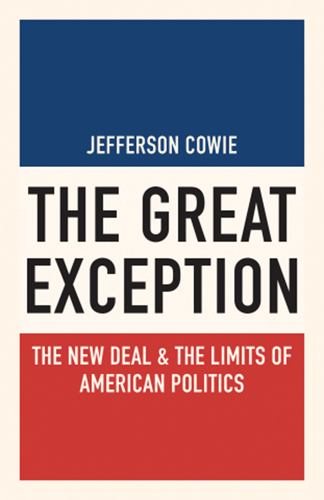
Progressives often look to the New Deal for political inspiration. In The Great Exception, Jefferson Cowie warns readers that doing so might be a mistake.
Cowie, a history professor at Vanderbilt University, is the author of the award-winning books Capitol Moves: RCA’s Seventy-Year Quest for Cheap Labor and Stayin’ Alive: The 1970s and the Last Days of the Working Class. He also writes frequently for popular publications, including Time, Politico, The New Republic and The New York Times. He answered questions via email.
You classify the era of the New Deal and its aftermath as “the great exception” in American political history. What do you mean?
People from many political traditions look at the era after World War II as a sort of “Golden Age” for the United States. And it is not just mythology. So my question is: How do we account for an era when wages went up, education was attainable, politics was stable, hard work paid off, and inequality — unlike before or after — was not the defining aspect of American economic and political life?
An axiom of political science says that more homogenous societies tend to breed a more social democratic politics, and in the postwar era the United States had a forced sense of homogeneity that it did not have before or since. I argue that a set of divisive issues, which defined much of American political life, were mitigated in the ’30s and beyond. Immigration, for instance, was greatly transformed by the closures of the racialized Johnson-Reed Act of 1924, and then opened back up in 1965. That period arcs across the postwar era, creating greater political homogeneity than in previous decades.

How have historians and political thinkers interpreted the New Deal in the past? How does your book contribute to this larger conversation?
Liberal scholars tend to see it as the long-term triumph of the reform impulse in American history, a near-permanent transformation in American politics. Conservatives tend to see a period in which state intervention bungled the economic crash, making the economy worse. Scholars of the New Left generation see it as propping up capitalism in a conservative way — less a transformation than an emergency patch job.
Unlike the Right and the New Left, I admire the accomplishments of the New Deal. But unlike the old liberal interpreters, I see it as a very unstable experiment, one that was sustained for a few decades but then reverted to what many call a “New Gilded Age,” a reversion to the Robber Barons of the late-19th century.
You argue that the New Deal failed to transform American politics, but also that it laid “the foundation for the greatest age of equality since the onset of the industrial revolution.” What explains this seeming paradox?
The book requires keeping two seemingly contradictory ideas in mind at the same time. First, the New Deal alliances were powerful and transformed American politics. Second, they were marbled with the past in such a way that proved unstable. One historian called the labor movement that emerged from this period a “fragile juggernaut.” I think that captures the whole thing perfectly. The seeds of its own destruction were there from the start.
For instance, most of the New Deal policies excluded occupations typically filled by African-Americans, as a way to win the political support of the “Solid South.” When the Democrats backed a civil rights plank after the war, then the Civil Rights Act of 1964 and the Voting Rights Act of 1965, things began to fall apart. The South bolted from the Democrats, and the North found itself embroiled in complex racial politics that undid the New Deal coalition.
Franklin Roosevelt celebrated “the forgotten man” at the dawn of the New Deal, but so did Richard Nixon in 1968, as conservatives inaugurated a new political era. Based on your book’s lessons, what paths can progressives follow to create a more just society?
Some people want to return to the class politics of the New Deal era as a means to redistribute wealth, but they often overlook how exclusively white and male that period was. Others look to the politics of race, gender and sexuality, which is obviously extremely important, but they don’t have good mechanisms for redistributing wealth or building the foundation for coalitions.
So, what’s the answer? Obviously we need a politics of both recognition and redistribution.
The title of your upcoming lecture at the University of Memphis is The Dark Note of American Freedom. What is your new project, and in what ways did it grow out of The Great Exception?
I’ve been fascinated with American ideas of “freedom” for a long time. But for this new book project, I am going deep into the primordial nature of American freedom in ways that I think the great Edmund S. Morgan first did (not to flatter myself!). We often do not examine what I call the “dark note” of freedom: the freedom to do what one wants to and with others. Often it has been the federal government that comes in and lays restriction on that, which has helped to make anti-statism a core expression of freedom and an important strain in American politics.
To read an uncut version of this interview — and more local book coverage — please visit Chapter16.org, an online publication of Humanities Tennessee.
Email arts@nashvillescene.com



