
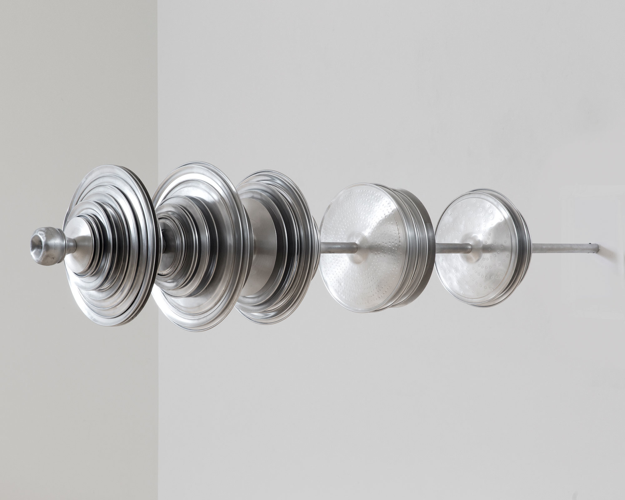


“Aviarium (Dicksissel),” Terry Adkins
The scientific specialization of the 20th century brought the West from the Industrial Revolution to the dawn of the digital age. In turn, the values of science informed everyday people’s experiences of their daily lives, from the repetitive tasks of assembly-line workers to the neatly corralled duties of cubicle-bound professionals. Even 20th-century artists tended to favor specific disciplines: Painters painted, sculptors sculpted, dancers danced.
But in the 21st century, we’ve seen the boundaries between fine art, popular art, design and craft become increasingly blurred. Contemporary creative practices are now multifarious operations that reflect the increasingly big-picture, holistic approaches that are remaking industries and bureaucracies seeking stability and sustainability over the long term.
Terry Adkins: Our Sons and Daughters Ever on the Altar, an exhibition currently on view at both the Frist Art Museum and Fisk University, is one part multimedia visual art display, one part musicological investigation. Its sculptures, prints, photographs, paintings and videos offer overlapping histories of black American music and black American lives. But the show — which includes work from the latter half of Adkins’ nearly-40-year career — is most noteworthy for its timely multidisciplinary aesthetics, which offer a strikingly contemporary perspective on lesser-known aspects of black art and music.

"Buffet Flat," from 'Belted Bronze,' Terry Adkins
The Frist’s contribution to the show occupies the three separate spaces that make up the Gordon Contemporary Artists Project Gallery. Adkins was a saxophone player and a guitarist who played in Fisk’s jazz orchestra and spun records on the school’s WFSK Jazzy 88 radio station. Three collections of sculptures, videos, drawings and textiles form a trio of what Adkins called “recitals” — substantial installations that attempt to blend music and art in an effort to make physical works more transcendent, and to make music more tangible and concrete.
Adkins’ best music-art hybrids are sculptural objects created from pieces of musical instruments. The Frist show opens with a quartet of “Aviariums From Ornithology’’ — four horizontal sculptures made of concentric successions of drum cymbals and trumpet mutes arranged along aluminum rods. The repetitive circular shapes evoke sound waves, and the “Aviariums” are a great example of Adkins’ penchant for combining familiar materials into unique new forms.
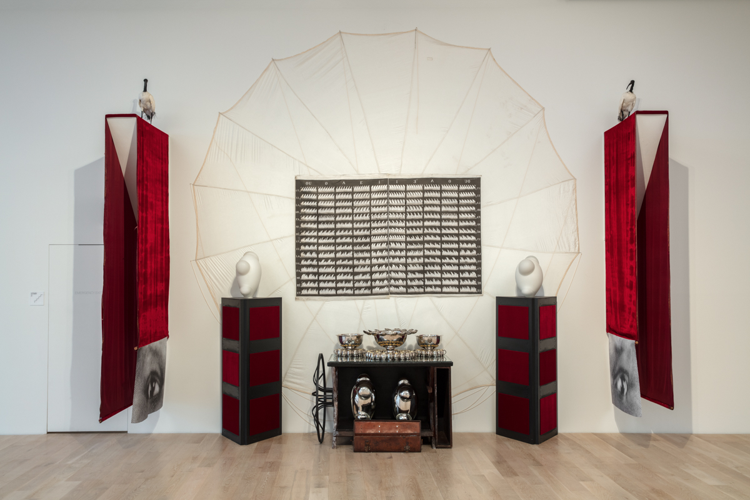
The Frist installations also include multimedia salutes to Adkins’ musical heroes: “Principalities” uses video, audio and even an actual parachute to contrast Jimi Hendrix’s anti-war flower-child image with his earlier, lesser-known stint as a paratrooper in the Army’s 101st Airborne. “Belted Bronze” offers large sculptures, drawings and video to celebrate Chattanooga-born blues singing legend Bessie Smith. My favorite work in this “recital” is “Columbia,” a large wood disc hanging on the back wall of the gallery. Adkins covered the disc in one coat of shiny black enamel paint for each of Smith’s platinum records. It’s simple, and it’s stunning.
Our Sons and Daughters Ever on the Altar is thoroughly preoccupied with music, but it’s also deeply inspired by Fisk’s Alfred Stieglitz Collection, as well as Adkins’ lifelong connection to the school. Fisk is part of Adkins’ family tradition: His father was a Fisk graduate, and his uncle was a former university president. When Adkins was just a fifth-grader, his artistic consciousness sparked to life during a visit to Fisk’s Carl Van Vechten Gallery, where the artist was knocked out by Georgia O’Keeffe’s iconic New York cityscape, “Radiator Building.” Adkins returned to the North Nashville campus as a newly enrolled college freshman in 1971, where he was mentored by Harlem Renaissance pioneer Aaron Douglas, artist-historian David Driskell, printmaker Stephanie Pogue, sculptor Martin Puryear and painter William T. Williams. Adkins stressed the importance of the university and his mentors throughout his career, and it’s fitting that this homecoming exhibition is split between Nashville’s premiere visual arts venue — the Frist Art Museum — and the site of Adkins’ creative awakening at Fisk.
The Frist component offers installations of large sculptures, series and constructions, but Fisk’s portion of the exhibition is mostly a 2D affair. The sizes of available gallery spaces necessitated this split between larger and smaller works, but the distinctions between the halves that make this whole exhibition are among the great successes of its arrangement. The Frist displays are large, looming, ponderous and meditative. But the Fisk presentation excites with variety — bursts of color, swatches of texture and deep history lessons. Continuing with musical analogies, the Frist installations are operatic — elaborate and grandiose. The Fisk display is a rocking jukebox loaded with shiny black portraits of people, places and periods at 45 RPM.
One highlight of the Fisk show is “Trope Heroic” — a gorgeous wall sculpture that at first glance looks like a set of giant brass minotaur horns, but is actually an assemblage of two tubas. Adkins’ early champions noted that his work seemed simultaneously ancient as well as ahead of its time, and the myth and mirth offered by this work puts those captivating contradictions front and center.
Other music-centric highlights here include a duet of gorgeous prints made from metal music-box discs, but the Fisk portion of the show also shouts out black contributions to art and literature. Some of the most stunning works in this two-part exhibition are included in Adkins’ “Progressive Nature Studies” — a portfolio display that re-creates George Washington Carver’s experiments with natural pigments, and celebrates Carver’s lesser-known contributions to the development of abstract painting. “The Philadelphia Negro Reconsidered” is inspired by the color-coded maps W.E.B. Du Bois created for a 1899 demographic study of black life in Philadelphia’s original South Ward. Of course, Du Bois is best known as the author of The Souls of Black Folk, and Fisk curator Jamaal Sheats includes the book’s original printing plates alongside Adkins’ “Darkwater Record” — an installation made from a stack of cassette decks set to play readings of Du Bois’ 1960 speech “Socialism and the American Negro,” but with the volume turned completely off. The bouncing meter needles transform the audio into a purely visual display, and the stack of tape recorders is topped by a bust of Chairman Mao Zedong.
In 2014, Adkins unexpectedly died of a heart attack at age 60, and his abbreviated life seems particularly stunted given the fact that Adkins’ art is so perfectly suited for today’s contemporary art conversation. It is yearning for history and authenticity even as it attempts to reflect the multifaceted viewpoints of the post-postmodern age. Adkins’ New York Times obituary described him as a “composer of art, sculptor of music.” Adkins was also an artist born for this new century, with a vision that put him ahead of his time — and the courage to never forget his past.



