
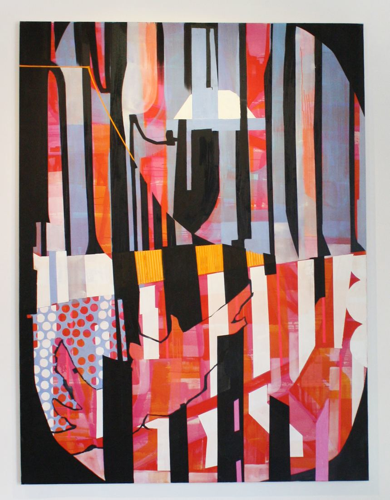
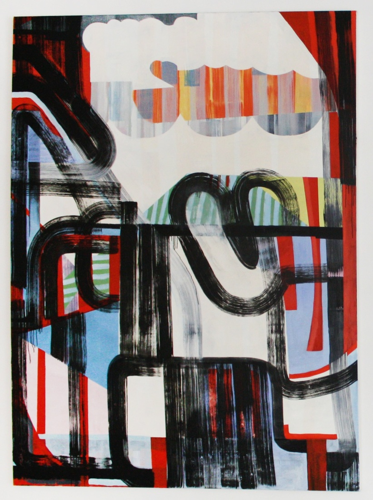
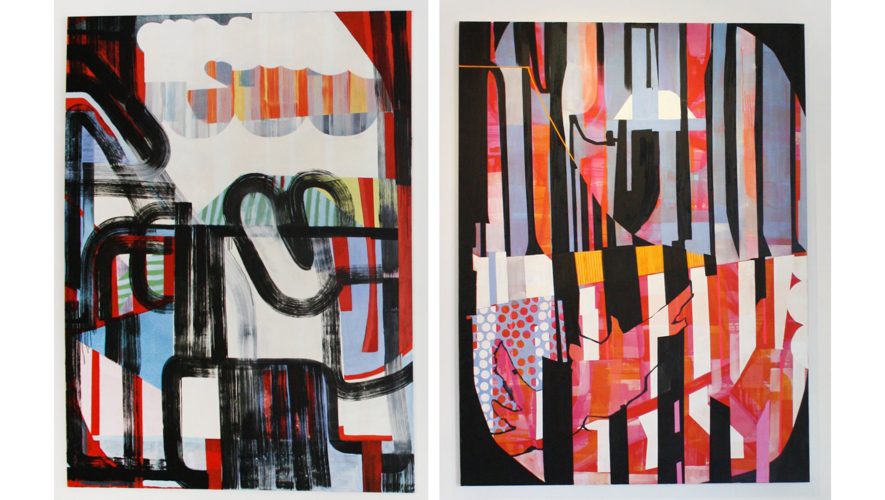

"Footnotes" and "Heaven," Jodi Hays
In anticipation of Jodi Hays’ latest show at The Red Arrow Gallery, titled simply Tend, several Nashville media outlets described the artist as a staple of the local art community. It’s not the worst thing to call someone, a staple — it implies reliability, and indeed Hays’ work is reliably captivating. But her work is also continually evolving, and the conversation surrounding it seems inexhaustible and always worthy of entering into.
Of course, “staple” may also suggest some kind of core nutrient, as in the staple foods of a diet. Or it could be a reference to office supplies — to the act of holding many parts together.
It can be easy to go too far with wordplay, but half the fun of Hays’ abstract works is in their titles, so picking apart a word’s meaning isn’t far off the mark here. Take the title of the exhibition itself — to tend is to care for or to cultivate; to behave in a particular way. “I tend to have trouble figuring out what abstract art is about,” for example. And just as the best way to understand words is by grasping their context within a language’s history, understanding the painter’s mark within the history of mark-making only gives greater power to the mark.
Tend is a selection of large-scale paintings — some larger than we’ve seen from Hays before — balanced with a number of smaller works. The size of two of her largest paintings is a big deal, and it feels impossible to talk about Tend without addressing them immediately. They’re massive, like a god’s lungs, and they confidently occupy the gallery’s tallest wall. One is titled “Heaven,” and it’s a direct descendent of Hays’ previous show, the more representational God Sees Through Houses, in particular the prismatic lens or windows of that show. If anything, this is our staple: The varied stripes that make up Hays’ painterly grids are her most important iconography, like the angles of a house, the walls that hem us in, the home we keep, the blinds that obscure windows.
But if “Heaven” places us within the context of Hays’ own history of work, its sister, “Footnotes,” places us within the context of an entire history of Abstract Expressionism. It’s a monumental dance of gesture, a wide sweep of the arm, an acrobatic, brazen movement. We see Hays’ prismatic stripes floating in a cloud, and in one of the show’s boldest shapes, a black swoop of paint forms a “U,” or a bubbly heart at the painting’s center. The title seems glaringly obvious: Of course it’s about women Abstract Expressionists who were so often relegated to the footnotes of history and popular memory.
Jackson Pollock and Mark Rothko — the cover boys of Abstract Expressionism — were given practically free rein to define mark-making and the use of abstraction to uncover emotional states. Women were working within this sphere — Helen Frankenthaler, most famously — but to this day, it’s the boys who tend to get all the attention. So how do you feminize the mark? Within Tend, the key could be in showing the parts, the labor, the pieces of the composite whole. Interspersed between the larger paintings are several suites of smaller paintings, which in their smallness seem to suggest they belong to a much larger story — and while they know what that larger context is, we can only imagine.
Hays’ grid softens even more with the fabric elements that compose several of her artworks. In these pieces, fabric wraps around the edge of the canvas, which Hays’ paint does not. Fabric as a historically feminine material is, once again, a tradition that Hays plays into. It’s rather impossible to avoid nostalgia when using materials that are found, like worn pajamas or patchwork quilts. Within the context of Hays’ own history, she is calling upon a small-town tradition of reusing and thrifting — in one of the works, fabric from Hays’ grandmother’s curtains peeks through. The seam of literal sewn edges is mirrored in nearby strokes of paint, emboldening the more organic shapes and calling to mind the vision of a woman poring over her craft. Several of the pieces’ names invoke this tradition as well, such as that of one of the most visually dynamic works, “Hem.” Its title suggests both an edge of clothing as well as restrictions, rules, the scaffolding that Hays plays within.
Rounded edges appear again and again in Tend, and they create an organic repetition, like natural bodies arranged in a garden. A curved stroke of paint blurs the hard edges of the canvas itself. Within the context of hard-and-fast rules, Tend is soft, supple and movement-filled — a rigid corner can become like a breast or like a flap of soft, curling fabric.
Within a painting tradition in which the rules have already been written, Hays continues to make the feminine presence elemental — a staple. She gives the feminine a necessary place at a much larger table.



Post a comment as anonymous
Report
Watch this discussion.
(0) comments
Welcome to the discussion.
Log In
Welcome to the discussion.
Keep it clean. Please avoid obscene, vulgar, lewd, racist or otherwise abusive language. Comments featuring hate speech or threatening or violent content will not be tolerated.
PLEASE TURN OFF YOUR CAPS LOCK.
Be truthful. Don't knowingly lie or mislead.
Be proactive. Use the “report” link on any comment that violates our comment policy.
Share with us. We'd love to hear your feedback.