
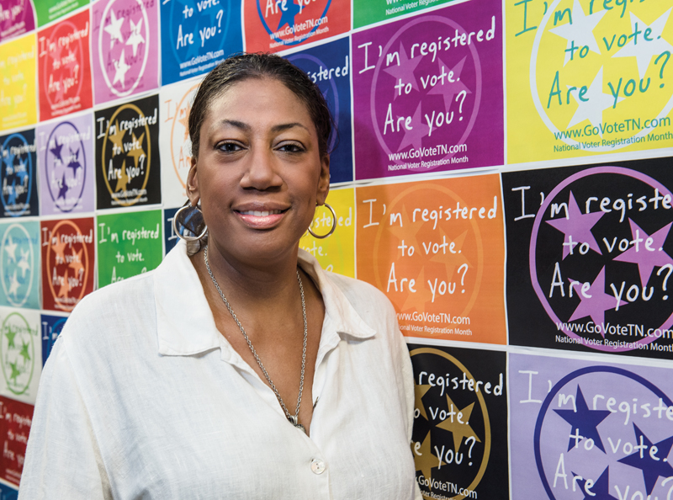

Joan Nixon has spent more than half her life working for the Davidson County Election Commission. Starting her 30-year career at the commission as a temporary employee during a summer away from school at Austin Peay State University, Nixon worked her way up to deputy elections administrator. She seems at ease talking about what the commission faces in 2016 — crossing her arms over her white linen shirt as she ticks off the long list of elections the DCEC will put on this year.
The commission has already charged through the primary for this year's presidential election. In June, it'll conduct a city election in Oak Hill. The team itself is made up of fewer than 30 people, and they — along with more than 1,600 poll workers — will also orchestrate elections in August for five Metro Nashville Board of Education districts, the state and congressional primaries, and a special Metro Council election for District 1. This will all, of course, culminate in the state and presidential general elections in November.
With a whirlwind year of elections coming, the Davidson County Election Commission announced March 21 it would tap Nixon, 50, as interim administrator while searching to replace Kent Wall, who retired March 31 after just three years as administrator. Wall left amid allegations he misused funds.
It won't be Nixon's first go-around as interim: She served the same role in 2013, when a critical review from the state's coordinator of elections led then-administrator Albert Tieche to resign. Nixon unsuccessfully threw her name in the ring for the position, but this time she won't add her name to the list of nearly 180 people vying for the position of Music City's election administrator. The high turnover in leadership has put the office under a magnifying glass, and Nixon says staying put increases the stability of the commission.
"We have a wealth of knowledge in this office," Nixon says. "But I just think this is where I need to be — as the deputy."
On the first day in her second stint as interim, the Scene asked Nixon, who manages to seem both youthful and sage, about her experience with the commission and what she expects from the next administrator.
Thirty years is a long time at any organization, but especially one like the election commission. Tell me a little bit about when you first started. My first job was to register people to vote. It just morphed into what it is now. But I did eventually finish my degree at Belmont, and in fact, I'm going to start a master's program at Trevecca in a few weeks. I've seen a lot of changes in state laws. When I teach my officers' classes, I go back to the '80s and explain the way things were then versus now.
So what's changed? Before, when we talk about purging voters, we had to actually list their names in the newspaper years ago, back in the '80s. Before early voting, we had to publish who voted during absentee by personal appearance in the paper. ... We didn't have provisional voting. Those types of things have made elections different and a little more stressful as far as making sure things run properly.
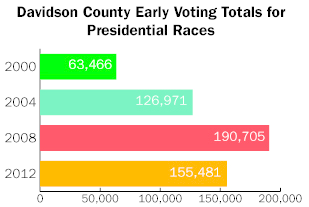
In your career, I'm sure you've had the opportunity to watch the rise and fall of voter registration in various elections. We measure it. Our premier election was the November 2008 election. The reason being is that we had over 190,000 vote early. And that's kind of been our model election year. With this type of election season, it could surpass that very easily. It has the potential to do that. That's exciting. We're pushing for and would like to break that record. ... It would be lovely for [early voting] to hit 200,000. It makes a voter's time much less stressful; you don't have to worry about going and waiting in line. And it makes our day less stressful. In fact, November of '08, the phones hardly rang. We almost thought they weren't working.
Day by day, what does the job of an administrator of elections look like? That looks like making sure, for instance, that this election, we're trying to put to bed to certify the [March primary] election — we have 45 days to get all of that paperwork in. We're in the process of putting on an election in the city of Oak Hill. That's in June, so we're preparing for that. Along with preparing for June, we're also preparing for the August election. We have a qualifying deadline [for candidates] coming up on April 7. That's for the August primary election. The AOE [administrator of elections] is making sure that petitions are being checked, that any email or communication from the state's election coordinator is getting dispersed and disseminated. Really just making sure we keep everything in line.
Aside from that, from elections in the county, we have a budget to prepare. We have to prepare for our budget hearing. We had our budget hearing with the mayor last week, and now I will be assisting the commissioners with any needs or questions about the budget. I actually had to go through this in '13 when I was made the interim. At that time, I had been made interim and then a week later had to go to our budget hearing before the council. So it was a lot of things thrown at me at one time.
In comparison with last year's budget, what's different this year? It's pretty much the same — status quo, aside from budgeting for more early voting locations for the November election. We're looking at 13 [polling locations], which was what we had in the 2008 election.
And of course you're trying to do all this right now while looking for the full-time administrator. It's like a vegetable soup. We're trying to do all these things at once, but it's going to come out as a good product in the end.
Is there a reason why you didn't apply this time around? I just feel my strength right now is to be that support for the AOE. Kent and I worked very well together. He had the business-management side of office. And I had that election knowledge that I was able to give to him, and just vice versa. I felt that that was my place. I've gotten phone calls, and staff have asked, "Do you think you're going to apply for it?" I've just said, "No. I think I'm best suited where I am as the deputy AOE." I'll do whatever the commission wants me to do as the interim. It is kind of a good thing for them, because they're still comfortable and less stressing about who's going to take care of the office. I've had my hand and helped at every job in the office — that knowledge and that historical staying power helps.
What challenges does the new administrator face coming in? What's the toughest part of this job? I think anyone who comes into this job, you have to understand that it's government. You have to want to understand the levels of government, and how important the relationships that we have with other agencies are. It's not just this office that puts on the election. We have help from the Davidson County Sheriff's Office, Metro IT, General Services, and the Office of Emergency Management. And we're all working together, so building those relationships with Metro government agencies is important. We have to have them. Building those relationships is important — also with the Metro Council, with elected officials, with voters, with staff. That new AOE is going to have to take that on. That's going to be one of those tough things because I'm sure [the community] sees the turnover in this office, and people are going to want to know how this person ticks. They also can't be above doing any job in this office.
I know that in this office you must get a deep look at Tennessee and Nashville politics. What's it been like to watch things progress? One thing that has persisted is that I wish people would work harder to educate themselves about voting — when it comes to processes and ballot, to what a primary is. I think it's really important, sometimes more important than the candidates on the ballot, but to educate yourself on the things you need to actually vote. As far as voter registration, our area has grown so much, and we have a lot of voters who are new to the state and come from a state that had same-day voter registration. We're going to really push that in Tennessee there is a 30-day cutoff, 30 days before an election. So for the August election it's July 5, and for November, the cutoff is Oct. 11.
Davidson County residents can register to vote in person at 1417 Murfreesboro Pike, or by mailing a voter registration application to Davidson County Election Commission, P.O. Box 650, Nashville, TN 37202. Application forms can be found at nashville.gov/ Election-Commission or at any Nashville post office, public library, county clerk, register of deeds, information desk at the county courthouse, the department of safety, the state or Metro health departments, the Department of Veterans' Affairs, and local branches of the U.S. Armed Forces.



