


Nashville doesn't do this very often.
In 1966, Tom Shriver — who had previously served one term in each chamber of the state legislature and worked as a prosecutor in the U.S. Attorney's office — was elected as Davidson County's district attorney. He held the job for two decades, before leaving in 1987 to take a judgeship. It was then that Torry Johnson, who had worked under Shriver before going into private practice, was appointed by then-Gov. Ned McWherter to take the post. Johnson would go on to be re-elected to three eight-year terms, before making the surprise announcement in January that he would leave the office when his term ends this fall.
It has been nearly half a century since Nashvillians had to choose someone new as the city's top prosecutor. So it was no surprise that Johnson's announcement made some waves in Metro political circles, and that several people want the job. (For his part, Johnson may have his eyes on another gig. He considered a run for mayor in 2007, and will be decidedly freed up should he want to run in 2015. Speculation abounds, but Johnson has been noncommittal.)
The election comes at an interesting point in the city's timeline of law and order. In January, Nashville police announced that the 2013 murder rate was the lowest in the 50-year history of metropolitan government. In many ways, the city appears to be safer than it has ever been.
But cracks have appeared in that veneer. Chief among them is the city's handling of domestic violence, an issue blown wide open by The Tennessean's recent and ongoing coverage of a 185-page report — which Metro kept private — that revealed troubling details of the city's shortcomings when it comes to domestic violence. These include victims waiting hours for police, and what victims describe as a less-than-sympathetic attitude from the DA's office on down.
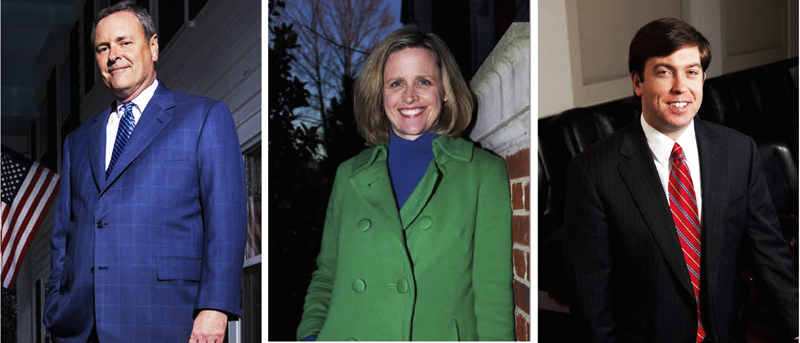
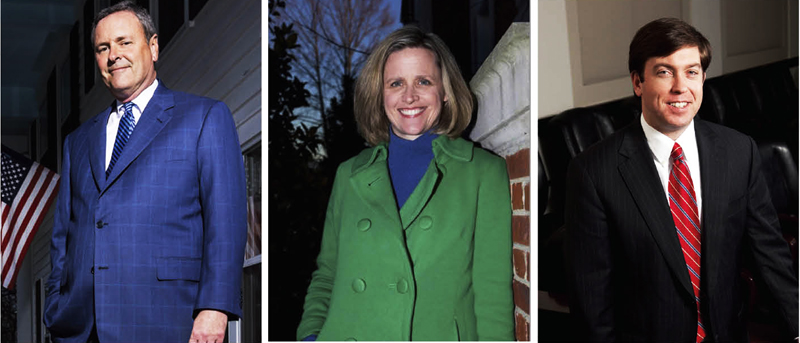
The passing of the qualifying deadline last week confirmed that the DA's race will be a Democratic affair. Three candidates are now making the sprint to the May 6 primary that will effectively serve as the general election.
Upon announcing his departure, Johnson endorsed Rob McGuire, an assistant DA in his office for 13 years, as his replacement. Apparently following that cue, a long list of political figures, including Metro and state level elected officials, immediately lined up behind his campaign.
Glenn Funk, who worked for three years as a prosecutor in the DA's office in the late '80s before spending the next 25 years in private practice as a criminal defense attorney, entered the fray soon thereafter. To jump-start his effort, after securing $120,000 from supporters, he wrote himself a $100,000 check.
In just under the wire was Diane Lance, also a former assistant DA for five years in the '90s. She has spent the past five years as a special assistant to Mayor Karl Dean and was a lead architect of the Domestic Violence Safety and Accountability Assessment, which produced the aforementioned 185-page report (as well as a shorter document that was released to the public).
Given the significant political and philosophical overlap amongst candidates, primaries can be less about ideas and more about the potential to execute. Put another way: Since candidates will agree in many cases how the job should be handled, the question instead becomes, who's most likely to get it done?
To the extent that question relies on past experience, the candidates offer backgrounds as varied as one is likely to find in such a race.
McGuire, whose younger brother is Metro Councilman Sean McGuire, joined the DA's office straight out of Vanderbilt University Law School. He has been a prosecutor there ever since. His caseload has largely consisted of violent felonies and murder cases, and he frames himself as the candidate who combines the best parts of the experience brought by the other two. He also has a running start.
"I'm the only person in this race who's actually advocated for a victim in the last 15 years," McGuire says. "What we do is prosecute cases. Neither of my opponents have done that in the last 15 years."
Funk has indeed been on the other side of the courtroom for a quarter of a century, playing defense. (It's the more profitable side, which McGuire is sure to note when asked about Funk's six-figure self-investment.) But he adds that "being a district attorney was still the best job that I ever had" and recalls something Shriver told him on his first day in the DA's office in 1986.
"I asked him, 'What's the most important thing about being a district attorney?' " Funk says. "He said to me, 'Glenn, the most important thing about being a district attorney is to be able to tell the difference between a bad person and a good kid in trouble.' "
More than two decades as a defense attorney has taught him how to make that distinction, he says, and that will help him as DA by giving him insight into how the defense will approach a case.
After five years as an ADA in Johnson's office, where her work was largely focused on crimes against children — and during which she also experienced the judicial system as an assault victim herself — Lance spent 10 years running a small real estate investment business out of her home before joining the mayor's office. She says she's engaged issues at the core of the DA's mission from all sides.
"I have the broadest base experience," she says. "My whole career has been about violent crime, and I've come at that issue as a social worker, when I worked in the nonprofit community, first with gang-entrenched youth and then managing a homeless and battered women shelter. I've come at it as an attorney, getting my roots in the DA's office, in the domestic violence division, the child sex and physical abuse division, as well as just general sessions."
The candidates will inevitably have to sell their pasts as a reason to trust them with the future. But beyond that, they advance some ideas too.
Despite Johnson's endorsement, McGuire says his is not a campaign for the status quo. While he cites his experience under Johnson as a strength, he says there are some things he would do differently, areas where he would bring more emphasis.
Take driver's licenses, for instance. McGuire says the DA's office could be a part of addressing the fact that "the criminal justice system falls disproportionately on the poor." Under state law, individuals who fail to pay their tickets or court costs lose their license to drive. Faced with the dilemma of driving without a license or missing the work that could help them get out of the hole, many choose the former — and end up facing more charges and costs for driving without a license.
McGuire says he'd like to go out into the community and find cases where officials can declare people indigent, waive as many of their costs as they can, and help them get their licenses back.
"They're not dangerous drivers," he says. "They're just poor people. My vision for that would be: We have to hold them accountable for breaking the law, but let's try to solve it so that they don't have to break the law."
Funk says one of his strengths is that over 25 years as a defense attorney, he's represented people from all over the county. The problem, he says, is that the DA's office does not reflect the community it's supposed to represent. Out of 60 assistant DA's, only two are African-American. It's an issue he says he addressed in a recent visit to Tennessee State University.
"One of the things that I talked to the folks at TSU about is potentially having some of their undergraduate criminal justice majors come over and intern in the office," he says. "If that could lead to more people from TSU, more minorities, going to law school ... then more of the folks in law school [could become] part of the pool that I can recruit from. I really want that office to look like Nashville."
Lance has a lot to say about cooperation between various parts of the system. When a possible fix comes up in one area, she says, officials should consider whether it makes sense to apply it systemwide. One such change, she says, is an update to the docketing schedule that could get the wheels of the system turning more quickly. It's an idea she says came out of the domestic violence report, which found that it can take 49 days for an offender to move from initial arrest to first court appearance.
Early voting in the primary begins on April 16, less than two months away. The candidates all acknowledge it's a sprint, not a marathon. But the last two guys in the office held the job for more than 20 years each. For whoever wins, Election Day is when the marathon begins.
Email editor@nashvillescene.com.



Post a comment as anonymous
Report
Watch this discussion.
(0) comments
Welcome to the discussion.
Log In
Welcome to the discussion.
Keep it clean. Please avoid obscene, vulgar, lewd, racist or otherwise abusive language. Comments featuring hate speech or threatening or violent content will not be tolerated.
PLEASE TURN OFF YOUR CAPS LOCK.
Be truthful. Don't knowingly lie or mislead.
Be proactive. Use the “report” link on any comment that violates our comment policy.
Share with us. We'd love to hear your feedback.