
Andy Holt is a proud farmer, the kind who decorates his legislative desk with pink plastic pigs and lets loose a lusty "Soooeeee!" during roll call.
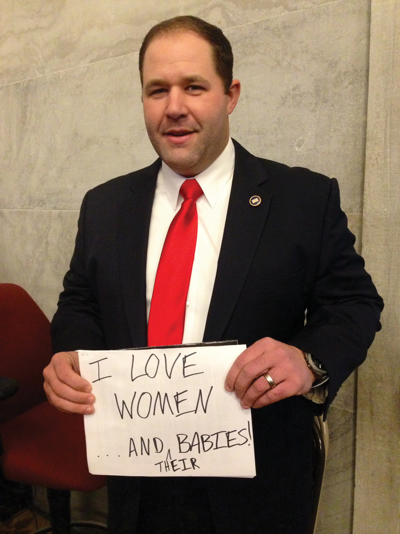
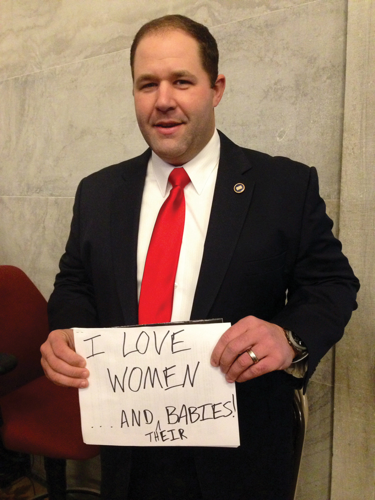
Government is too big for his tastes. Regulations are often too burdensome, and the federal government largely ought to leave Tennessee the heck alone, he contends. He gravitates toward the controversial, like convincing the legislature last year to pass a resolution urging Fox News host Sean Hannity to move to Tennessee. And last month, when throngs of women chanted in the Capitol hallways over women's reproductive rights, the adamant anti-abortion Republican scribbled and carried around a sign that read, "I love women ... and their babies."
The 33-year-old representative has always worn his hog-farmer's independent nature on his sleeve. But for the past five years, the small-government conservative has run his West Tennessee farming operation afoul of state and federal law, dragging his feet in responding to state officials and never scoring a new permit to cover his 1,400-acre hog farm.
Holt, vice chair of the House Agriculture Committee, argues that's all in the past. As of the end of 2014 he's no longer a pig farmer, he says, in part because of the stringent regulations.
But various state departments and federal agencies aren't ready to let bygones be bygones. The Environmental Protection Agency accuses him of dodging questions about whether he pumped waste from his overfilled lagoons into a tributary that leads into the Mississippi River. And the Tennessee Department of Environment and Conservation all but says it's about to drop the hammer on him for five years of skirting the law.
"We're not letting this one slide under the doormat. We've been working on this," says Kelly Brockman, director of communications for TDEC. Even so, Brockman would neither confirm nor deny an active investigation into Holt.
"When we have an active potential enforcement matter, we cannot talk about where we are in the process," she says. Neither would the EPA, whose spokesman Jason McDonald tells the Scene, "It's an open case. It's ongoing, so we cannot comment."
But a week ago TDEC filed a chronology of permit problems for Holt's farm, A&E Livestock. That would seem to signal a case building against the Dresden Republican, who according to state officials constantly ignored deadlines until after information was past due and repeatedly gave the state less than it asked for to obtain a permit.
The report comes on the heels of a WTVF-Channel 5 news story contending that TDEC is going easy on Holt because of his political position. Holt last had a proper permit in 2009, but to date he has faced no consequences. Indeed, in an email cited by WTVF reporter Ben Hall, an unidentified state inspector wrote that after he noted "serious violations" on Holt's farm in 2011 — among them improperly disposed hog carcasses and hog waste pumped into a nearby creek — he was "discouraged by upper management" from pursuing further action.
State officials deny that they've let Holt off the hook or that the administration dissuaded further action. Instead, they contend, they've been focused more on compliance than punishment.
Suspicions that state administrators play politics with inspections are nothing new. The Associated Press reported that long before Fred Thompson was an actor, senator or presidential candidate, a state inspector accused him of using his ties to then-Gov. Lamar Alexander to get the inspector reassigned in 1980. The reason, he claimed? The bothersome inspector had repeatedly lodged environmental violations against the coal company Thompson was representing. Both Thompson and Alexander denied any meddling.
But Holt has been more a thorn in the current administration's side than a friend to reward. Since Holt took office in 2011, he's pitched two of the three bills vetoed by Gov. Bill Haslam. Haslam, who took office at the same time, says he would "never, ever" leave agencies with the message that enforcement should be discouraged for certain people.
"I'll let TDEC do the follow-through on that, but I think the important thing from my end is to make certain that nobody is ever communicating that message that different people get treated differently," the governor tells reporters.
Holt's permit expired in 2009, as did permits for other farmers with a high volume of large animals. But according to state records, by then he had already missed three years of submitting annual analysis of manure nutrients tied to the last permit. Since that time, Holt has applied for the new permit at least twice but never with everything the department needed, says Britton Dotson, a technical fellow for the Division of Water Resources.
"When the old permit expired, the new permit came into effect, and it was no longer just lack of manure analysis that we needed, it was the entire package," Dotson says.
Holt says he found it too expensive to commission a third party to gather all the samples, analysis and development plans required for a permit. Meanwhile, he says, the size of his farm was shrinking below the permit's threshold of 750 large animals.
Holt's farm is one of a class of 59 "animal feeding operations" that had yet to finish filling out applications and submitting necessary samples for a permit in January 2013. As of last week, Holt's farm and 19 others are still out of compliance, according to TDEC.
But Holt says he no longer has hogs on his farm — a detail TDEC didn't know until this month and confirmed this week during a surprise inspection. It's a decision Holt says he came to in part because of steep regulations, but also because he says his farm is falling apart after one of his barns collapsed.
"For a multitude of reasons, but part of it is the regulatory environment surrounding that particular type of operation," Holt tells the Scene, "we're out of the hog business. That's it. It's unfortunate because I love raising hogs, I think I'm pretty good at it," he adds. "The good thing about it is that farm has reached the end of its productive capability. ... It's just old. ... You do it until you're done. We're done."
That didn't stop Holt from hosting his third annual "hog killin' " in January, preserving what he calls a "dying tradition and potentially lost set of skills." The WTVF report also showed footage from "a full month into 2015" of buzzards ravaging a hog carcass on Holt's farm. Holt told his interviewer he didn't know how long the dead pig had been there.
He's since moved on from swine to soaps, a hobby of his wife's. The farm is also home to a pumpkin patch, an agri-tourism attraction he's shifted to in recent years to provide better income in the fall.
"It's been a really good diversification for us," Holt says. "Hopefully more of that will occur."
Switching to soaps might be a good idea, given the stink that lingers over the legislation Holt has pushed on Capitol Hill. His best-known attempt, the infamous "Ag Gag" bill, required whistleblowers who documented cruelty to farm animals to report their findings within days. Holt touted it as a way to quickly address abuse, but outraged constituents and critics saw it as a camouflaged attempt to thwart the kind of long-term investigations that can build a case — such as the 2013 conviction of a prominent walking horse trainer who pleaded guilty to 22 counts of animal cruelty after the Humane Society captured undercover videos of abuse.
That didn't stop Holt from comparing animal-abuse activists to human traffickers and branding Humane Society efforts to document such cruelty as "tape and rape." Another Holt bill, this one aimed at retail vandalism by flash mobs, was vetoed last year by the governor, who sided with critics who said it opened up the law to reduce penalties on polluters.
Holt isn't out of hot ham water yet. The EPA, which issued an administrative order to Holt last September, cites his farm for violating the Clean Water Act's monitoring laws for slow-walking information to the agency. It issued an administrative order warning him of civil and possible criminal penalties, and the agency still seeks Holt's compliance after asking for an initial response in May.
Holt rejects the idea that he been "caught" doing something. Any time he's had to pump waste from his lagoon, he says, he reported it himself to TDEC. Sure, there was the time he sprayed waste on a neighbor's trees, but he promised not to do it again. Then there was the time right after Holt bought a traveling gun and reel for pumping and he "shot manure all the way across the highway," according to state records. He was just testing it out, the report says.
At least one item may not stick: State officials say they thought he pumped waste into a tributary, but later said the discoloration was from a certain type of leaves. So he's avoided that branch of the proverbial shit creek. If the EPA or the state tries to send him up another, for slow-walking reports and dodging permits, that soap might come in handy.



