
Friday afternoon: the Titans' practice facility. Three-quarters of the way into the locker room, in the small clearing of cheap carpet not occupied by oak stalls, stand the sportswriters. Men, and one woman, clicking Morse on their ballpoints, flipping through notebooks absentmindedly, trying to avoid locking eyes with the enormous, barely toweled men plodding past them. The writers are, as one embittered ex-member of their ranks coined them, foot soldiers in the Department of Hero Maintenance and Disposal.
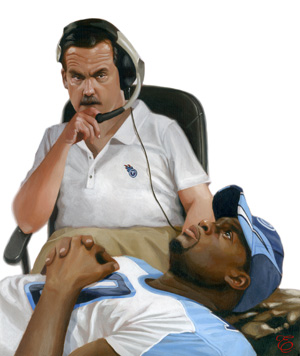
Today's hero strides by in a white skullcap. His is a noble walk: unhurried, chin high, feet cushioned by the electric-blue-piping Reeboks ordered custom-made by trainers. He breezes past the scribes, Caesar among plebes, as they pretend not to notice that the most compelling storyline in professional sports—the elephant in the locker room—has just been allowed safe exit by a handler. The handler who, earlier in the day, crossed his arms like a referee signaling an incomplete pass while mouthing, "No V-Y."
Empty-handed, the writers mine the outer edges. One approaches locker mates Alge Crumpler and Bo Scaife, and the two tight ends take a momentary break from their conversation.
"He's just gonna ask you a bunch of questions about Vince," teases Crumpler.
Scaife doesn't bother to look up. He sounds weary as he thumbs a text into his phone's keypad.
"They always do," he says.
Anyone who thinks this is unfair lacks an understanding of the word. Besides risking their short- and long-term health—besides being targets of physical abuse from opponents, not to mention verbal abuse from coaches, fans and columnists—not much is asked of professional football players. They are grown men making a relative fortune at a kid's game. Fielding dumb questions about the team's fearless leader should be the mildest of occupational hazards.
Only these days, the questions hit like a 350-pound lineman.
The Titans are the only undefeated team in the National Football League. Their hero of the moment is a 35-year-old recovered alcoholic. They have arguably the league's most physical defense. Narrative angles should be as abundant as flaming-T helmets during a gang tackle.
But for all intents and purposes, all anyone wants to discuss is Vince Young.
The quarterback is the most highly scrutinized athlete in all sports, not just the NFL. He is the general, the executioner, the battlefield coordinator. When struggling to describe the importance of a position, no matter what the sport, announcers typically invoke the signal-caller—as in, "the catcher is the quarterback on the field," or, "the point guard is the quarterback on the court." But even before he was taken third in the 2006 draft, Vince Young was already a special case.
Young's entrance into the professional ranks was preceded by high school superstardom, followed by one of the greatest individual performances in college football. With 11 guys on either side, football at any level is undoubtedly a team sport. And yet never have so many analysts, nor so many casual fans, dubbed a victory "single-handed" as they did Texas' 41-38 win over the University of Southern California in the 2006 Rose Bowl.
The game is legend. Facing a team considered the most talented in the country—no fewer than two Heisman Trophy winners anchored its backfield—the Longhorns piled up 500-plus yards of offense. Of those, golden-boy Young accounted for all but 89. He rushed for three touchdowns, including the game winner with nineteen seconds left. Ex-Trojan and Hall of Fame safety Ronnie Lott called Young the greatest quarterback to ever play the sport.
At 22 years old, Vince Young wasn't just a hero. In Texas, where the fervor of sports devotion takes on a cult-like cast, he was a near-deity—a superhero.
Three years later, though, he's looking more like Hancock than Superman. Young is currently mired in the worst stretch of his professional career. Booed after refusing to come off the sidelines during the fourth quarter of the Titans season opener, Young eventually relented, only to sprain his knee a couple plays later. Then things got weird.
The Monday after the game, Metro police got a call from someone at Young's house. He'd gone AWOL without his cell phone. An all points bulletin was issued and negotiators were put on hold. The Titans' team therapist told police Young had mentioned suicidal thoughts. His family said he kept a gun in the glove compartment. The bizarre saga ended at midnight when Young met with Titans' coach Jeff Fisher and declared the whole incident a misunderstanding: Depending on who you believe, Young or the local media, he was either watching Monday Night Football at a friend's house or bartering autographs for hot wings at an East Nashville barbecue joint. Either way, if Young wanted heat, he got it.
Was he mentally ill? Depressed? Or was it less a matter of chemistry and more a matter of character? Was he, as ESPN's most vociferous Young-critic Merril Hoge suggested, just a "crybaby?" Despite the subsequent spin, speculation about Young still dominates the airwaves. And his few recent interactions with the press have done little to quiet the chatter. In a press conference last week, he was still blaming the bad ol' media for his current woes—the kind of lame cop-out nobody buys from Paris Hilton, let alone a leader of men.
With Team Vince circling the wagons, dozens of phone calls and interview requests to ex-coaches, ex-teammates and talking heads went unanswered. So it was left to a handful of those who've watched Young's roller-coaster rise from the beginning to answer the question: What's eating Vince Young?
Of all the prevailing theories as to why Young has handled his pro setbacks so poorly, the one that carries the most weight is his unfamiliarity with failure. Being a football demigod in Texas is equivalent to soccer stardom in Rio. And for six years, from high school in Houston to college in Austin, Young's grip on the state rarely slipped. Chip Brown, a Dallas Morning News sportswriter during Young's college career, still refers to him as "Black Jesus" during his weekly radio show.
"The adversity (Young) faced in college was brief," he says. "It lasted one week."
That was during his sophomore year, when Young was benched against Missouri after throwing two first-half interceptions. After the game, Texas coach Mack Brown was asked who was starting the next Saturday: Young or Chance Mock, his in-game replacement. Brown said he didn't know. A week later, Young was back in the starting lineup. There endeth the lesson.
But even in high school, Young's mere presence had U2-like drawing power. During his senior year at James Madison, the Marlins played their "home" games at the Astrodome, regularly drawing more than 30,000 fans. Marlins coach Ray Seals had spent a decade coaching, sometimes with Division-I-caliber talent, but he'd never seen anything like the way Young lit up Houston.
"He was electrifying," he says. "People just had to see him play."
Young led the Marlins to an undefeated regular season, losing in the state semifinals. But the loss was less a blemish than a reminder of how far Young had led the team. Their opponents were a suburban powerhouse that arrived via charter bus. Madison couldn't even afford to emboss all their players' helmets with blue-and-red "M" decals. M.K. Bower, a Houston Chronicle sportswriter, says the team's Bad News Bears underdog image extended well beyond the uniforms.
"[Young] was the superstar," he says. "There was no one else on his team worth anything. It was all because of Vince."
From an early age, Young was athletically superior to just about anyone who lined up against him. His Uncle Keith, the most consistent father figure in Young's life, started bringing his birth certificate to Pee Wee games—a preemptive defense against the opposing coach's inevitable claim that the behemoth tearing his team to shreds was a ringer.
Things are different in the NFL, where freakish athleticism is just a prerequisite. Success in the pros relies on never-ending repetition and study, a brutally efficient way of ensuring only the most devoted playbook junkies succeed. Even in the most advanced college programs, the jump to the NFL represents a quantum leap in complexity, especially for the man under center.
Chris Simms, who also played quarterback at Texas under Coach Brown, likens the transition to going from long division to trigonometry. Some question whether Young is bothering to do his homework—or whether his entourage is letting him slide.
At the center of the controversy are the people who make up Team Vince: Uncle Keith, his business manager; Major Adams, his agent; Ms. Felicia, his mom; and a handful of close friends from Houston. Adams, in particular, has been the target of finger-pointing since he signed on in 2006. A childhood friend of Uncle Keith's, Adams had only worked with one other football player—his highest-profile client at the time was Houston rapper Mike Jones. An embarrassing series of gaffes leading up to the NFL draft drew attention to his inexperience.
First, Young showed up to a post-championship White House meet-and-greet without a suit and tie. Then it took him two tries to get a 16 (out of 50) on the Wonderlic, the aptitude test given to prospective draftees. A stroll down radio row at the Super Bowl, posse in tow, didn't help matters. When columnists questioned whether Young's sycophantic surrounders were less guiding light and more enabling distraction, Coach Seals heard echoes of his own warnings.
"He tries to please people. That's one of his fallacies, one of his faults," says Seals. "I have my opinion on the people he's around but I don't want to put it in newspaper print. Let's keep it at that."
Chip Brown can relate to Seals' reluctance to speak out. He was a victim of Team Vince's omertà back at Texas. After Brown wrote a semi-unflattering article on the QB, Uncle Keith would no longer return his calls. Still, others are willing to attest to Young's supporting cast.
Benny Swain has been friends with Young since the sixth grade, when they were both middle schoolers in Houston's rough-and-tumble Hiram Clarke neighborhood. Blacks and Hispanics met daily to decide who owned the hallways. Swain and Young were never in the fray, but stood close enough to catch heat anyway.
The first time they got called to the principal's office, they were greeted by Houston's finest. Innocence wasn't enough to keep Swain from feeling like a criminal as the cop's hands swept down his leg and across his outstretched arms. He may have been embarrassed, but Young was downright scared.
Swain knew why: Ms. Felicia. He heard her before he saw her—Mom, Dad and drill instructor all rolled into one, her "Where's my boy?" echoing off the hallway walls. Swain watched as they walked away: Young's head cowed in shame, Ms. Felicia's arms crossed with disapproval. They never got called to the office again.
Understandably, Swain doesn't think a lack of discipline is the issue. It's one misunderstanding among many, he says, that have developed over the years about Young. For example: Young is often criticized for isolating himself. Standing on the sidelines, away from other players, Young sometimes gives an impression of detachment, of not caring. But Swain contends that's just how Young keeps himself focused.
Coach Seals also had those same concerns when Young first became his quarterback. The two got along immediately, but Seals wasn't convinced his young pupil was paying attention to him.
"Me, I like ya lookin' in my eyes when I'm talkin' to ya," says Seals. "When you'd talk to Vince he'd never look at you."
In sideline powwows before a big play, Seals would give his instructions and make Young parrot them back. Eye contact or not, Young was listening.
"Quarterbacks are either really shy or they have these huge personalities," says Andy Bark, co-founder of Elite 11, an invitation-only camp for top high school quarterbacks. "Vince is one of the shy guys."
Bark thought his first meeting with Young would be his last. It was 2001 in San Juan Capistrano, Calif., and Young was one of the dozen QBs Bark had invited to camp to be tutored by former pupils like Carson Palmer, a future Pro Bowler with the Cincinnati Bengals.
Bark watched Young struggle his first day, looking overwhelmed next to college prospects that'd been groomed from a young age by high-priced gurus. Convinced he was going to catch the next flight home, Bark was surprised when Young showed up at camp the next morning. He was even more surprised when Young played well enough to sweep the camp's Most Improved award.
On his last day out West, as if to punctuate the turnaround he'd made, Young dunked over a member of the NBA's Los Angeles Clippers during a pickup basketball game. Bark has seen hundreds of quarterbacks come through his camp, many of whom went on to the NFL. By his estimation, only one was more competitive than Young: the Steelers' Ben Roethlisberger, the youngest quarterback ever to win a Super Bowl.
For Swain, Seals and Bark, Young's struggles are largely a reflection of how he's doing on the field.
"Vince never talked about fame, he never talked about money," says Swain. "It was always about football."
And in the NFL—an acronym sometimes modified as the No Fun League—that can be a problem.
Writer Stefan Fatsis spent months embedded with the Denver Broncos while working on his book A Few Seconds of Panic. As an average Joe given access to the Land of Jocks, Fatsis emerged with a surprising conclusion: Lots of players hate their job.
"The life of the NFL player is far more complicated, far more stressful, and far less fun than the public might appreciate," he says. "(Young) might not be psychologically equipped to handle the pressure of playing professional football."
Alge Crumpler, a four-time Pro Bowler, understands as well as anyone the transition from football as a game to football as a job. On his first day in the league, Crumpler was being shuttled from the airport to a press conference so the Atlanta Falcons could show off their newest draft pick. Crumpler stretched out in the back of a limo, high on life, until he picked up a local paper and read the headline.
"I'm coming from the most exciting moment of my life, getting drafted, and I open the newspaper and see 'Another Tight End—What the hell were the Falcons thinking?' " he says.
Young's introduction to the Titans was, of course, viewed less as a liability and more as the Second Coming. And in the economics of professional sports, the combination of age (he's only 25) and dollars invested ($20 million thus far) make him a far more treasured commodity than a veteran tight end. But it doesn't mean the grind of life in the league hasn't taken its toll.
Earlier this year, Young told a reporter that he'd considered retiring after his rookie year, without question his most successful as a pro. Young is a player who seems at his best when the mood is light. Remember the story about the one week in college where he struggled? What isn't as well known is the transformation that took place between games.
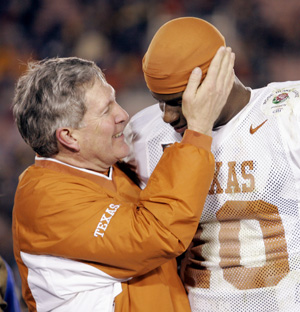
Worried that his star player needed a reminder of his own greatness, Coach Mack Brown ordered his staff to make a special highlight reel. He then sat Young down and hit play. The video showed Young at Madison juking defenders, breaking end-zone-to-end-zone touchdown runs. It was essentially Vince Young's Greatest Hits, pure showtime—a compilation that said, "Remember? This is who you are."
When the screen went black, Young asked his coach if he could take the reins. The team was tight, he said. In Brown's time, players didn't so much as talk on the bus: that meant breaking your focus. Young was convinced the team needed to recapture that spirit of play, to cut loose. He talked Brown into letting them play music during practices and battle-rap on the way to butt heads. Texas never lost another game.
The carefree dance, the shimmy—it became part of Young's repertoire. Even before the Rose Bowl, the biggest game of his life, Young warmed up to a beat, his head bobbing and weaving.
"That's his gift," says Chip Brown. "That's what he needs to get back to."
But it's harder to two-step when you're sitting on the sidelines. Young's sprained knee is the first substantial injury he's ever sustained, at any level. It's a situation familiar to Titans defensive end Kyle Vanden Bosch, who missed most of his rookie year with a torn MCL.
"That's when you start to get depressed," Vanden Bosch says. "When you watch the game move on without you."
Young has watched the Titans move on to the tune of a 6-0 record. Yet at a time when the story should be about anyone other than him, Young has still managed to court minor controversies.
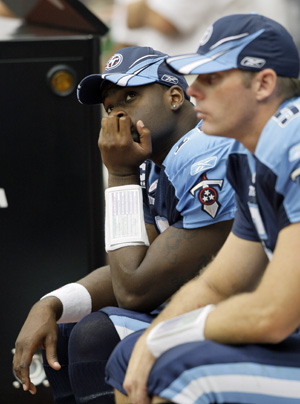
During the Titans' week-four victory over the Minnesota Vikings, Young was criticized for not acting the part of the backup—spending most of the game sitting on top of an equipment trunk, rather than joining third-stringer Simms on the sidelines. It was a small matter that Young managed to exacerbate last week when he accused the media of turning against him, telling reporters he was a "great, humble guy." That violated the First Rule of Humility: Being humble means not saying you're humble.
Those are the kind of comments, says ESPN.com's Paul Kuharsky, which cast Young in an unfavorable light. Especially when measured against the former Face of the Franchise, Steve McNair.
Kuharsky has covered the Titans since 1996, arriving in the locker room a year after McNair was drafted. He's quick to point out that Young is in the unenviable position of following up a legend—"the new guy is never as good as the old guy," he puts it. Even so, Kuharsky says, Young could help himself by taking a page from McNair's playbook.
According to Kuharsky, Young takes offense at nearly all criticism and is dismissive of any questions that paint him in even a semi-negative light. It's an attitude far removed from McNair, his mentor, who Kuharsky describes as almost relentlessly culpable.
"The beautiful thing was McNair was the most self-critical guy in the locker room. He was responsible for everything," Kuharsky says. "Vince does not take the blame for anything. He has never said, 'My bad.' He's in a scenario where everyone's trying to protect him and he's still defensive and not self-critical at all. That's where it doesn't work like it did under McNair."
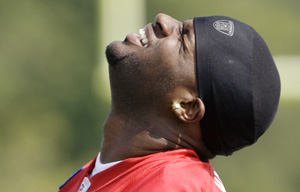
This thin-skinned petulance has helped make Young a tackling dummy for Titans fans. When his troubles began this year, Flamin' T die-hards were not shy to pile on. To be sure, hurling invective at a slumping athlete is a time-honored tradition, particularly when fans detect a whiff of arrogance. But in this case, the complaints have an edge of hurt that is commensurate with Young's promise. And for those who've watched his star ascend, the sting of the unfamiliar is written all over Young's face.
"He's hurtin'," says Coach Seals of his former student, "'cause he's never been booed by his own people."
For the people who know, or have known, Vince Young, it's all still a matter of perception. Those who know the day-to-day life of the Titans QB refuse to comment; those shielding him in his inner circle have left the information vacuum to be filled with Internet chatter and sports-talk fat-mouthing. And if Young's Texas glory days taught him anything about human nature, it's that people are far more forgiving of winners. Unless the man himself decides to clear the record, speculation into Young's goals, methods and personal character will remain just that: speculation.
But one constant emerges from the disparate views of the many people who have been drawn into this brilliant and elusive superstar's orbit. However much they know or don't know Young the person, they know Young the football star. And though they've had different degrees of proximity, all are certain of one uncontestable rule, born from watching him up close and in the flesh: Don't bet against Vince Young. Especially if he remembers how to dance.



