
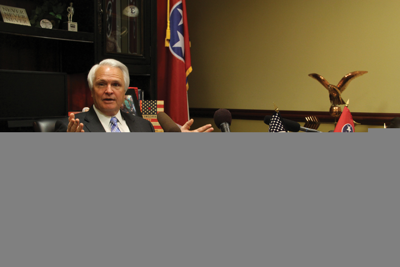
Lt. Gov. Ron Ramsey, the towering conservative ringmaster known for spinning his losses into wins and calling the shots in the circus that is the Republican state legislature, stood at the well of the state Capitol's upper chamber with butterflies in his stomach.
After 24 uninterrupted years as an elected official in the General Assembly, he gripped the podium last week with tears rolling down his face as he spoke words few in the chamber expected to hear: He wanted out.
Those weren't his exact words, of course. They were more like, "Life is flying by," and, "This has not been an easy decision."
But yeah, he wanted out.
The reasons politicians give for leaving office usually elicit eyerolls — none more so than the generic "wanting to spend more time with family." But in this case, with a 300-mile drive twice a week to run the Senate while his three grown daughters have produced families of their own, the reason seems genuine for a doting grandfather with four young grandchildren. Make that five — the fifth was born the day he announced his legislative retirement.
A 60-year-old auctioneer with a big personality from far East Tennessee, who likes to chew tobacco and farm at least a couple cows, Ramsey couldn't be more resolute that it's time for him to go. But his absence will leave a power void in a legislature that he largely defined (and corralled) in recent years.
Ramsey's effect on state government depends on the lens through which you view Tennessee politics. Most who live and die by the legislative session each January through April will remember Ramsey as a renaissance man for the GOP and a straight shooter with a high-pitched twang, quick mouth and a commanding presence.
But those outside the bubble of state politics may remember Ramsey more for the headlines he's made and the fights he's picked. Like contending that Islam isn't a religion. Like announcing he couldn't say for sure President Barack Obama wasn't born in Kenya. Like calling global warming a farce because it's cold outside.
He's also pooh-poohed extending food-stamp money to poor people during the recession (for fear people might expect too much from government), and he ushered through legislation requiring a driver's license or a handgun carry permit to vote (although the state had a hard time producing the examples of voter fraud that would justify such a move).
He's taken on the Tennessee Supreme Court's three Democratic-appointed justices, endorsed not telling the whole truth during elections, and demanded that heads roll at the University of Tennessee's office of diversity for its perceived war on Christmas. He once chided a reporter for suggesting that not everyone can afford a Chevy Tahoe the way the Ramsey family can. All along, he relished the opportunity to say handgun carry permit holders are above reproach, even after a fellow Republican representative was caught drunk-driving with a loaded pistol holstered in his car.
This year the lieutenant governor turned his attention to immigration. He urged the state attorney general to sue the federal government over placing Syrian refugees in Tennessee, despite insistence from Gov. Bill Haslam that the system is sound and fine. If the AG refuses, the legislation Ramsey pushes all but promises the two speakers will find their own lawyer and sue the feds themselves.
Despite that and other bouts of heartburn Ramsey has given the governor, Haslam says he spent months begging the lieutenant governor to stay.
The two ran against each other for the 2010 Republican nomination for governor — a bid Ramsey says he never plans to repeat — with the sitting lieutenant governor coming in a distant third and Haslam going on to a landslide in the general election. Ramsey spun his loss into a win, positioning himself as the most powerful Republican in the state as the new governor was still figuring out where the bathrooms were and new House Speaker Beth Harwell was learning what it means to lead a chamber of 99 members — a task akin to herding cats, even when most of those wayward felines are fellow Republicans.
But it was under Ramsey's leadership that Republicans gained those majorities in the first place. After vying unsuccessfully for Senate speaker in 2005, Ramsey tried again in 2007, convincing then-Democratic Sen. Rosalind Kurita to cast her vote for him in a coup that won the politically split body its first GOP leader since Reconstruction.
He then recruited Republicans to run for the Senate, including now-Congresswoman Diane Black, whom he lied to about her polling numbers to get her to run, he told reporters. He also fielded Sen. Jim Tracy, whom he called every Thursday for weeks while the potential candidate was heading out to referee basketball games.
As the years went by, the once split Senate grew unapologetically Republican, claiming every seat in the chamber but five from the Democratic strongholds of Nashville and Memphis.
"Of the Republican senators that are here, they were either here for the revolution when Ron took over, or Ron helped them get elected. And so there's a fairly remarkable cohesiveness that it's hard to have unless you have the circumstances that Ron has led over the last several years," explains Haslam, who has known Ramsey for some 20 years.
"If you were here in the Senate when Ron won that vote and Rosalind Kurita voted for him, everybody says, 'That was one of my most memorable moments.' And so they feel like, 'I was kinda there at the revolution.' It's hard for people who haven't been around to appreciate that. And Ron was the first person who really said, 'Republicans can win.' We can have the majority in the Senate."
And he still commands that power, with more than $685,000 in his political war chest that he can continue to divvy out to fellow senators and Republicans for years to come.
He also has the loyalty of many of its members, including Senate Speaker Pro Tempore Bo Watson, R-Hixton, a longtime confidant and roommate during the legislative session.
"There are certain attributes that all leaders have. It's just a sense about them that people recognize although they may not be able to define it, and Ron has that," Watson says. "He's very folksy, which represents much, particularly the area he represents here, but it represents Tennessee in many ways. Even though he's kind of folksy and plays sort of the 'aw, shucks' card, there was never any question in the Senate about who's in charge."
Watson is one of five informally in line to take Ramsey's seat when he leaves office in January. That group includes commerce committee Chairman Jack Johnson, caucus leader Bill Ketron, finance committee Chairman Randy McNally and Majority Leader Mark Norris.
McNally is the apparent front-runner, being one of two to openly vie for the position. The argument in his favor is that he's old — that is to say, he's been in office for 38 years, has at best one more term in him, and could operate as a placeholder to transition into the post-Ramsey era for the next two or four years while the Senate sorts itself out.
Ramsey says he'll stay out of that rat race. The last thing he wants is a "bloodbath" for the seat, he says. But to some extent, it's up to the members how they want to run the Senate in his absence.
Until then, he's thinking about a future that no longer includes four-hour trips to the state's capital city every Monday morning, and means more time on his farm with his family.
"I'll take a Tahoe off into the sunset," he said.



