
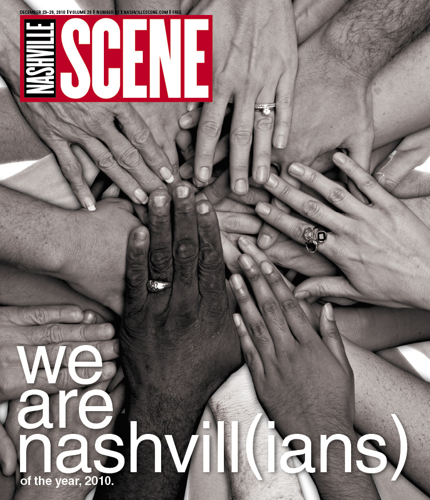




Every year for the past 21 years, the Nashville Scene has honored an individual (or individuals) whose efforts have made the city a better place. It could be a noted politician or civic leader; it could be a less well-known but equally deserving figure from the charity or nonprofit sector, or an advocate for social justice. It almost always involves a lot of argument and debate as the selection list narrows.
This year, however, in the wake of an unprecedented natural disaster — and an equally unprecedented outpouring of citywide compassion, courage and personal sacrifice — there wasn't a moment's doubt about the obvious nominee. The Nashville Scene awards its 2010 Nashvillian of the Year honors to ...
you, the residents of the city of Nashville.
Make that "to us." If last May's catastrophic flood did nothing else — besides dislodge families, destroy lives and cause billions of dollars in damage — it washed away the idea that we live in mutual isolation. It was a leveler in every sense. On Friday, the city went to sleep in pockets of racial, social, religious and financial segregation. On Monday, we woke to discover floodwaters recognize no boundaries, real or imposed.
The marvel, though, was that instead of sinking to the lowest common denominator — looting, violence, paranoia and fear — Nashvillians rose to the highest bar they could set for themselves. Maybe you paddled around East Nashville in a canoe, rescuing people from their submerged houses. Maybe you tried to warn Belle Meade motorists off West End at White Bridge Road as the water rose around your feet.
Or maybe you were the mayor, maintaining a public poise that gave no hint of the massive challenges you were facing behind the scenes. Maybe you carted cans and cleaning supplies to a Lewis Street food bank where the walls still bore watermarks. Maybe you took a stranger a casserole. Maybe you sold out nine back-to-back concerts at Bridgestone Arena and gave the money away.
Whatever you did, though, it helped in ways both tangibly small and intangibly huge. It meant forging a city of victims into a city of fighters. It meant enduring the nation's indifference in the short term, only to eventually earn its astonished respect. And for all the jokes made at the Bible Belt's expense, the city's churches, and their indefatigable parishioners, answered the call of need with a dispatch and mercy no government agency or insurance company could begin to match.
Rather than list every individual or agency that made a difference — which would amount to reprinting the Davidson County directory — we've tried to provide a kaleidoscopic view of the flood relief effort, from citywide organizers to people who held the fort in their own neighborhoods. We've tried to suggest how little things, such as goofball humor or an unbidden offer of help, ended up meaning a great deal. In the end, all we can do is express our gratitude, and thank each and every one of you for lifting us all to higher ground.
On Monday, May 3, on top of the city's other overwhelming concerns, crisis loomed in MetroCenter, where the rising river now threatened Nashville's supply of drinking water. Mayor Karl Dean held a press conference asking for emergency volunteers to help with sandbagging, hoping maybe 50 or 60 people would step up. An hour later, some 350 Nashvillians had reported for duty. It wasn't a fluke. As of Dec. 16, the city's coalition of willing helpers numbered 21,560, with an estimated economic impact of $1.9 million.
Those are impressive numbers for Hands On Nashville, the organization that channels volunteer efforts throughout the city. Where the Community Foundation gives Nashville a place to direct gifts of money, Hands On Nashville coordinates those who donate time, effort or service. It was among the first organizations to convene in the war room — yes, there is such a thing — of the city's Office of Emergency Management, a compound near Belmont where decision-makers including the sheriff, the fire chief and the heads of local utilities and city agencies met to take immediate action as the office's large screens pinpointed trouble zones. In that adrenaline-stoked atmosphere, their efforts proved invaluable in confronting the biggest and most widespread disaster in Nashville's recent history.
Yet if you ask someone like Hands On Nashville director of external affairs Lisa Davis Purcell or emergency preparedness manager Josh Corlew about the long hours they put in, or the mental and physical strain they endured, they insist it was nothing compared to the effort put in by the area's many volunteers. They point instead to people who stepped up without pay or reward when their help was needed most — people like Bonnie Duckworth, the secretary at the Bellevue Church of Christ.
A self-described bundle of energy, Duckworth had three feet of water in her crawlspace the weekend of the flood. When she returned to work Monday morning, however, she realized she'd gotten off light. State troopers had directed motorists stranded on impassable I-40 to the church's makeshift shelter, and its halls were filled with displaced families. They would come to learn the Bellevue area was among the hardest hit, with more than 2,300 homes sustaining water damage up to 8 feet or higher.
Rising to the challenge, the Bellevue Church of Christ transformed into a one-stop answer to the ravaged community's needs. Its huge fellowship hall resembled a Costco stocked with truckloads of emergency cleaning supplies and clothing; its gym became a grocery store where stricken families could fill carts as needed. Not only did volunteers pass through the church several times a day, the church provided them as many as 300 lunches daily: ham or turkey sandwiches, cookies, chips. Through it all, Duckworth would arrive at 5:30 a.m. and leave at 10 p.m. that night.
"We were getting notes from people, but you just knew they were grateful," says Duckworth, who describes the devastation to the area as nothing short of surreal: living rooms full of dead fish, appliances found far from their homes. That led to maybe the biggest discovery she made throughout that hectic time, besides the big hearts of victims and volunteers alike.
"I never knew refrigerators could float," Bonnie Duckworth says. "Now I do!" JIM RIDLEY
When the floods hit, Patten Fuqua was still bristling from the Predators' first-round playoff loss to the Blackhawks. As the rains fell, looking perhaps to fill the sports void, he went Googling for information on the Kentucky Derby.
That little foray around the Internet gave him his first glimpse into the devastation facing his city. A few days later, he got on the Internet again — only this time, his life was about to change, and he was about to give a rallying cry to a city left dazed and dispirited by the emerging disaster.
Fuqua contributes to Predators blog Section303.com, the Internet presence of the raucous top-level section of Bridgestone Arena known as The Cellblock — a section best known for irreverence and declaring that all Preds opponents suck. But on May 4, Fuqua apologized for not adopting the normal Cellblock tone and for ignoring hockey altogether.
Instead, he wrote a love letter to his city titled "We Are Nashville." Rather than complain that Nashville was being ignored in its time of need, Fuqua posited that we would make it through the dark days because "we are Nashville." We would bind together to help ourselves and our neighbors because that's who we are — come hell or, in this case, very high water indeed.
Now the blog post's title is on T-shirts and billboards and bumper stickers — a slogan of civic resistance, and resilience.
"I just wanted to get linked by Puck Daddy," Fuqua said during the first intermission of the Predators' Dec. 11 game against the Panthers, referring to the popular Yahoo hockey news aggregator. And so he did.
But he also got linked by Huffington Post. And Rachel Maddow. And Andrew Sullivan. And BeliefNet. And mentioned by Anderson Cooper. And so on, and so forth. To date, "We Are Nashville" has more than 500,000 clicks.
"I had an idea it would be big," Fuqua said. Just not that big.
Part of the charm of "We Are Nashville" is that it's such a departure from the usual tone and reputation of 303. The blog, riddled with in-jokes, doesn't take itself too seriously. But Fuqua says there's a connection between "Red Wings Suck!" and "We Are Nashville."
"Our job up here [in The Cellblock] is to be loud and rally people," he said. "It was just a really wordy chant."
No. It was much more than that. J.R. LIND
[page]
On May 1, 2010, a killer storm system was bearing down on Nashville, preparing to unleash historic devastation on areas that rarely saw more than puddles. That day started like any other for Ellen Lehman, president of The Community Foundation of Middle Tennessee, who says she was doing nothing more dramatic than being "a dweeb" – that is, sitting at work on an unusually rainy Saturday when she could have been relaxing.
But the more she listened to the weather radio, standing in the foundation's Green Hills office in her raincoat, the more convinced Lehman became that disaster was imminent. The ensuing 48 hours, and their aftermath, became the first real test of Nashville's emergency response network, with The Community Foundation proving a pivotal long-term liaison between nonprofit relief organizations and the many thousands desperate for a way to give.
As Nashville's designated handler of charitable contributions — a move that ended years of needless red tape and confusion whenever the city was deluged with post-emergency envelopes full of coins, cash or checks — the Community Foundation's role was sometimes misunderstood in the anxious weeks after the flood. Stricken residents saw money pouring in from TV and radio telethons and celebrity benefits, and wondered why they weren't getting a check in the mail.
But the foundation's job is to stretch those contributions as far as they will go. Toward that end, Lehman says the foundation was "smart-bombing" grants into support networks that were already set up and running — a case in point being St. Paul AME Church in Bordeaux (see p. 18), which not only was offering aid but had already established trust and a relationship with its neighbors. To date, the foundation's two flood-relief funds have distributed $5.48 million in grants and allocations — as large as $450,000 to The Housing Fund (see p. 20), as small as $500 to provide for rescued horses.
Put another way: Lehman's teenage son was volunteering at Clear Channel's 19-hour radio telethon when an elderly listener phoned in. She offered $10 — a $5 donation on each of her credit cards. Maybe that's a drop in the bucket in itself. But as part of a $10,000 grant, it helped provide anything from new mattresses to day care for people facing the loss of their jobs.
Ironically, Lehman says, the source of Nashville's resilience has also been the source of some resistance — pride. "Most of the people who need help and deserve help are really hesitant to ask for it," says the calm, dryly funny Lehman, whose laser-pointer gaze hints at her effectiveness. (Upon finding the Scene's meeting spaces full, she commandeered publisher Mike Smith's office so swiftly and sweetly no one noticed the coup.) As the city enters the long-term recovery phase, she says, the foundation's challenge will be to help find those people and let them know they are not alone.
"This has brought out a common unity," Lehman says, then smiles. "I hate to use this phrase, but it's true: We're all in the same boat together." JIM RIDLEY
Kevin Mawae had been at my house helping with the flood cleanup for a while before I noticed him. All day long, people had been showing up to help with the unpleasant task of cleaning out the house. Friends, relatives and strangers worked together to complete a dirty job. Some of the churches sent out teams of volunteers, and he had arrived with a group from The People's Church in Franklin. On a day of grim, exhausting work, everyone seemed cheered by the sight of the big ex-Titan, whether they recognized him or not.
Mawae played center for the Titans before he was released earlier this year after playing in the NFL for 16 years. He was known as a tough, smart player who wasn't afraid to mix it up in the trenches. A center's job is to understand his opponent and do whatever it takes to protect his teammates. It's a thankless job that often goes unnoticed in the NFL world of celebrity players.
When the Titans signed Mawae in 2006 the team got a savvy veteran, but Nashville got a man who cares about his community. During his time on the field, he was the anchor of the team. This time he played that role for people needing help after the floods.
He worked nonstop, while always in a good humor. When it came time to remove the soggy gray insulation from our kitchen, he refused to wear a mask. "I'll just cough it all up in a couple of days," he said. He proceeded to go around the kitchen walls using a crawling motion with his hands and arms, flinging down strips of insulation like they were so many nose tackles. Next, he and some others ripped out my hardwood floors in what seemed like minutes.
In between it all, he took time to sign autographs and pose for pictures, never minding the interruptions to his work. He was there because he really wanted to help. There were no cameras following him around.
When he was finished, I asked him if he would take a picture with me. He insisted that the dozen or so people in his church group be included in the photo, since they had worked just as hard or harder. Naturally, he stood in the center. SCOTT A. MARTIN
At a time when Nashvillians often felt the rest of the world was looking the other way, especially in the national media, local newscasters, reporters and photographers shouldered the burden of conveying the enormity of the disaster. Nothing made the outside world stand up and take notice more than John Partipilo's photographs in The Tennessean, which traveled rapidly far beyond the city limits.
Partipilo's eye for drama and human detail never deserted him even in plainly dangerous conditions. More importantly, neither did his compassion or empathy for those he was photographing: a dazed boy cradling a ruined guitar, a homeowner weeping in the boat taking him to shore. During the flood, Partipilo functioned as witness, sentinel, recorder for posterity and signal flare. His wrenching photos from The Bottom — an impoverished and little-known community off Murfreesboro Road, where elderly African-American residents lost not only their living quarters but the wheelchairs that would help them get to shelter — opened eyes as well as wallets, and arguably saved lives.
Years from now, when people want to show their children (or grandchildren) what the city lived through, minds will boggle at Partipilo's iconic images: of the Opryland Hotel's carefully manufactured indoor Delta overrun and destroyed by the real thing; of a trapped tunesmith serenading the six-feet-under parking lot of his inescapable hotel; of Riverfront Park underwater and Lower Broadway awash in silt. In so doing, he provided just what the city needed — focus. JIM RIDLEY
[page]
During those first few days following May's historic flood, Nashvillians east of the Cumberland River felt like the rest of the city largely ignored their devastation. To be sure, neighborhoods in Bellevue, Bordeaux and West Nashville felt the brunt of flood-related damages. But houses off Dickerson Pike, Moss Rose Drive and Electric Avenue weren't spared either.
So East Nashvillians, who sometimes consider themselves the city's ugly stepchild, say they took matters into their own hands. Among them was Alan Murdock, owner of ArtHouse Gardens, who turned his Woodland Street establishment into the neighborhood's "command center." Volunteers showed up each morning before scattering around East Nashville to help their neighbors.
"East Nashville took care of East Nashville," says District 5 Metro Councilman Jamie Hollin, who represents parts of the area. "They had that mentality after the tornado [of 1998]. East Nashville had the neighbors and the resources here to take care of it on its own."
At the center of East Nashville's cleanup was Catherine McTamaney, a professor at Vanderbilt University's Peabody College. Known as something of a community-activist all-star, McTamaney was the one making sure volunteers hit the right places, appointing team leaders and pulling in an army of volunteers via the popular East Nashville Listserv.
"Catherine McTamaney has the most awesome organization skills of anyone I've ever met," says Hollin, who recognized both McTamaney and Murdock at a council meeting over the summer. "People were coming at her nonstop. She was the person who triaged flood recovery in East Nashville."
McTamaney, who says the real story is the army of 1,600 volunteers who offered their services in East Nashville, began her work that first Sunday during the storm, eventually helping direct assistance to 640 homes as the days unfolded.
"On Monday, we already had volunteers lined up thinking we were going to spend the day pumping out some people's basements," McTamaney says. Then the dam opened.
"I think part of what happened in East Nashville is that we responded really quickly," McTamaney says. "And so there were already people there to keep going once things elevated to a different level of need."
Flood damage "ran the gamut," she says. "What was unique about this area is that in some parts of town, the water came up and then it went away. In East Nashville, the neighborhoods that were most significantly hit, the river ran through these neighborhoods." JOEY GARRISON
Until the flood, the Twitter feed for the Nashvillest website was pretty ordinary. It either pointed you to interesting things on their website or was filled with chatty comments. But on Saturday, May 1, that Twitter stream became the lifeline of Nashville's online community.
@nashvillest aggregated every bit of flood news and rumor that the women who run the website, Christy Frink and Morgan Levy, could find. They directed help where it was needed; they urged people out of places where they were not. They even debunked exciting "news" like the escaped piranha rumored to be swimming around Opry Mills.
Because Frink and Levy spent the flood scouring the Internet for people's firsthand experiences, anyone following along on Twitter heard about things and saw photos minutes — large chunks of minutes — before the local media could get to them. They then used their webpage as a more static platform for directing people both locally and around the world where they could go to get or give help.
The old saying was that news is the first draft of history. Frink and Levy proved that's no longer the case. Now social media is the first draft of history, the place we look when we want to know what's happening right now.
As our city drowned and all we could do was look on in horror, Frink and Levy turned their hobby into a lifeline. They were also inventing a new and vital form of disaster response — one cities across the country would be wise to emulate. BETSY PHILLIPS
When Remziya Suleyman moved to America in 1991, she thought she had left behind the squalor and suffering of Kurdish refugee camps. What she found at the Millwood Manor apartment complex off Murfreesboro Road, however, in the flood's immediate aftermath brought back memories in a sickening rush. Hundreds of Egyptian families who once called the complex home were now tearfully trying to rescue what belongings they could from their uninhabitable apartments. For Suleyman, policy coordinator for the Tennessee Immigrant and Refugee Rights Coalition, the most painful memory was of seeing a family's two remaining possessions on high ground: one adequately dry sofa cushion — and on it, their newborn baby.
Faced with chaos, Suleyman and TIRRC youth organizer Amelia Post began hitting their network. Suleyman's first call was to Loews Vanderbilt Plaza general manager Tom Negri, described by many as one of the unsung heroes of the flood-relief effort. Negri literally left his first meal at home in three days and answered Suleyman's call for help, using his web of contacts to begin securing everything from supplies to emergency shelter. So did another little-recognized local champion of social-justice causes, Avi Poster from the Jewish Federation of Nashville. Suleyman and Post, meanwhile, enlisted the help of Wafa Beshay and Dina Amin from the St. Mina Coptic Orthodox Church on McMurray Drive, who stayed until 3 a.m. acting as translators and helping the volunteers gain the isolated residents' trust.
As word of Millwood's conditions spread, Suleyman says, offers of help came in from everywhere from the mayor's office and the Red Cross to nearby Glenview Elementary, Wright Middle School and Glencliff High School. Public pressure improved the quality of living for the families who decided to stay. For TIRRC, though, and support organizations such as Conexion Americas, the challenge of flood relief for Middle Tennessee's many immigrant enclaves was just beginning — from the Latino residents of a devastated Smyrna trailer park to the Somali and Kurdish mom-and-pop businesses on Murfreesboro Road and Harding Place destroyed by Mill Creek's swollen waters.
Many still need help. What they need most, Suleyman says, is the kind of support system that proved so pivotal during the flood: neighbors looking out for neighbors. "Just have a conversation with someone [in these communities], and see what they need," she explains. She knows Nashvillians are capable, after witnessing their generosity first-hand. "This is why I've lived in Nashville 20 years," she says. JIM RIDLEY
St. Paul AME's minister Harold Love Jr. initially thought his church was mounting only a short-term effort to help a few people on May 2. Though like thousands of others he'd witnessed the nonstop rain that hit Nashville that weekend, he was operating under the mistaken notion that there hadn't been much destruction in the Bordeaux community around St. Paul, his ministerial home for nine years.
"We were cooking burgers and offering bottled water, and we noticed how many people kept coming to the church," Love remembers. "But we just thought it was one of those things where the word had gotten out and people just wanted to get together and socialize. I really was operating under the assumption there were a few people whose carpets might have gotten wet or had a little standing water in their basement."
He realized how wrong he was when he went out into the neighborhood and the adjacent area around Hamilton Street, accompanied by the brothers from his Masonic Lodge as well as the church. There, many of his African-American parishioners were stranded without power, without food — and to an alarming degree, without homes.
"Everything was gone," Love says. "Possessions, life's work, furniture, all of it lying there under water. Once we saw that, I knew we had to do a whole lot more than just offer some food and comfort."
For the next two months, Love, with assistance from Bishop Vashti McKenzie (the 13th District's first female AME bishop), NAACP President Marilyn Robinson, Councilman Jerry Maynard and other political and community leaders, turned St. Paul into a key center of flood relief activity for North Nashville.
"We had to do some of everything," Love continued. Toward that end, over subsequent weeks, St. Paul turned into an all-purpose clearinghouse for the stricken neighborhood's needs, whether clothes and shelter, helping with FEMA paperwork or tiding people over until their loans came through. It also became a place where Love, plugged into the nerve center at Hands On Nashviille, could confirm or shut down the torrent of speculation and rumor unleashed in the flood's wake.
"For this period," Love says, "we became something that we talk about the church being but hasn't always been the case — a place of solace and comfort for people in the community as well as a beacon for social action and positive change."
Love even had to juggle his own responsibilities. As a doctoral candidate nearing the end of his quest for a Ph.D. at Vanderbilt Divinity School, he had three papers due the first week of the relief effort. "There was no question for me what choice to make," Love says. "I couldn't possibly think about my own academic career when people were suffering and had lost so much. I just said to myself the Lord would take care of the situation, and my place was in the church at that time."
Love eventually got most of his work done and plans to complete his degree early next year. As for his part in the flood effort, he sees his participation as an extension of the community activism, spiritual fulfillment and advocacy for social justice that were the hallmark of his legendary father Harold Love Sr. — who was elected to the state legislature in 1968, and is still remembered today for his meteoric personality, love of his alma mater Tennessee State University, and tireless work on behalf of others.
"The church must be more than bricks and mortar and a place people come to sing and worship once a week," Love says. "During the flood relief efforts, we became a refuge, a sanctuary and a center of activity for North Nashville that enhanced and expanded our spiritual mission, and really made all of us understand just how powerful a force for good the church can become." RON WYNN
[page]
Maybe it's because Florida-based Publix has cut its disaster-relief teeth navigating a hurricane or two. But when the flood hit Bellevue, while residents say nearby competitors blocked off aisles and rationed batteries, the Highway 100 Publix ordered power generators. Some 50 outside associates came in to help man the fort. They trucked in ice by the tractor-trailer load — four times. Their employees, some facing their own flood damage, pulled double shifts. They served water. Baked around the clock. Sold everything that was safe to sell until it ran out. Coordinated with nonprofits for aid. They offered their electrical outlets — even the ones hidden under the store shelves along the aisles — so stranded residents could charge cell phones and laptops for as long as they needed.
Within hours, word had spread that Publix was communication headquarters for anyone who needed reliable information on roads, friends, schools and safety — and a beacon of light for anyone who needed a cup of coffee, some water or even just a place to sit.
"They had ice," says Kathy Rivers, a Bellevue resident whose family of four trekked a half-mile on Monday morning toward the store after losing power the night before. They went to see what the flood damage had wrought, and instead they found a lifeline.
"I was sitting in the ATM area," she says. "Those outlets are stacked on each other. You could be next to a complete stranger and you're sitting there for two or three hours to charge your phone. You start talking about stuff."
A transformer was underwater, she found out, rendering Internet and cell phones limp. A police officer informed her about schools. Another neighbor passed on info about water rationing. She went back three times that day to get more info, calmed by the store's business-as-usual operations.
That order was thanks to people like Dave Fulmer, a 30-year employee and district manager who came in to oversee operations. First, he brewed coffee.
"It was as fast as you could go and make it, with a line down the aisle just wanting coffee," Fulmer says. Then he moved to the bakery. "We started from scratch baking bread," he says. "People hadn't eaten anything and had lost everything in their refrigerators. We couldn't make sandwiches fast enough." The produce department was wiped out.
Outside may have looked like the apocalypse — two men canoed through a half-flooded parking lot to reach the doors — but inside, the store's tightly run Plan B made customers feel as normal as possible given the circumstances. To residents like Kathy Rivers, that effort made all the difference.
"It was great people could still come in and shop," Rivers says. "But it was still seeing the regulars working there — people who live in Nashville and had their own experience with the flood, and here they were working, and they were being so calm and so community-focused. The normalcy was very comforting, because everything else was so surreal." TRACY MOORE
Scott Potter usually goes unnoticed. He's the director of Metro's water department, the man behind the scenes who oversees the treatment of around 105 million gallons of water used by Nashvillians daily.
But during Nashville's Great Flood of 2010, and the weeks that followed, Potter was thrust into the spotlight, staring down television cameras during a series of hastily arranged press conferences to alert Nashvillians of a dire situation: The city's clean water supply was running low.
With the K.R. Harrington water treatment plant in Donelson submerged under floodwater, only the old but sturdy Omohundro, built in 1929, remained operating — thanks to a last-ditch stand that saw volunteers using sandbags filled by prisoners from the Davidson County jail to hold back the rising tide. Despite that effort, the water department was forced to dip into Metro's water reserves at an accelerated rate, bringing its capacity down to just 37 percent at its low point.
That added a new nerve-wracking worry to an already stunned city. So Potter, visibly tired during those first few days in May, asked us to do something new to most — conserve water, sacrifice those long showers, car washes and daily laundry loads, for the sake of helping the city. He did so sincerely, in a way that conveyed the severity of the crisis.
All that bottled water paid off. During the second week of K.R. Harrington's inactivity, the city's water reserves finally reached adequate levels, though the conservation plea remained until June.
Nashville's monthlong conservation effort taught us — at least for a few weeks — to appreciate the availability of and access to water. It also introduced the city to Potter, a Metro department head who remained cool throughout it all. What made Potter's performance admirable was his refusal to take any of the credit. He saw himself simply as another government employee doing his job.
"I'm working no harder than anyone in Metro Water or the Metro government," Potter said time after time. JOEY GARRISON
Last week, the 22 or so people working now at The Housing Fund — a local nonprofit that is borrowing about a dozen staffers from various city departments to deal with continuing high volume — got six new applications for assistance with flood repairs.
Those names were added to a list of more than 1,000 households who have requested assistance from "We Are Home," a swift and innovative post-flood recovery program designed to address a need that often emerges in the gauzy aftermath of a major disaster, now nearly nine months past.
Homeowners who fall into a certain economic demographic tend to require more financial help recovering from catastrophe. Many Nashvillians got their FEMA and/or insurance settlements only to find they still needed a large chunk of cash to finish the actual repairs. Of those who applied for a loan from the Small Business Administration to cover that gap, 53 percent were either denied or did not qualify.
Many have turned to "We Are Home," says Housing Fund director Loretta Owens. In partnership with the mayor's office and other Metro agencies, the program funnels federal grants into local households. On average, participating homeowners have needed about $20,000 to fully recover their houses. So far, ailing Nashvillians have been awarded $10.5 million in gap-filling recovery cash; as of last Friday, they had taken $3.8 million from that pot. The program has become something desperately needed in times of high water: a lifesaver. STEPHEN GEORGE [page]
As Nashvillians of all stripes — even some of the Scene's notoriously cranky music critics — continue to bask in their post-Garth euphoria, it's an ideal time to reflect on just how generous Music City celebrities have been with both their time and money. Sure, Garth may live in Oklahoma, but he did live here for a time, and generated enough Music Row prosperity to merit status as Honorary Nashvillian for Life. And if coming out of retirement to play nine sold-out shows and raise $3.5 million for flood relief doesn't scream "I am Nashville," we don't know what does.
Garth's stand at the Bridgestone was only the latest in an outpouring of love from Nashville music luminaries of all stripes. It may not be surprising that our famously sweet and down-home local-girl-made-good Taylor Swift kicked in a cool half-million, but local-girl-gone-naughty Ke$ha also stepped up with a flood relief show and a half-ton of dog food for displaced pets stuck in animal shelters. Country music's ultimate power couple, Tim McGraw and Faith Hill, hosted the blockbuster Nashville Rising benefit at Bridgestone, featuring Swift, Michael W. Smith, Brooks & Dunn, Amy Grant and both Cyruses. Just days after the floodwaters submerged much of the city, Vince Gill and WSMV-Channel 4 teamed up for a star-studded telethon that brought out Keith Urban, Alison Krauss, Naomi Judd, Darius Rucker, Phil Vassar, Lee Roy Parnell, Lonestar, Buddy Jewell and Bo Bice. We heard rumor that chart-busting rockers Kings of Leon made a sizable donation, which they chose not to publicize — hail to the Kings for their anonymous goodwill.
There's no doubt we've left several celebs off this list, not to mention all of the smaller clubs and local bands who stepped up to help their neighbors in need. Frankly, Nashvillians, you've made life hard on journalists like us who are trying to recall all the fabulous flood benefits. But it's a good problem to have, and part of the reason it gives us the warm (and now, thankfully, dry) fuzzies to call Music City home. JACK SILVERMAN
When the overflowing Cumberland began to pour into one of the downtown cityscape's crown jewels — the Schermerhorn Symphony Center — Eric Swartz, associate vice president of venue management for the Nashville Symphony, proved to be exactly the kind of guy you want on your team during a crisis. Loyal, resourceful and seemingly indefatigable — not to mention stubbornly resistant to the spotlight — he spent the evening of May 2 immersed in water up to his hip waders, trying to attach electrical wires to hydraulic pumps to save the city's symphony hall.
"Eric definitely went above and beyond the call of duty during the flood," says Mark Blakeman, the symphony's general manager and vice president of orchestra and building operations.
Swartz, 50, did what came naturally to him. As a young man, he worked with his father at a professional baseball stadium and spring training facility. After graduating from David Lipscomb University, he spent 19 years working for the Tennessee Performing Arts Center, where as general manager he oversaw all aspects of the facility's technical operations.
After he joined the symphony in 2005, Swartz became concerned about flooding at the Schermerhorn. Anticipating that possible future damage to Kentucky's Wolf Creek Dam could cause the Cumberland River to overflow its banks, Swartz helped develop a flood-emergency plan for the concert hall.
More recently, he's been working with American Constructors, the Schermerhorn's contractor, to devise a new flood mitigation plan. Shortly after May's flood, Blakeman nominated Swartz for one of the symphony's "Keeper of the Culture" employee awards. Swartz was stunned at the recognition.
"Eric is an unassuming guy," says Blakeman. "But during a crisis, he's also an invaluable asset." JOHN PITCHER
In hard times, when laughs are few and far between, a great big boner can be a small good thing. In the midst of his valiant round-the-clock coverage of the dire weather, WTVF-Channel 5's Charlie Neese diagrammed the storm front bearing down on Nashville: two big circles and a long shaft tipped by an arrow. Thus was born the mighty Nashville WeatherPenis, immortalized on YouTube, Jimmy Kimmel Live and a heavily traveled Facebook page that became a kind of resistance movement of juvenile merriment. No matter how discouraging the day's news got, the WeatherPenis page could be counted on to pop up with some awful new penile pun or wang-centered euphemism. What's more, it seemed the perfect symbol for both the shaft Nashville was getting in the days immediately after the flood, and the way we rose to the occasion. More serious attempts to commemorate the disaster have risen and wilted, but for those who recall that sorely needed surge of levity, the WeatherPenis stands tall. JIM RIDLEY
WAYS TO HELP
• First, if you know of anyone who needs but still hasn't received flood assistance, please direct them to one of the city's little-known assets: the United Way's 2-1-1 help line. Flood victims can make a free call to 2-1-1 or (615) 269-HELP to get help finding resources. A service directory can be found at tn211.mycommunitypt.com.
• Davidson County flood victims can also call 2-1-1 to find a United Way Restore the Dream Center in Nashville, where they can access case management services. These can assist in everything from creating a recovery plan and finding resources to securing donated materials and volunteer labor, which can dramatically reduce the cost of rebuilding.
• The project calendar at Hands On Nashville lists a variety of needs that require volunteers, whether it's sorting perishables at Second Harvest Food Bank or preparing a dish for Nashville Safe Haven Family Shelter. See www.hon.org or call 298-1108.
• Remziya Suleyman at TIRRC says Nashville's hard-hit Egyptian immigrant community — many of whom only recently escaped religious conflict in their homeland — needs financial aid, furniture to replace their destroyed belongings, and volunteer ESL teachers who can help them learn the language (which proved a stumbling block during initial relief efforts). Contact St. Mina Coptic Orthodox Church, 476 McMurray Drive, 333-9280.
• Finally, The Community Foundation's two flood-relief funds — the Metro Nashville Disaster Response Fund and the Tennessee Emergency Response Fund — are still accepting donations. In addition, on the foundation's home page you can purchase a Giving Card that acts as a gift certificate for charitable donation, or you can browse the online "Gifts That Matter" catalog for a list of worthy causes in need of support. Visit www.cfmt.org or call 321-4939.
Email editor@nashvillescene.com.



