
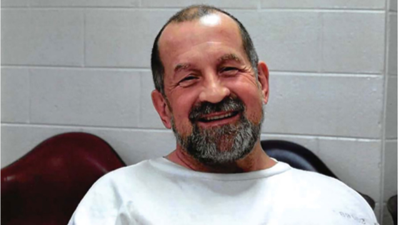


Photo courtesy of Nick Sutton's legal team
Over the course of nearly half-a-century working in and around prisons, James Aiken became familiar with an old adage in the world of corrections. In his own words: “If you can’t say nothing bad about an inmate, you don’t say nothing at all.”
That’s why he was so struck by the case of Nick Sutton.
Sutton is set to be executed on Feb. 20. Unless a court stays his execution or Gov. Bill Lee grants him clemency, Sutton will be the first Tennessee prisoner put to death this year, and the seventh to be executed since August 2018. Since Lee took office in January 2019, three men have asked him for mercy before they were taken to the execution chamber. He has said no each time.
Sutton, who is 58, was sentenced to death in 1985 for stabbing another prisoner named Carl Estep to death. Sutton was 23 at the time and had already been convicted of three murders. At the time he was serving a life sentence for killing his grandmother Dorothy when he was 18 years old, and he’d also been convicted of murdering Charles Almon and John Large in North Carolina.
In a 29-page letter to the governor, Sutton’s clemency attorney — former federal judge Kevin Sharp — writes about Sutton’s remorse for the killings. But he also emphasizes that Sutton “has gone from a life-taker to a life-saver.” The clemency request includes affidavits from three former prison staff members who praise Sutton’s character and detail incidents in which he saved their lives.
Aiken worked as a warden at multiple prisons in South Carolina and as a consultant to numerous corrections departments. He has also personally overseen the execution of two prisoners. As part of Sutton’s clemency effort, his attorneys asked Aiken to review Sutton’s incarceration history and write a report on his “potential for adjustment to a life-without-possibility-of-parole sentence in general population.” What stood out to Aiken in reviewing Sutton’s history was not just his conduct as a prisoner — Sutton has not received a serious disciplinary action since 1990 — but also the fact that he had been so exemplary that correctional officers were willing to speak out on his behalf.
Speaking to the Scene about Sutton’s case, Aiken describes it as one that compelled him to write a report supporting clemency for Sutton.
“You look at all of these decades of not just compliant behavior, but one of stepping across the line and actually saving staff’s lives,” he says. “I’m not talking about saving them from injury, I’m talking about saving them from being killed.”
Aiken emphasizes that he has personally been in dangerous situations inside prisons where he had to authorize lethal force.
“I’m not talking about something in an academic journal,” he says. “I’m talking about real life here. And for an individual like Mr. Sutton to step forward when he did not know what the outcome would be — he did not do this in order to get me to write this type of report. He didn’t even get an extra fruit cup that evening. There was no benefit for him.”
Drawing on his experience running prisons and his review of the records surrounding the prison murder that led to Sutton’s death sentence, Aiken says Sutton “was in a life-and-death situation while in confinement in a facility that was, to say the least, dangerous and dysfunctional.”
Aiken’s report expresses confidence not just that Sutton should be safely moved off death row, but also that he would continue to contribute positively to life inside the prison as he reportedly has for years now.
Sutton has taken lives, and he has saved them. Now his life is in the governor’s hands.



