

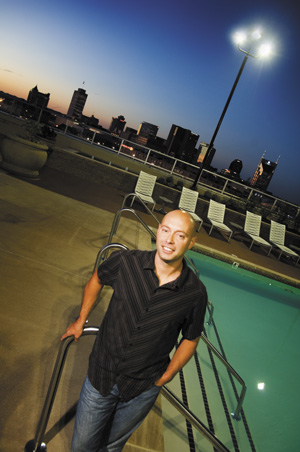
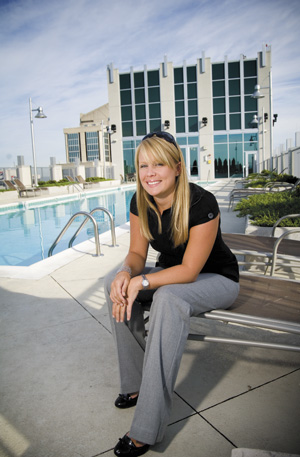

A humid breeze hits with a damp gust as you waltz toward the rooftop pool, which holds the blinding gleam of an automobile showroom. Just beyond a row of crisp South Beach lounge chairs lies a kingly view of the skyline.
Trees in swollen stone pots sway lazily to hip-hop beats that thump from speakers disguised as stones. Flanking either side of you are cabana grilling stations and sizzling fire pits. Back inside, a bar, pool table and flashing flat-screens guard plush seating for you and your closest friends.
With little stretch of the imagination, you're already picturing yourself here with the friends, the job, the money and the sex appeal to match. You are young, sophisticated, aesthetically blessed and elegantly draped in white linen, a smart cocktail in your bronzed, well-moisturized hand. You're wildly successful, well-traveled and highly cultured. You know the choice restaurants, the right bottles of wine, your foie gras from your fricassee.
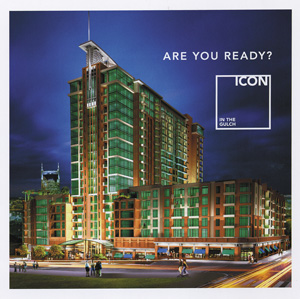
This view isn't courtesy of a Manhattan penthouse or a Hollywood Hills mansion. It's at the ICON in The Gulch, atop Nashville's largest high-rise condominium.
Welcome to the new Nashville skyline: It's frighteningly high, undeniably modern and so...money. It's no Nashville you've ever seen, because it's every bit an image straight out of Miami or Los Angeles—or at least a show set there. And it's not just the ICON pimping this Metropolitan Home snapshot. Other high-rises with velvet-rope names like Velocity, Terrazzo, Encore! and Rhythm promise exclusive living, stunning views and anointed lifestyles.
It's every decadent desire you've ever imagined—and a lot of bam and bling you haven't—all just a key fob and an elevator ride away.
And it's not just happening in The Gulch: Drive through SoBro, Germantown, West End, Midtown or the East Side and the eye glides along a once low-slung city newly autographed in fresh concrete, glass and stone.
More than a dozen projects are finished or mid-construction, and with each slab of onyx, Nashville emerges as a city slowly donning the armor of the alluring metropolis. But are Nashvillians, who've always prized lawns over lofts and Wal-Mart Supercenters over sidewalk cafes, ready for big-city glamour?
Many think it's an idea whose time has come. Now that U.S. cities are truly post-industrial, downtowns nationwide have reclaimed the neighborhoods once occupied by immigrants, meat packers and factory workers. They're pressure-washing away all the dirt, noise and ill-repute, replacing them with the cosmopolitan hustle of fair-trade coffee shops, vegan eateries and pet salons.
But while cities such as Charlotte, Atlanta, Memphis and Indianapolis redrew their skylines, we slept comfortably in our affordably priced suburban beds. It took the city council's repeal of a dated zoning ban on new downtown residential construction in 1993 for Nashville to lift its sleepy limbs toward regenerating its vital core.
The Cumberland, a 24-story apartment building, first penetrated Church Street airspace in 1998. But the current condo boom, which began with the 31-story Viridian a block away, wouldn't come for six more years.
We can tip our oversized hats to developers such as Tony Giarratana and Bill Barkley for the surge that followed, as well as a slew of studies proclaiming a population anxious to sleep where it toils.
By all accounts it's been a successful surge. Though a blossoming recession has slowed lending to buyers and developers alike, there's no denying that units have been selling steadily.
That's because local wisdom—from developers, planners and downtown boosters—says we've long been underserved. According to a report by the Downtown Nashville Partnership, many similarly sized cities have double or quadruple Nashville's downtown populace.
In 2001, there were only 1,380 residential units available to accommodate a workforce of over 47,000. That number is expected to triple by the end of next year.
Healthy sales imply that Nashville's been seduced by city living. ICON sold its top-tier units in less than 48 hours. Encore! announces 85 percent sold. Velocity in the Gulch claims 60 percent of its units are contractually bound. (Calling a unit sold doesn't mean the buyer has closed on the deal.)
Call it the Sex and the City Effect: Thanks to a generation of yuppie sitcoms like Friends, Melrose Place and the aforementioned fashionista romp, the rite of passage into young adulthood means chucking two-car garages for fifth-floor walkups, the coziness of marriage for the excitement of endless hookups. With younger generations veering off the marriage-and-breeding track, they now enjoy several years of post-collegiate socializing with the walking-around money to support it.
They want everything closer, faster and sooner, with the status of a hip city address. And they aren't quite ready to grow up—at least not by their parents' definition.
"This whole urban living deal has been brokered in pop culture for a while through New York," says Richard Lloyd, a Vanderbilt sociology professor who's writing a book about Nashville's downtown renewal.
"What they're selling is this idea that essentially your adult life, for some period of time, will be exactly like being in college, only with better shoes. You saw that with Melrose Place, Friends and Sex and the City. Adult life means you're still with your friends all the time, you still drink all the time and you serial date. You do all the stuff you did when you were an undergrad, and you live in these big, very well-appointed dorms. That's what these amount to."
Again and again, condo buyers drop three words when justifying trading space and acreage for co-ed urban chic: amenities, convenience and cool. And that's exactly the finger-on-the-pulse language condominiums use to spellbind. "We typically market urban, young, fun," says Lee Schaefer of the Bristol Development Group, whose projects include the ICON, Velocity, Bristol Broadway and Bristol West End. "And that's a message that resonates with all of our buyers, regardless of their age. Yes, we market young. Are all our buyers young? Absolutely not. They range from their 20s to—would you believe it?—the 70s."
With exclamatory glee, Sobro's Encore! proclaims "big, wide open space that is the stage for the performance of your life." A recent sweltering Saturday at the seventh-floor pool found the place mobbed with ridiculously attractive twenty- and thirtysomethings sunning themselves to Kenny Chesney's greatest hits.
Terrazzo in The Gulch, a pricier buy with Italian finishes, promises "passionate living" and "The Art of Exclusive Living."
ICON is the most provocative of them all, daring would-be buyers: "Are you ready to live like an ICON? Are you ready for urban living?"
The message is brilliantly simple: If condo living isn't for you, it's because you're just not ready to be fabulous.
The websites look eerily similar: Fluid graphics sell young, hip, energetic types in repose against a dazzling Nashville skyline. It's a bold nod to the risk-taker in all of us: Who doesn't want to be the guy or gal savvy enough to know when to get in on the ground floor?
But getting on any floor will cost you—likely more than you'd drop on a single-family home. Condos and lofts are running on average between $300-$400 a square foot, with sale prices ranging from the low $100,000s to a cool few million.
At the midtown Adelcia, a mere 687 feet moves for $197,500. At ICON, 614 feet runs $250,400. And the higher your eye climbs, so will the price tag—all the way up to $2 million at the top.
Who's lining up for this neon thrill?
Talk to developers, realtors and concierges, and they'll list young professionals, grad students with wealthy (and generous) parents, happenin' middle-agers and empty nesters who are tired of the 'burbs.
Take Jeff Coyne, a forensic engineer whose words are as carefully tailored as his wrinkle-free casual wear. The 32-year-old travels frequently for work and has the option of telecommuting. He currently lives in Green Hills, so ICON's walking proximity to restaurants and bars—and its maintenance-free living—was appealing. The two workout facilities and pools didn't hurt, either. For him, the marketing scheme wasn't so much a pitch as it was a game-show with a fabulous prize behind the curtain.
"It was all decorated and everything," Coyne says of the model unit he visited. "They had a huge model of the building itself that they have in the lobby now. It's definitely [long pause] eye-catching." His eyes narrow as he lingers over the last statement, like someone who has just stifled the urge to gush over an attractive woman.
Or take Sarah Clark, a 26-year-old lawyer from Hendersonville. She was drawn to Viridian during law school at Vanderbilt, when she worked downtown as a summer associate. She notes the convenience of walking across the street to work in the Fifth Third Building. But it's the amenities—including the social network that approximates her years in dorms and apartments—that she mentions often.
"I like having people around, and I really like the amenities," says Clark. "I love the pool on the roof."
Clark has made friendships beyond what you'd expect for a twentysomething lawyer who hits Morton's for happy hour. She's on the building's social committee with Sherry Shearer, an animated 54-year-old Southern Belle who moved to the Viridian with her husband.
Though the Shearers' relationship to condo living began as a weekend romance—a place to escape the doldrums of suburban life—they eventually moved in full-time, and now make the 30-mile commute to Robert's Springfield medical practice.
Sherry helps plan margarita parties and mixers for the building, while she and her husband regularly hit the Ryman, TPAC and the Schermerhorn—and the same neighborhood bars Clark frequents.
They also eat out "98 percent of the time." It's the neighborhood's youthful energy that sustains them.
"You stay young by staying exposed to younger people and pushing yourself," Sherry says. "I don't want a fraternity house here, but we don't have that here anyway."
At least not anymore. A Wall Street Journal article from two years ago—"Animal House Meets the Empty Nest"—looked at condos such as Viridian, which faced the unexpected tensions that arise when people are cramped together in the generational gap. At the time, the Viridian's rooftop pool looked more like Spring Break to older residents, who found themselves shying away from their No. 1 amenity when they found it overrun with college kids.
But that was then. Today the pool deck sits empty, save for three residents sunning themselves. "This was the first pool on a roof in Nashville this high when we opened [in 2006], so everyone wanted to come," says Shearer. "But all the new eventually wore off. It's not even crowded up here anymore." The Viridian also implemented a visitor policy that restricts each occupant to four pool visitors on the weekend, all of whom must wear wristbands.
Twenty-two-year-old Alejandro Paschalides recently graduated from Philadelphia's Wharton School of Business and joined a private equity firm in Green Hills. He finds Adelicia's proximity to bars such as Virago and Lime, its high-end finishes and affordable price a steal compared to his previous residences in London, Philadelphia and Caracas.
Though he thinks of Nashville as a small country town, the price tag for his 1,276-square-foot condo makes New York friends sigh enviously.
"Even though there's not a lot of hot spots and chic restaurants, it's enough," he says. "And it's not as expensive as other downtowns. So it's not as big a sacrifice either. My friends there are like, 'Wow, how can you afford so much space for a brand new condo in the city?' I have friends paying as much as $3,000 to rent a 500-square-foot studio in New York. My mortgage is less than their rent."
And it's just enough to approximate the metropolitan life he's grown accustomed to. "It's definitely the urban lifestyle in the sense that it's the best Nashville can offer in that direction. I do wish there was more public transportation." But amenities like his midtown view—and, quite naturally, that glistening rooftop pool—make it worth the extra hassle.
And when there isn't a pool, as is the case with Velocity, there's still the promise of a built-in social network. Will Witherow, who works in global copyright at Sony, is excited about the community space at Velocity.
"There's an open courtyard where you can walk out and read," he says. "And there's the rooftop sky lounge or whatever it is. There's not a pool there, so I guess it's just seats and a fireplace."
With an income under 40K, he had to sell his Green Hills condo to keep his Velocity mortgage in reach. He bought a low-end unit, which boasts recycled materials and energy-efficiency as a selling point.
"Velocity was all modern looking, and everything is green," Witherow says, sipping coffee outside Frothy Monkey. "All the recycled materials for countertops seemed cool. It's just easy to get a lot of things done without having to drive anywhere. I think it's cool that they're trying to at least join the downtown neighborhoods and get people more active, 'cause I would never go downtown."
The key word is "trying." Fledgling redevelopment in any city faces a catch-22. The pedestrian culture and "sidewalk symphony," as Lloyd refers to it, are still missing from a city so innately drivable. The airport, after all, is just 10 minutes away, and a tough day in traffic finds you stuck on I-40 for 20 minutes.
"Urban districts are hard to establish because it's the chicken or the egg," explains developer Lee Schaefer. "Typically, you have to lead with something—residential or retail. It's difficult to establish a retail district that doesn't have [residential] rooftops. It's also difficult to sell residences if you don't have services."
But true urban living means stepping out and having most of your needs met—where the goods and services desired in daily life are all reachable by foot or public transport. And not just during business hours. Urban living burns the candle at both ends—24-hour neighborhoods that never hit the pillow.
Step outside your door and grab a newspaper, breakfast and a good cup of coffee in the morning. Walk to work, then stroll a few blocks away to a reasonably priced restaurant on your lunch break. After work, hit the neighborhood bar for a beer. Movie theaters, nightclubs, strip clubs and sporting events also await.
It's a landscape ostensibly colored with characters from every walk of life, from the executive hailing a cab to the janitor finishing his shift at the bank. Of course, a post office, library, decent bookstore and the mother lode—a grocery—are critical.
These conveniences have only begun to dip their toes in downtown Nashville, where the financial district thrives and the honky-tonks, karaoke bars and kitschy cowboy shops on Lower Broad remain stuck in novelty T-shirt entropy. Most of downtown shuts down after 6 p.m., when all the bankers, accountants and lawyers go home, and nothing much steps in to take their place that doesn't have a tourist vibe airbrushed onto its chest like a neon necklace.
Try inputting most addresses into the website walkscore.com, which measures a neighborhood's walkability, and Nashville ranks 39th out of 40 major cities.
The Viridian scores well into the 90s. There are several restaurants and live music venues. The city's impressive library is just a quick walk away. But if you're hoping to fill your new Restoration Hardware bookshelves, you'd better be a fundamentalist or a pervert: The closest booksellers are Adult World and two LifeWay Christian Bookstores.
Importing coastal glam to a landlocked Southern city that isn't steeped in neighborhood connectivity presents a unique challenge. "The South doesn't have this tradition of pedestrian culture and neighborhood cohesiveness that you would find in Northern cities," says Lloyd. "So there's a real challenge to try to inject these things where they don't have a tradition."
This is less of a problem for Midtown high-rises such as the Adelicia, which benefit from the network of shops, salons and retailers that support Vanderbilt. Developer Ray Hensler devoted a half-acre park for residents only.
But for the Gulch, which was little more than a few restaurants eight years ago, the announcement of a new Urban Outfitters—the name in affordable hipster fashion—was a coup the city hasn't seen since Nordstrom announced its intention to open in Green Hills.
Still, big-city style comes at a cost: The retailer will fill the warehouse space once occupied by the rock venue City Hall, leaving only the bluegrass haunt Station Inn for live entertainment.
For now, a handful of restaurants such as Sambuca, Watermark and Bar Twenty3 are the only real "attractions" the district offers. An as-of-yet-unnamed grocery store is rumored to be near, depending on whom you ask. A coffee shop—hinted to be Fido or Bongo Java—is vaguely slated as well.
Most of the new condos have dedicated retail space on the bottom floors. And some are still waiting for tenants.
"As you develop and build a residential base, you'll have more demand for those services," says Tom Turner of the Downtown Nashville Partnership. "Obviously, they don't happen just because someone mentions them. They happen because there's a market and supply and demand will take over. So you might ask, is there a point in the future where we'll have another product similar to the [Viridian's] Urban Market? And the answer is yes. Is there a point in the future where you'll have a smaller scale regional grocery store? The answer is yes.... At least there's the promise of being able to walk to the conveniences, whereas in the suburban market you have the knowledge that you'll always be getting in your car to get somewhere."
For now, that promise will have to be enough. Not only is Nashville a city that goes to sleep at night, but the factors that drive downtown migration—congestion, traffic and expensive parking—don't apply here, where you can hit the road and run into cow pastures in under 20 minutes. We have no real grasp of the killer commute that traps drivers in other cities. And you can still find room enough for a family of four in a centrally located neighborhood for less than $200,000.
"Nashville is one of the least urban cities in America," says Schaefer. "Nashville is so suburban that people think of Hillsboro Village as a primary district—a pedestrian district. Hillsboro Village is great, but it's one street for two blocks. I'm not sure that even counts as a district. We don't have a lot of urban cues in this city. I think buyers from other cities who have become accustomed to a pedestrian lifestyle, or to living in districts that have all the services they want within a short distance from their front door, are much more willing to consider urban living."
But most buyers—many of whom are from Nashville or smaller, rural towns—couldn't care less. They're too enamored with their fitness rooms and 24-hour concierges to sweat driving distances they're already used to.
And developers realize it. "People are really interested in this type of development," says Schaefer. "They recognize the limitations in urban living. But they are hungry for it, and they're not content to wait till it gets here. They want to lead it. It really says a lot about the kind of person that would do that—they're adventurous, social, pioneering. They'd rather be the first ones down there and show it off to their friends."
So what if there's no grocery store, wine shop, or fancy restaurant yet.
"The proximity of a place to go drinking for people who are 23 or 24 years old powerfully trumps proximity to Kroger," says Lloyd. "You can get in your car and drive to Kroger once a week, but the opportunity to stumble home drunk every night? Well, that's priceless."
At 5:30 p.m. on a Monday afternoon, the sleekly nostalgic lobby of the ICON is uninhabited, save for a concierge manning the front desk. With its retro chairs empty, no shadows flickering in the light of playful lamps, and no audience for its faux waterfall/fireplace, the space feels overdressed and a little overeager, like a host anxiously offering to refresh the drinks of the first few guests at a soiree. Fewer than 30 residents have moved into the building.
Allison and Leo Flores, newlyweds in their early 30s, traded their Franklin starter home for a two-bedroom on the fourth floor.
They've been here two months, and they've been waiting for the party to start ever since. "I've lived in Franklin my whole life except for college, and when I moved back to Nashville after college, I went right back to Franklin," says Allison, an insurance broker. "So I've never really experienced downtown Nashville. When I went to tour the presales unit two years ago, it was just absolutely amazing. And if I'm ever going to do anything like this, this is the time, before we have kids."
The way the couple see it, they've given up an extra bedroom, a fenced-in backyard and a bounty of vinyl siding for a living-room view of the Nashville skyline.
They met nearly seven years ago at a resort in Acapulco, where she was visiting and he was working. But as a branch manager of a financial institution, Leo's no mere cabana boy. They bought a unit that runs in the $400,000 range, purchased two parking spaces for $15,000 a pop, and even bought an extra storage unit for $5,500.
"I come home and I totally don't think about work," says Allison, who still drives to Franklin every day. "I feel like I'm living in a resort. Everyone is so super-friendly here. They talk to you in the halls. We used the concierge service to get a cab for the first time about a week or two ago.... We called an hour before we needed the cab to arrange it, we walk outside and we have a Town Car waiting for us."
There was no hard sell for this couple, who are anxious to enjoy city living and make new friends. They're about to head out to Sambuca for happy hour, 30 seconds across the street.
"I worked for several years in a resort in Acapulco, and I just feel like I'm back to that, the feeling of it," says Leo.
Leo lived in congested Mexico City for several years, but he finds Nashville—less dirty, less traffic, less noise—a literal breath of fresh air. They know they've taken a risk waiting for the pedestrian culture to show up, and like the fact that they're helping to expand downtown.
"At night, when the lights are on, it's gorgeous," says Allison. "And it's a quiet city. If it was New York, that would be a huge lifestyle change with the noise, going from the suburbs to here. But here, it's not that loud at night."
In many ways, they're the typical Nashville buyers—young, well-paid and eager to experience this brand of urban living that comes with suburban ease. And with plans for children some five years off, they're living their last hurrah.
"And we don't have to do anything," Leo insists. "The only thing we have to worry about is the garbage. It really is like a resort."
Only right now, it's more like a resort in the off-season.



