
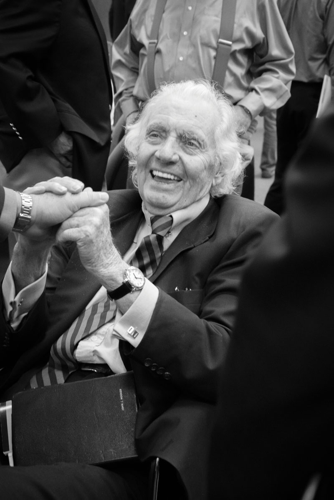
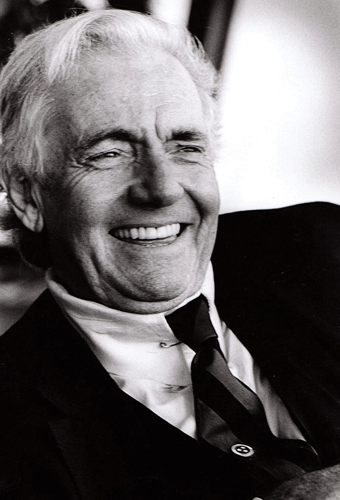

John Jay Hooker, June 2015
He aimed high, that must be said about him. John Jay Hooker, gone from this world at age 85, was a man of high principles and lofty ambitions. He stood tall, too — Abe Lincoln tall (almost), with a finely sculpted face, a prominent beak offset by a wide toothy smile and bushy eyebrows that lay like fuzzy caterpillars on his brow. His eyes, depending upon the mood, could offer the benign gaze of a beloved professor.
But on other, often very public occasions — as when arguing the need for election reform, or any of a half-dozen causes in need of a champion — those glaring eyes could prick the conscience like an ice pick.
He was a Nashvillian born of privilege who lost a fortune large enough to crush a less confident man. Yet he always found his way to new beginnings. He had legions of friends in high places all his adult life. Even those who disliked his politics admired his gumption, if nothing else.
But his era is over. The man who last summer unsuccessfully tried to convince judges that a dying man had the right to expire with dignity died Sunday in the natural way, surrounded by family.
A stubborn streak of political ambition kept him plunging forward, even though he never won a general election. In later years, he tossed his dapper hat into the fray just to make a point. He made these windmill tilts with a winning smile that might have led Hollywood to tell his story — absent a few complications.
John Jay Hooker Jr. was born in 1930, the oldest child of successful Nashville attorney John Jay Hooker Sr., whose drive and energy created one of the city's largest law firms at the time. The family lived in Belle Meade, well-connected and financially secure. He was a descendant of U.S. Constitution signer William Blount, appointed governor of the region by George Washington in 1790.
The son emulated his father, so it was no surprise that the young Hooker fancied a life in law. He loved to go to court and watch his dad light up the courtroom with his booming voice.
After graduating from Montgomery Bell Academy in 1948 and receiving an undergraduate degree from the University of the South, Sewanee, in 1952, he joined the Army, serving as an investigator for the Army Judge Advocate Corps. After two years, Hooker returned to Nashville to attend Vanderbilt University School of Law.
His class of 1957 produced a number of exceptional lawyers, including Watergate prosecutor Jim Neal and revered civil rights attorney George Barrett. By his own admission, though, Hooker was not a good student.
"I didn't like law school. It didn't interest me," he told the Scene in a 2002 story. "I was more interested in watching my dad try a lawsuit."
Hooker graduated at the bottom of his class, but it didn't matter. There was an opening awaiting him at his father's firm, Hooker, Keeble, Dotson and Harris. In a manner that would replicate itself many times throughout his career, however, an opportunity soon fell into John Jay's lap.
Early in 1958, he was loaned out as assistant to one of the city's finest attorneys, his father's close friend Jack Norman Sr., who was handling the legislature's prosecution of Chattanooga Judge Raulston Schoolfield. The jurist allegedly took $20,000 in bribes from labor unions.
The move to impeach the judge attracted the attention of Robert Kennedy, then attorney for a U.S. Senate committee exploring illegal union activities. Kennedy was invited to testify at the Nashville hearing. While the legislature's eventual impeachment of Schoolfield ended his days on the bench, Kennedy and Hooker developed a fast friendship.
The saga of how Hooker became a confidant of the Kennedy clan is preserved in an oral history stored in the John F. Kennedy Library, recorded in 1965 at Hooker's Nashville law office. Hooker explained he was given the job of taking the younger Kennedy to the airport after the hearing. But RFK, ever the history buff, asked for a quick detour to The Hermitage, Andrew Jackson's home. Kennedy told Hooker he planned to stay only 15 minutes.
"He then spent four hours going through the home," Hooker told the interviewer.
Rather than being put out, however, Hooker said he came away with admiration.
"Watching him go through the Hermitage for four hours left me with the feeling that I had met a young man who was going to be a part of the future of America," he said.
A few weeks later, Kennedy called to say he was returning to Middle Tennessee to buy a pony for his children. He asked if Hooker could put him and his wife Ethel up for the weekend, a request Hooker gladly obliged.
"We had a very pleasant 48 hours together, at the end of which I felt that I was his friend and that he was my friend," Hooker said.
In the summer of 1958, Hooker was invited to Hyannisport, Mass., for a weekend with the entire Kennedy clan, including then U.S. Sen. John Kennedy and his wife, Jackie. Hooker marveled at the closeness of the Kennedy clan, how they enjoyed each other's company, how John Kennedy conducted himself.
"I have the very positive feeling and said to my wife [the former Eugenia "Tish" Fort] that I was convinced that John F. Kennedy was going to be the president of the United States," Hooker remembered.
During the 1960 Democratic National Convention in Los Angeles, Hooker was brought in to help out. The morning after JFK received the nomination, Hooker stopped by to meet with Robert Kennedy. "Let's go up and see my brother," the younger Kennedy told him. They found the nominee in his bedroom suite sitting on the bed tying his shoes. Hooker and Robert Kennedy took a seat.
"[JFK] looked at me and he said, 'Who do you think ought to be vice president?' which was I guess the last question that I expected," said Hooker, affectionately nicknamed "Long John" by the future president. "I don't know whether he asked me for the purpose of getting my opinion or just for the purpose of seeing how I would react."
Hooker replied that U.S. Sen. Lyndon Johnson (D-Texas) or U.S. Sen. Stuart Symington (D-Missouri) would be reasonable choices.
"And that broad smile came across his face and he never responded to it nor asked me any further," Hooker recalled, "but I felt some sense of electricity with him, that we were communicating."
A month later, Hooker had taken a leave of absence from his practice and joined his good friend John Seigenthaler to work in the Kennedy for President campaign. For a time, the Nashville men bunked at Robert Kennedy's home in McLean, Va., Hooker said, and the three commuted to and from D.C. together.
After Robert Kennedy was named attorney general, Hooker was appointed special assistant, a post he stayed in from 1961 to 1963, when he returned to Nashville to continue his law practice and to prepare himself for his first run at public office, a gubernatorial bid. Unfortunately, the 1966 Democratic primary resulted in a tough loss to Buford Ellington, assisted by the scorched-earth opposition of the conservative Nashville Banner.
In his inimitable style, however, Hooker rebounded with a seemingly sound business proposal: a restaurant concept to rival KFC called Minnie Pearl Fried Chicken. Hundreds of franchises were sold, and the company's stock rose at a meteoric rate, topping near $50 a share. Hooker became a multimillionaire. As the 1970 gubernatorial election came into view, he was poised to step from a successful business venture to the governor's mansion — and from there, through the mist, he could see the White House.
He might have gotten there, too, had his fortunes not taken another of their roller-coaster plunges. The Securities and Exchange Commission launched a full-blown investigation into the quick ascent of Minnie Pearl Fried Chicken stock. Hooker would always maintain he had been sandbagged by the Nixon administration, leery of his political future and his outspoken opposition to the Vietnam War — a stand, like his vocal support for civil rights, that he took without regard for its popularity.
Whatever the case, the ensuing Minnie Pearl collapse derailed his campaign and hounded him for the rest of his days, an asterisk appended to everything he did. Although he won the Democratic primary, he lost to Memphis Republican Winfield Dunn, the first time in more than 50 years that the GOP held the governor's seat. Ironically, in the early 1970s the SEC concluded that the Minnie Pearl chain had violated no laws. But by that time the damage had been done to the company — and Hooker felt, to his character.
Hooker tried three more times for the governorship: 1998 (won the primary, lost to Don Sundquist), 2006 (lost the primary to Phil Bredesen) and 2014 (ran as an independent, lost to Bill Haslam). In 1976, he ran in the primary for the U.S. Senate and, for a time, was considered a frontrunner. In the end, Jim Sasser won the primary and the general election, holding the seat for 18 years. In 2006, Hooker ran for U.S. Senate while also running for governor. He lost both in the primary. Somewhere in there, he ran for a seat in the U.S. House, but lost there too.
From 1973 to 1983, he served in top positions in three ventures: president of engine-additive company STP; publisher of the now defunct Nashville Banner, his old archrival; and, finally, chairman of United Press International. None of those stints lasted long.
Over the past 15 years, Hooker spent much of his time filing lawsuits and promoting legislation that would halt contributions to judicial candidates by attorneys and ban donations from out-of-state donors in all state elections. In 2008, his law license was suspended for 30 days because many of his lawsuits were deemed frivolous.
His last battle was a personal one. Diagnosed with melanoma that had spread across his body, Hooker took up the death-with-dignity banner. He lobbied the legislature for a physician-assisted suicide bill. He went to court to have current law ruled unconstitutional, and when the judge refused, he appealed last fall to the Tennessee Supreme Court. They, too, denied him.
At word of his death Sunday morning, social media flooded with tributes: friends, admirers, former adversaries; pundits, loyalists, political rivals. Obituaries recalled his friendships with Muhammad Ali and Warren Beatty, his role in ventures ranging from the founding of health care giant Hospital Corporation of America to H. Ross Perot's independent presidential run in 1992.
And yet all his accomplishments and crusades, and accounts of his barnstorming life, will be haunted to some degree by what might have been.
Following the disastrous Bay of Pigs invasion in 1961, more than 1,000 CIA-trained Cuban exiles were captured by Castro's forces. Robert Kennedy assigned Hooker to a committee of four, including Eleanor Roosevelt, to facilitate a swap of tractors for the prisoners. The task was not easy. Committee members seldom agreed.
In the Kennedy Library recording, Hooker said that after nine weeks his phone rang one day at the Mayflower Hotel. He recalled hearing a woman's voice say: "Will you hold for the president?"
In a moment, President Kennedy came on the line.
"Well, Long John, how's it going?"
Not so good, Hooker replied. He laid out all the problems with the negotiations. The president reiterated how important it was to free the captives, how the task must be completed. But several weeks later, the negotiations broke down for good. No tractors; no captives. Hooker returned to Tennessee, and to the seemingly cloudless destiny that awaited.
A year later, however, a Chicago lawyer named James B. Donovan negotiated a deal: $53 million in food and medicine for 1,113 Cuban captives. Earlier, in 1962, Donovan had negotiated the handover of a convicted Russian spy for American pilot Francis Gary Powers, whose plane was shot down on a recon mission over the Soviet Union.
That story became Steven Spielberg's current Oscar-nominated film Bridge of Spies, with Tom Hanks playing Donovan. But had history shifted another way, one can easily imagine a scenario involving another unlikely hero: a charismatic, stubbornly principled Tennessean who saves the day in Cuba. He goes on to shepherd campaign finance reform to reality, gets elected governor (or U.S. senator, or congressman, or something), then successfully nudges the state legislature for terminally ill men or women to die on their own terms.
Had any of that happened, we are left to wonder if Tom Hanks would be right for the role.



Post a comment as anonymous
Report
Watch this discussion.
(0) comments
Welcome to the discussion.
Log In
Welcome to the discussion.
Keep it clean. Please avoid obscene, vulgar, lewd, racist or otherwise abusive language. Comments featuring hate speech or threatening or violent content will not be tolerated.
PLEASE TURN OFF YOUR CAPS LOCK.
Be truthful. Don't knowingly lie or mislead.
Be proactive. Use the “report” link on any comment that violates our comment policy.
Share with us. We'd love to hear your feedback.