
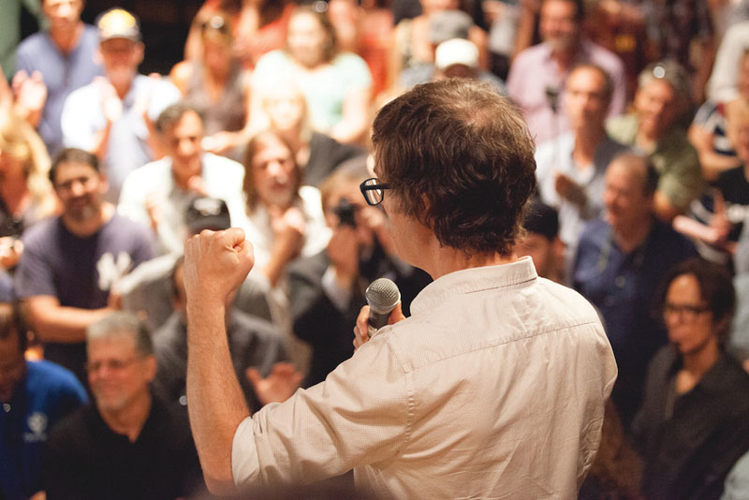
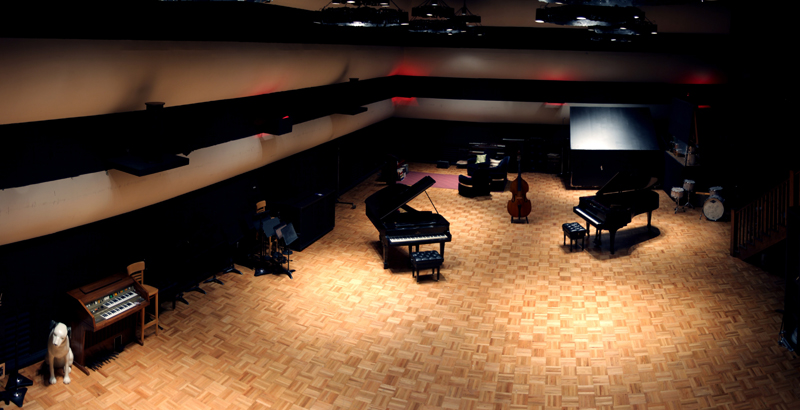

Ben Folds dropped the MIC, so to speak, at a rally Monday morning inside RCA Studio A — the historic Music Row studio he's rented and operated for 12 years.
Astoundingly, a few hundred musicians and industry types showed up awake and alert at 9 a.m. as Folds and friends announced the foundation of the Music Industry Coalition (MIC) — a leaderless nonprofit neighborhood association dedicated to "the preservation and development of the Nashville Music Row community."
"Thanks for being a part of staving off the demolition of this place," singer, songwriter and bandleader Folds told a shoulder-to-shoulder crowd of supporters — including the likes of Deana Carter and Bonnie Bramlett — standing in the space where giants like Dolly Parton and Jimmy Dean and newer favorites like Kacey Musgraves cut recordings.
The fate of 30 Music Square West may be safe for now, somewhat settling a nationwide outcry that erupted last week over the potential loss of the studio within. But the controversy over whether Music Row needs an historic overlay to protect the sites of Nashville's recording history — and indeed, whether those sites are worth protecting — is rising in volume.
It began last week when Folds posted an open letter to the city of Nashville. "Last week, on the day that would have been Chet Atkins' 90th birthday (June 20, 1924), my office received news that the historic RCA Building on Music Row is likely to be sold," he wrote. "This building, with the historic Studio A as its centerpiece, was Atkins' and Owen Bradley's vision and baby, and had become home to the largest classic recording space in Nashville."
Admitting that he'd "like to remain the tenant and caretaker of this amazing studio space," Folds delivered an impassioned plea to the supposed next owner of the property — Brentwood condo developer Tim Reynolds and his Bravo Development LLC — "to take a moment to stand in silence between the grand walls of RCA Studio A and feel the history and the echoes of the Nashville that changed the world."
"I don't know what impact my words here will have on anything," Folds wrote. "But I felt the need to share, and to encourage others who also care about preserving our music heritage to speak up as well."
They did, by the thousands. Folds' letter was printed on the Scene's music blog Nashville Cream and broadcast across the country by bloggers and music writers. In its wake, a "Save Nashville's RCA Studio A and Music Row" petition directed at Mayor Karl Dean and posted on Change.org had garnered, at press time, more than 1,300 signatures.
Those who signed it evidently worried that Studio A might meet the same fate as unofficial Music City landmarks like the 135-year-old Pilcher-Hamilton House, which was recently demolished for a multi-million-dollar Virgin Hotel on the Music Row Roundabout. Or the McGavock Street building that once housed the RCA studio where Elvis Presley cut "Heartbreak Hotel," razed in 2006. Or the Hillsboro Village building that housed Bradley Studio, where Kitty Wells cut "It Wasn't God Who Made Honky Tonk Angels" in 1952, which was leveled earlier this year. Or the former home of Combine Music, which fell to the wrecking ball just two weeks ago.
In a conversation on Friday, Reynolds rendered moot some of those worries about Studio A, saying he had always intended to preserve the space. "It is going to be an engineering feat," he said. "But if it can't be done, I would certainly withdraw my contract, because it has always been our intention to incorporate [Studio A] somehow in our design."
But the letter galvanized a greater Music Row preservation movement on social media. By Monday, Folds was encouraging supporters to expand their concerns and shift the #SaveStudioA hashtag to #SaveMusicRow.
"When you guys need me to get the word out ... we've got some momentum now," Folds proclaimed at the rally.
One faction remained conspicuously silent, however: the estates of the late Music Row titans Owen Bradley and Chet Atkins, which own the property. That silence broke Tuesday night, when Harold Bradley — Owen's brother, and said to be the world's most recorded session guitarist — sent his own letter to the Metro Council and Metro's director of planning, zoning and development.
Titled "Fact v. Fiction," it outlines the steps that led the Bradley brothers to open the fabled Quonset Hut studio that gave birth to Nashville's modern recording industry. That studio, Bradley writes, is the one that made history. Studio A, he argues, was "an inducement to keep the music group in Nashville."
"The Bradley-Atkins play worked: RCA rented the 30 Music Square West offices and studio for 25 years," the Country Music Hall of Famer writes. "Nostalgia wasn't a factor. This was business. When Chet Atkins and Owen and Harold Bradley built 30 Music Square West, Owen said, 'One day we might not have anything, but if we buy this property and build this office building, we can at least have something to sell.' It was an investment in their futures."
Expressing some surprise at the controversy — he mentions that he has been trying to sell the building for 24 years, something the property manager conveyed over the nearly 50 times that Folds re-signed his 90-day lease — Bradley cuts to the heart of the debate in a central paragraph:
"What makes a place historic? The architecture of the Nashville sound was never of brick and mortar. Certainly, there are old studio spaces that, in our imaginations, ring with sonic magic; but in truth, it's not the room; it's the music."
Nevertheless, the movement has clearly struck a nerve, given Nashville's tendency in recent decades to raze its irretrievable past.
"I think right now people are tired of seeing things that mean something, that motivate or inspire, torn down," Folds tells the Scene. "I think that's part of it. I think people all across the country are sick of that. In Nashville I think it's more of a survival concern. I really believe that the community in general are thinking, 'Oh, shit, we're Music City. We're built on this infrastructure and these ideas. And we're now coming to a turning point where they're taking the heart out of it.' You're going to see a lot of people mobilized about this that have a lot at stake in it."
"We'll do everything we can to support this cause — [it's] critical," Nashville Convention and Visitors Corp. president Butch Spyridon told the Scene at the rally. "Promoting things that are gone doesn't work from my end of things.
"I think we as a city need to engage Metropolitan Development and Housing Agency, and the Historic Commission, and the mayor's office, and the planning commission."
On that front, Tim Walker, executive director of the Nashville Historical Commission, explains how MIC can go about permanently protecting Studio A and other Music Row landmarks.
"Because the building is eligible — and it's because of the studio the building is eligible for listing in the National Register of Historic Places — then it could be landmarked through the Historic Zoning Commission [as] a historic landmark district, and that would protect it from demolition," Walker says. "And I would say you could probably just landmark the studio portion, which is only 40 percent of the building. ... That would be a way to protect it and some other key studios on Music Row that have that status."
Walker says none of Nashville's still-standing historic studios have official landmark status, which would protect them from demolition, though RCA Studio B (which Belmont University's Mike Curb College of Entertainment and Music Business operates with the Country Music Hall of Fame) is listed on the national register. (Mike Curb purchased the Quonset Hut for preservation in 2006.) A handful of others — like Jack's Tracks, which Garth Brooks bought in 2010 and re-christened Allentown, after his longtime producer Allen Reynolds — are likely eligible for the register.
Even though those aforementioned studios aren't designated landmarks yet, they aren't in danger of demolition. That's because the people who own them intend to preserve them.
"Many of them are protected, even though they're not historic overlays, because they have owners who think the institutions, the buildings and what they mean to our cultural history are very important." Walker says. But the process of obtaining landmark status starts with the property owner, not a renter like Ben Folds.
"It generally takes property-owner support," Walker explains. "The councilperson will have to file the bill to designate it; it'll have to go to the Historic Zoning Commission and the planning commission for a recommendation, then to council to approve. So it would make it very difficult if the [property] owner wasn't in support of it, but it's not impossible."
Folds admits he never took a business-savvy approach to running Studio A, because the reality of "It City" Nashville is so far removed from the city's red-headed-stepchild standing circa 2002 when he started renting.
"The grand ol' studio was just sitting there wide-open with the breeze blowing through," he says. "I took it over never knowing if I'd have it for more than three months. The only reason that it's still there is because no one offered any money for the near 15 years I've been there. No one ever wanted to buy it, because who cares. Now all of the sudden Nashville's hot stuff compared to the rest of the country, and a lot of people — these developers — they need to dump a lot of money quickly into something. ... That's one of the reasons why I think the community needs to really get savvy."
In response to questions about why he hadn't purchased the building himself, Folds wrote Wednesday on Facebook, "The owners' asking price has been $4.4 million for the whole property (it's valued by local govt at $2.4 million) not to be divided. The studio comprises nearly half the building which comprises about one fifth of the footprint of the property. I'm a touring recording artist and not a developer or real estate mogul. Four-million-plus clams is well out of my range."
In his letter, Harold Bradley is adamant that a historic overlay is not the best way to protect Music Row's history, or its future.
"An overlay for the entire area would be a downzoning of the worst order, diminishing value almost immediately, and potentially stymieing future creative endeavors," Bradley writes. "Such restrictions would likely prevent two brothers from slapping a Quonset hut on an old house and trying something new.
"Music City isn't about making a perfect room, or hanging just the right baffling. Turns out, the architecture of Nashville's evolving sound is a synergy of creative energy. That's still here, and it has nothing to do with this building."
Email editor@nashvillescene.com.



Post a comment as anonymous
Report
Watch this discussion.
(0) comments
Welcome to the discussion.
Log In
Welcome to the discussion.
Keep it clean. Please avoid obscene, vulgar, lewd, racist or otherwise abusive language. Comments featuring hate speech or threatening or violent content will not be tolerated.
PLEASE TURN OFF YOUR CAPS LOCK.
Be truthful. Don't knowingly lie or mislead.
Be proactive. Use the “report” link on any comment that violates our comment policy.
Share with us. We'd love to hear your feedback.