


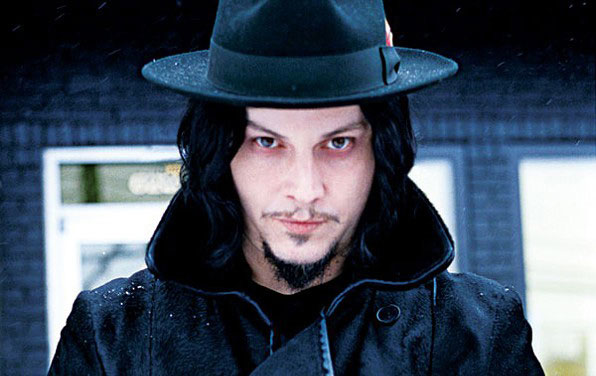
Jack White in front of Third Man Records
It's an October night in Music City, a Friday, in a gritty industrial no-man's-land between downtown and The Gulch. Two years ago, nobody but street people and strip-club habitués would have been found down here after dark. Tonight, though, outside a black brick building beside the railroad tracks, a line of eager music fans wraps around the block.
The occasion is the Next Big Nashville festival. It's an annual plea for the music world to see Nashville as it sees itself — a buzzing hive for everything from jazz to gospel to classical, but especially a rock scene that's been primed for two decades to pop. It's barely 9 p.m., but for most in the serpentine queue, hopes of making it inside the mysterious building with the Tesla tower on top are futile. Already the room is at capacity.
Midway though a raucous set, local garage-punk quartet Heavy Cream bash away before a frenzied crowd of any and all ages. Bathed in blue, the band can be seen above the undulating human underbrush, all pumping fists and airborne elixirs. The excitement, the energy — they're palpable. Is this really Nashville?
Indeed, if the major-label hitmen and local paparazzi shut outside could peek within the curved blue walls, they'd see a city they might not recognize. In here, Music City is ahead of the musical curve, not chasing it. Here, buzzed-about acts travel hundreds, even thousands of miles to play, instead of driving past en route to other tour dates.
In a dark corner, taking in this view from the shadows, is a man clad head-to-toe in black. He is international rock superstar, guitar god and Nashville transplant Jack White, and this epicenter of cool, Third Man Records, is his house.
In it, no detail appears without purpose, as if art-directed to a photo-shoot T. And every artifact, from the photo booth in the corner, to the logo behind the stage, to the red sparkle-wrapped drum-kit with peppermint painted skins — familiar to anyone who's ever seen a White Stripes video — bears the fingerprints of White's seeming Midas touch.
"People always look at the finished product and they assume it was written down on paper beforehand," White tells the Scene one afternoon, long after the crowds are gone and the blue lights dimmed. "The funniest thing is, the bands, and the building, and these records, they're all the exact opposite — they're all just happenstance."
Still, for anyone venturing into this room for the first time, it all just looks too perfect. In a sense, it is. Local rockers hoped White's cachet of cool would galvanize the scene when he planted roots here four years ago — even if they feared he'd overshadow them.
But past experience made the acclaimed rocker slow to impose his identity and curatorial savvy upon a music city so steeped in its own traditions. From The White Stripes' early success in Detroit's happening garage-rock scene of the 1990s, and the resentment it fostered, White knew the pitfalls of local rock politics and pissing contests. By the time he left, bands he'd helped get national attention tried to get even more by slagging him publicly and milking confrontations for coverage.
"I tread lightly on the scene in Nashville because I don't wanna infiltrate it and be too involved in it," he says. "I got really burned in Detroit, being heavily involved in the scene up there, so it's a little bit scary. I have some trepidation about it. I don't wanna cause any problems" — he laughs — "you know? I don't wanna interrupt the flow of what's naturally happening with [Nashville] bands either."
So instead of painting the town a White Stripes red and white, he settled for black and yellow (and white). He recruited a tight group of close confidants to start up Third Man — a boutique record label, store, production and distribution center, photo studio, and live music venue. Each show is recorded, and most are released as live albums — souvenirs of an experience, not a concert.
In so doing, Third Man Records has produced one of the most counterintuitive, and inspiring, business models the music industry has seen since the extinction-level advent of digital. Its releases are primarily vinyl. Promotion and marketing costs are almost nil. Above all, its artist roster is driven by personal taste.
And yet Third Man has become something of an indie-rock tourist destination — a magnet that attracts collectors, early adopters and vinyl junkies, as well as the attention of typically indifferent-to-Nashville media. Its headquarters acts as a veritable Chocolate Factory to White's Willy Wonka. And there's almost as much curiosity, and misconception, about what goes on inside.
People know Third Man is a store, but what does it sell? They know Conan played there, but who could get in? They've heard there's a recording studio inside. There isn't. Why do they wear matching suits? Because they feel like it.
True, the place is a monument to Jack White's musical accomplishments. But the dirty secret behind Third Man is that it's not a vanity project. You don't have to be a fan of White's to find records there you'd like but have never heard. And for those of you who are fans of White's, well, there's Mastercard.
It also helps if you own a record player. If not, they sell those too — in addition to headphones, and any other item that accompanies onset audiophilia.
Third Man's slogan, "Your Turntable Is Not Dead," applies to both the products they sell and the experience they provide. In this day of featureless digital downloads — the boneless skinless chicken breast of the music industry — White is the rare post-Napster artist who's a celebrity even to people who don't follow music closely.
Accordingly, the label's focus is on the tangible. While the rest of the music business struggles to keep up with ringtones and apps, Third Man is doing the opposite — investing in, and capitalizing on, the visceral appreciation of collectible vinyl artifacts, as if records were baseball cards or comic books. And just as the card collector gets little intrinsic payoff from a JPEG of Mickey Mantle, significant numbers of Jack White's fans get little from an MP3.
"I think the labels are just as confused as the fans are — confused by how many formats, and how many different types of experiences are thrown at them just from the Internet alone," says White, who describes his business and his aims in quick, disarmingly conversational terms. "[With] this place, we start with something real, and tangible, and things that you can only get and experience if you got up off your seat and went and did it.
"It's kids getting real records in their hands and listening to them, and starting a whole new trek down some other path that's not digital, not invisible, not disposable. It's about appreciating real experiences, and real objects, and art that can be appreciated, listened to, and loved."
Step inside the tiny storefront, and you'll see what's essentially a glorified merch-table display. Tour souvenirs and framed photos give a cursory history lesson of White's successes. Yellow tinted windows cast a golden glow throughout the shop, resonating off the yellow and black wood paneling, gold tin roof and black floor.
This space may be about 400 square feet, but it houses a carnival of antiquity. The store is decorated in eye-catching trinkets and gadgets: button dispensers, a wooden phone booth, stuffed birds, shrunken heads, vintage Victrolas, a coin-operated automated monkey band. Perhaps the last thing you notice is the lone record rack to your right.
Yet its seemingly modest selection of records — remember them? — is where Jack White's heart lies. Dig through and you'll find a treasure trove of releases you'd be hard pressed to find aggregated at any other record store. LPs and 45s span artists as wide-ranging as Flat Duo Jets founder Dex Romweber, rockabilly pioneer Wanda Jackson, Swedish psychedelic outfit Dungen, even the late astronomer Carl Sagan.
Each is produced and overseen by White and manufactured in house. And each is a testament to the fastidious, hands-on presentation for which he is known.
On the opposite side of the building is its anchor, known as "The Blue Room." Originally intended as a joint rehearsal space/photo-studio — complete with adjoining darkroom — it has evolved into Nashville's latest concert venue, accommodating an audience of 300 or more.
But the performances you're likely to see there are unlike any you'll see at clubs in this city or any other. Like when White flew legendary Japanese garage-rock trio The 5.6.7.8's around the world to Nashville for a one-off gig, then got up and jammed with them. Or when he tapped Elvira, Mistress of the Dark, to host the label's Halloween shindig.
Or, yes, when Conan O'Brien stopped in for a performance last year on his way to Bonnaroo — an experience Coco described on the premiere episode of his TBS show (with White as a guest) as "one of the highlights of my tour, and my life."
All the shows in The Blue Room are recorded, and most are released (even Conan's). It's the only venue in the world where concerts can be recorded live direct to analog tape. That includes lesser-known artists like comedian Reggie Watts and locals like PUJOL.
Since opening in March 2009, Third Man now has an impressive 74 titles. Two weeks ago, the label released JEFF the Brotherhood's Live at Third Man, and on Tuesday they'll put out Wanda Jackson's The Party Ain't Over — an album White produced and performed on with the rockabilly queen and Rock and Roll Hall of Fame inductee.
If you ask White, he'll say he's not trying to make over Nashville's street cred or give the town's artists a ride on his long coattails. But as Third Man's fame spreads, it's getting harder and harder to tell. After all, it's happenstance. So how did Nashville end up holding the golden ticket?
"I wanted to live down South when I was trying to leave Detroit," says White, who was looking for somewhere to explore his bone-deep affinity for Southern music and folklore. "I just looked everywhere — Mississippi, South Carolina, Kentucky — and I kept finding myself working in Nashville for reasons out of my control.
"And it sort of just hit me over the head, 'There's a reason I keep coming here.' At first it was Tennessee: I thought, 'Memphis.' But Memphis is too similar to Detroit."
[page]
Detroit's the reason White is cautious about casting his shadow over Music City. In Detroit, he was recording and championing bands long before he reached the highest echelons of rock stardom as singer, guitarist and songwriter for The White Stripes (and later as a member of The Raconteurs and The Dead Weather). But his rise above the fray rankled many in the Motor City.
"[Jack's] relationship with Detroit will always be peculiar," says Ben Blackwell, White's nephew and a Third Man fixture. "Not a lot of people can point to someone that they hung out with, that was doing pretty much the same thing they were doing, and turned around and made millions of dollars doing it. They say, 'What's so special about that guy?'
"Well, you know what? He wrote really great songs and he worked really fucking hard. And maybe you did too. And maybe you didn't."
Perhaps no one knows better than Blackwell how John Anthony Gillis became Jack White. In the band's first three years, he saw every show The White Stripes played, and he has long acted as their archivist. Independent of his uncle's celebrity, he's a Detroit luminary in his own right.
Blackwell, 28, spent his adolescence steeped in Motor City's legendary garage-rock scene of the '90s. By 17 he'd begun drumming for the Stripes' electrifying peers The Dirtbombs, and he went on to found Detroit's Cass Records. But before this fresh-faced, dry jokester could rattle off music-production factoids faster than Rain Man counts cards, he was a 15-year-old enamored of his young uncle's upstart rock combo. He'd meticulously file away each show's handwritten setlist — artifacts that obsessive White Stripes fans covet more than a white-label pressing of The Freewheelin' Bob Dylan.
"At the time, I was just excited, you know, making my annotations and writing lists and all that stuff," Blackwell recalls. "And then three or four years later it becomes one of those things, like, 'Oh, this is actually, probably gonna be important.' Like you could see it happening in front of you."
Such foresight inspired him to ask for a fireproof safe one year as a Christmas present. It turned out to be a wise move. When a fire struck his mom's house two years later, the priceless fliers, handwritten lyrics and setlists stayed secure. They survive as proof of the hustle White honed early on, which would come in handy by the time he got to Third Man.
"It was five years until people really started to pay attention to them, and that was five years of touring in a Ford Taurus," Blackwell remembers. "It was Jack and [drummer] Meg [White] up front, and me in the back with my arm on the bass drum, driving to Cleveland on a Friday night for a show and then driving back after the gig. I've never seen a band do as little after-show partying and hanging out as The White Stripes. Where Third Man's at now is a testament to that dedication."
As Blackwell rode shotgun on White's meteoric rise to fame, he says, there were always moments where they'd say to each other, "It's never gonna get bigger than this." The most specific, he recalls, was when The White Stripes played The Craig Kilborn Show in 2001.
"I remember us just thinking, 'A two-piece band from Detroit made it onto late-night television,' " Blackwell says. " 'This is it, it'll never get bigger than this.' "
But while White may have never anticipated highs of success such as, say, playing for Sir Paul McCartney and President Barack Obama at The White House — as happened last year — he wasn't without an insurance policy. When inking his major-label deal with V2 Records in 2001, he established Third Man Records, a self-owned label licensing his masters to V2.
For years Third Man remained mostly exclusive to White's projects, existing in name only. In 2007, however, not long after he planted roots in Nashville, V2 collapsed. White's insurance policy paid off. He gained full control of his masters.
Unsatisfied with the original vinyl pressings of his White Stripes and Raconteurs records, White seized the opportunity to retouch and reissue them under his total control. To assist in the endeavor, he called upon Blackwell and longtime friend Ben Swank, a jack-of-all-trades whose background includes label promotion, music journalism and a stint as drummer in The Soledad Brothers. At the same time, White had grown tired of paying rent on storage spaces. He reveled in the opportunity to design his east of Eden — his Graceland, if you will.
"I'd never had the time to take courses in design or architecture like I'd wanted to when I was younger," White says. "So places like this, constructing them, I finally get to expand on the design fascinations I had when I was younger and I had my upholstery shop [also called Third Man]."
In March 2009, the label celebrated its private grand opening with a debut performance by White's latest project, The Dead Weather. Nearly a year would elapse before another audience would pass through the back doors to The Blue Room.
Third Man was open for business, but the establishment was, and is, largely a mystery to most Nashvillians. In terms of the label's mystique — and White's — Swank says, "We cultivate it to a degree, but I think people think it's worse than it is." He laughs. "I've had people tell me we're in a cult."
Really, he says, the mystery is no greater than quality control. "I think Jack's misunderstood a lot because people are like, 'Oh, he doesn't like computers. He doesn't like this, or that,' " Swank says. "No. I think he doesn't like having his art misrepresented."
To press their vinyl, Third Man looks no further than their own backyard, using United Record Pressing Inc. — a Nashville institution that dates back more than a half-century. The plant is a whopping 1.3 miles from Third Man's doorstep, a drive Ben Blackwell makes on a daily basis. He's such a fixture at the plant, he even moonlights as a tour guide.
The proximity of the plant cuts down dramatically on shipping costs. Plus it fits Third Man's neighborly attitude. As Blackwell says, "If you have something in your hometown, use it." In Third Man's first 18 months, the plant has pressed more than 200,000 pieces of vinyl for the label — more than half of which have been sold. Almost each label bears the branding, "Manufactured by United Record Pressing, Nashville, TN."
"That's one of the secret weapons of Third Man, that we're in a city that isn't crazy expensive like L.A. or New York, but has that infrastructure," Blackwell says, showing a guest through the factory while its odd-metered mechanical clamor rattles the walls like a T. Rex.
As for Third Man's catalog, Blackwell says, instead of "Your Turntable Is Not Dead," the label's catchphrase could just as easily be, "Recommended if you like Jack White." While the Third Man crew are democratic in their decision-making, the last word on everything is White's. And like the collectors who bend over backwards to get the next release, he's racing to get it out.
"He could just sit and let 'Seven Nation Army' pay his bills for the rest of his life," says Blackwell, "[but] the guy does not stop working. It's constantly the rest of the staff trying to keep up with him."
As White guides the Scene through the Third Man offices, while The Cold War Kids sound-check for their show later that night — a sellout despite the late December snowstorm outside — he walks and talks at the pace of a shark who must keep moving, and he can taste the blood of each finished product. Despite his success, he moves like a hungry man.
In an age when it's a Dostoevskian struggle to sell a single iTunes download, labels froth at the idea of selling more than 100,000 physical copies of anything, let alone a vinyl record. But they don't have what Third Man has — brand loyalty. When someone in the industry murmurs the mantra, "You have to brand your artist," they might at as well just say, "Do a magic trick and pull Jack White out of a hat."
But you can't create lightning in a bottle, which is the beauty as well as the limitation of the Third Man model. Third Man has succeeded in large part because White — like multimedia mogul Jay-Z, who reportedly stopped by Third Man's offices for a summit meeting — has tended his fame and image with the care of a Japanese garden. That care frees his creative endeavors, shielding their vital spark of ramshackle spontaneity.
"If you don't stand for something to begin with, you can't be branded," says White, "It has to come from what you love to do, first and foremost. I happen to care about the design of covers, and the design of the presentation, the aesthetic, the lighting onstage ... [But] I would never put anything out that looks cool just because it looks cool, or sounds cool just because it [sounds cool]."
[page]
Third Man's success is a testament to the rabid interest of a worldwide fan base, which counts the days till each Third Man release and lineup. Many even travel from outside the city to be one of the lucky 300 to get a split-colored Jenny & Johnny LP, or a tri-colored Dead Weather 45. And even more limited items, like Third Man's split-colored White Stripes reissues, are proportionally more coveted.
Some fans are driven by completism. Some are driven by their desire to hear what new — and old — sounds come out of their speakers when they spin the records. Still others are just trying to get something they can flip on eBay — where, at press time, Third Man merchandise is listed at prices as high as $1,599. That's one reason the label made the controversial decision to post some of its releases on eBay itself. The move infuriated some fans, who accused the label in December of jacking up prices by deliberately pressing limited quantities. But Swank says they're committed to getting the records into the hands of those who will cherish them. For fans, the records are their window onto Jack White's world: their way of touching what he touched, hearing what he heard — or just hearing a show they heard themselves.
"If some kid in Topeka wants to buy it, we'll make sure he can," Swank says. "We want people to be able to buy these records. ... The collectors stuff is harder to get, but that's kind of the joy of collecting. Honestly, I don't think any other label worries as much where their records go once they leave the door as we do."
As proof, he cites their practice of distributing limited-edition copies of a release to independent record stores in the artist's hometown. While doing so drastically reduces the profit margin, Swank says it's part of the label's greater mission to get people in those towns "back into brick-and-mortar record stores, buying records from real people."
Would real people buy those records, or see Third Man's shows, if they didn't come with the Jack White stamp of approval? In some cases, probably not. But White's fans, sometimes entire families, will make hours-long treks to any show that bears his imprimatur. Their devotion gives Third Man shows a singular energy. Visitors take to every performance the way the hordes at Bonnaroo greeted The Dead Weather. It doesn't hurt, Swank adds, that most Third Man regulars have at least one story of meeting White.
Not that all of them want that. Die-hard Third Man fan and collector Peter Galloway, a 48-year-old Irishman based in Los Angeles, thinks close contact might spoil the illusion of what he really cares about: the music. But whenever his business consulting brings him to Nashville, he says he plans his trips around special releases and events in The Blue Room. He credits Third Man with rekindling his lifelong interest in collecting records.
"I'm back flicking racks at Grimey's," Galloway says. "I probably wouldn't have tripped into the whole Nashville scene if I hadn't been experimenting through the Third Man channels." Galloway estimates he owns "a couple hundred" records from artists exposed to him essentially via Jack White, including locals such as PUJOL and JEFF the Brotherhood.
Asked if he considers himself a tastemaker, White claims, "If I am, it's by proxy." But for fans like Galloway, that's exactly what he is. For him, Jack White has filled the void left by rock's supreme arbiter of taste: the late BBC disc jockey John Peel, who was among The White Stripes' ardent early champions.
"My window into the world was John Peel," Galloway says. "And it was until he died. That was where you heard pretty much anything worth hearing — including The White Stripes. So when Third Man came along, and knowing what Jack's tastes were, and bands around that scene, I said, 'I've gotta check this place out,' and the rest is history."
Nineteen-year-old Dillon Watson of Murfreesboro can relate. For him, Jack White was his gateway artist to a life-changing musical continuum.
"I got into The White Stripes when I was 12, then I got into pre-war blues," Watson says. Country from the '50s and '60s would follow, then rockabilly, then garage-rock and onward. When a high school job shadowing assignment turned into an internship last year, he jumped at the chance.
Being near Swank and Blackwell, Watson says, gave him access to their music-distribution knowledge. That was a priceless resource: Not only has Watson played guitar in local bands such as Kindergarten Circus and D. Watusi, he helps run the local label Nashville's Dead, an offshoot of co-founder Ben Todd's popular blog of the same name.
But Swank, White and Third Man got something in return: a pipeline to kids doing something similar on an even smaller grass-roots level, building a scene and a cottage industry by following their tastes. Watson and Todd act as curators of Nashville's rock underground just as surely as the Third Man crew surveys and filters the outside world.
"They're not just young punks saying, 'Screw you, old man,' " Swank says. "They're really eager young guys that really have their own strong brand as well, and they're eager to learn from what we're doing. A point came where it was like, things are actually kind of happening with this sort of music in town, and it would be silly to ignore each other."
Taking on the role of de facto A&R man, Swank was eager to bring bands in the scene to White's attention — especially Daniel Pujol. But there was a slight problem.
"I can't take Jack to Glenn Danzig's House," Swank laments, referring to the scruffy house venue that's become a magnet for hot Nashville bands. For White, one of fame's costs is he can no longer see shows without taking the spotlight off the stage.
"You can't check somebody out because immediately it's an endorsement: You 'love the band,' even though you've never even seen them before," White says ruefully. "Then there's the aspect that everyone's got a camera in their pocket, and you've got flashing. I don't wanna do anything that's rude, that's distracting to the person onstage."
So instead of going to house shows, White built a house and brought the shows to him.
"I think at the first couple shows we did people felt like they were in an art museum or something," White says. " It was very quiet between songs. They were worried because it was being recorded. But now, that's all gone. It's rowdy; and electric. When JEFF the Brotherhood played here, it was incredible."
The Nashville rock scene has spent years waiting for something different to happen — something idiosyncratic, something no other city does or could have. In Third Man Records, it has that thing: a curatorial institution with enough star power to generate headlines, while focusing attention on local, national and international acts of genuine distinction — raising them all in estimation in each other's company. Jack White says he finds the Nashville's Dead kids as much of an inspiration as they find him.
"If you don't have that electricity and energy to begin with, it's harder to get to someplace new, someplace that musicians haven't gone to before," he says. "It's a wild abandon inside them. I can see that it's inside of those guys, and it's just gonna keep snowballing."
Outside, it's gray and wintry near the gaping hole of the convention-center site. Inside Third Man Records, Jack White talks as if enthusiasm alone could change the season to summer.
"Out loud, we don't say, 'When I go to the show tonight, I want something to catch fire, I want something gettin' knocked over, I want a new song I've never heard before that I want listen to 50 times this week,' " White says. "But that's really what we want once the lights go down and the show starts. We wanna see something happen. So I gravitate to those people who wanna make something happen."
Email editor@nashvillescene.com.
Read the complete interview with Jack White at Nashville Cream



Post a comment as anonymous
Report
Watch this discussion.
(0) comments
Welcome to the discussion.
Log In
Welcome to the discussion.
Keep it clean. Please avoid obscene, vulgar, lewd, racist or otherwise abusive language. Comments featuring hate speech or threatening or violent content will not be tolerated.
PLEASE TURN OFF YOUR CAPS LOCK.
Be truthful. Don't knowingly lie or mislead.
Be proactive. Use the “report” link on any comment that violates our comment policy.
Share with us. We'd love to hear your feedback.