
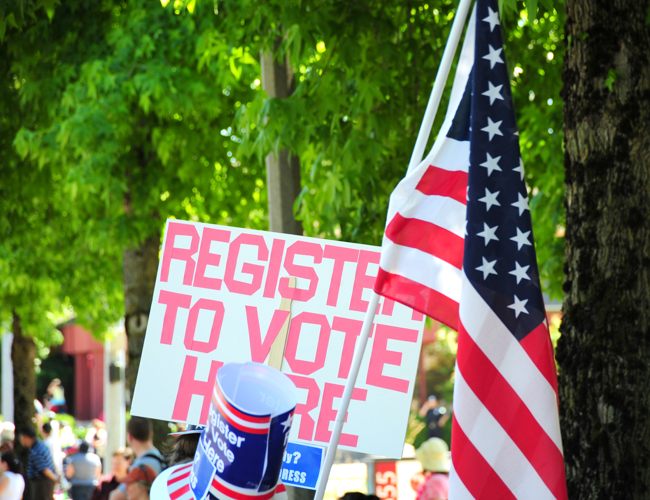
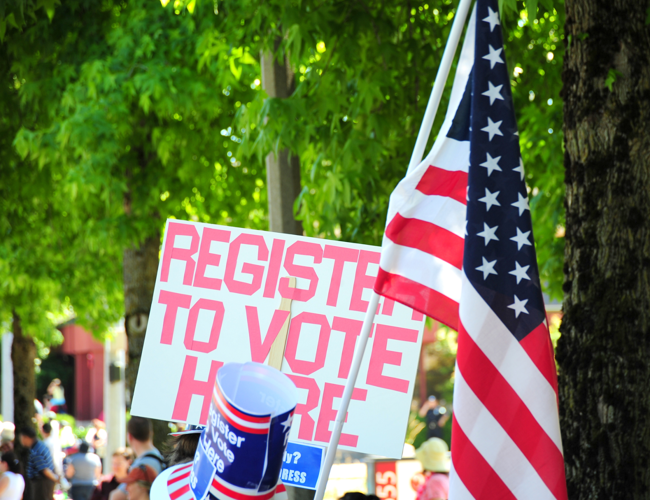


Democracy is government by those who show up.
That sentiment is pithy, Pollyannaish and prosy, perhaps, and political scientists would no doubt deconstruct those eight words into oblivion. But in a majoritarian system — particularly in a stubbornly binary one like what we have in the United States — the side that turns out its supporters, naturally, is going to win.
And before they turn up, those supporters must be registered to vote. If we have a system that favors those who show up, we have a structure that’s, for better or worse, government by paperwork — and turning out supporters is meaningless if those supporters aren’t registered to vote.
Much to the chagrin of Tennessee Secretary of State Tre Hargett — now with a decade at the helm of the state’s bureaucratic fleet — our state currently ranks at or near the bottom of nearly every metric of voter participation and registration. According to the Pew Charitable Trust’s Election Performance Index, Tennessee is 49th in voter turnout and 45th in registration.
“We open the restaurant and we prepare the dinner, but we can’t make people eat,” Hargett is fond of saying.
It’s easy to argue Tennessee isn’t making it as easy for people to sit down to the great civic meal as it could, though. Tennessee’s motor-voter program is one of the least proactive in the country. The Department of Safety does make registration forms available for people applying for or renewing their driver’s licenses, though often that means a stack of papers alongside the scores of others. Tennessee does have online voter registration, but it was the 37th state to implement the program, back in 2017.
Then there’s the new law that allows the state to charge voter registration groups with misdemeanors and levy penalties of up to $10,000 for various registration violations. Those violations include paying workers based on quotas, failing to complete mandated training and submitting incomplete registration forms. Hargett asked for the bill after realizing that many of the 10,000 new registrations made by the Tennessee Black Voters Project in the Memphis area were submitted at the registration deadline and were incomplete.
The bill came under almost immediate criticism from the NAACP, the American Civil Liberties Union, Rep. Jim Cooper and various voting-rights groups, including nonpartisan organizations like the League of Women Voters. After Gov. Bill Lee signed the bill into law, two federal lawsuits were filed challenging the law as unconstitutionally overbroad and vague and seeking to enjoin its enforcement. Earlier this month, the state filed motions to dismiss the suits on procedural and standing grounds.
Turnout for the 2016 presidential election was 62 percent statewide and 66 percent in Metro (those numbers line up with the national average). If Tennessee and Davidson County struggle to turn out voters for the high-profile elections, things really take a turn when it comes to local elections. That’s not unusual. One of the great paradoxes of voting is that even though local government has a far greater impact on people’s day-to-day lives, far more people show up to vote in federal elections.
But Nashville’s apathy toward local government is almost surreal. More people voted in the 1971 mayoral election than did in the 2015 mayoral election. Not just at a higher rate, but in raw numbers — 6,000 more people voted in the election giving Beverly Briley a second term (Briley defeated school-busing opponent and political newcomer Casey Jenkins in a runoff) than did in the crowded 2015 race that gave the city its first female mayor. And that’s despite Davidson County growing by 206,000 people in that 44-year period.
Bizarrely, voter registrations in Davidson County have been essentially static despite the city’s overall growth, adding roughly 58,000 registered voters since 2010, with 25,000 of those coming in the six months ahead of the 2016 presidential election. In short, there’s a concerted effort to add people to the voter rolls ahead of federal elections, when people are already primed to participate by the constant horse-race media coverage, and very little energy applied otherwise.
Cooper and Republican state Sen. Steve Dickerson launched Project Register in 2017 — prompted in part by the bizarre mayoral turnout statistic — as a bipartisan initiative to encourage Nashvillians to register to vote. Among their ideas is encouraging employers to add voter registration forms to their on-boarding paperwork so the influx of new Nashvillians joining the workforce can more easily register. Dickerson was the Senate sponsor of legislation that would make it easier for convicted felons who have served their sentences to have their voting rights restored; that legislation was deferred until 2020.
Contra the hindrances some see in the new voter registration drive law and the state’s seeming apathy towards bolstering voting, Tennessee has made some progressive moves. A pilot program in Rutherford County allows voters to vote at any precinct on Election Day, rather than the one assigned them. That’s particularly useful in a county with a high population of commuters. Because of that initiative’s success in 2018, there is discussion of expanding it to the state’s other 94 counties.
But for those strides — slow as they may be, or as regressive as other measures are — the job of encouraging people to register is often left to groups like the League of Women Voters and Indivisible Tennessee, as well as political parties and campaigns.
Mayor David Briley’s campaign is, for example, doing outreach to homeless communities, a demographic that’s overlooked, if it’s even thought about at all, as a source of potential voters. In the two weeks before the July 2 registration deadline, Indivisible Tennessee and like-minded groups will set up at civic events and fan out across traditionally underrepresented neighborhoods in an effort to get people to sign up and show up. They’ll also try not to run afoul of the state’s new strictures, which are still in effect despite the pending litigation.
But to borrow Hargett’s metaphor, the campaigns and activists could well be spending their time preparing for a meager feast. And if history holds, Metro will be governed not by a mandate from all across the city, but instead by the one in five voters who show up.



Post a comment as anonymous
Report
Watch this discussion.
(0) comments
Welcome to the discussion.
Log In
Welcome to the discussion.
Keep it clean. Please avoid obscene, vulgar, lewd, racist or otherwise abusive language. Comments featuring hate speech or threatening or violent content will not be tolerated.
PLEASE TURN OFF YOUR CAPS LOCK.
Be truthful. Don't knowingly lie or mislead.
Be proactive. Use the “report” link on any comment that violates our comment policy.
Share with us. We'd love to hear your feedback.