
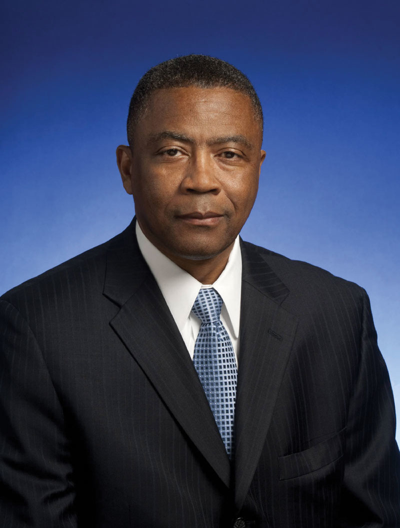

Last week, Gov. Bill Haslam's office announced that the commissioner of the Tennessee Department of Correction would leave his post at the end of June to join Florida-based private prison company GEO Group. After five years leading the state's 14 prisons, Derrick Schofield — a Haslam appointee — leaves the prison system in the lurch. GEO Group is one of the country's largest for-profit prison corporations — second to Nashville-based Corrections Corporation of America. And like CCA, it has been at the center of controversy regarding how its prisons are run.
Luckily for the 55-year-old Schofield, he's grown accustomed to controversy. In his time leading the department, especially throughout 2015, the safety of state prisons has been called into question — not only by anti-prison activists, but also by guards, as well as legislators in both parties.
The department has been understaffed, a hepatitis C epidemic in the prisons is on its way to becoming a class-action lawsuit, inmates and their families claim gangs have taken over units in prisons, and assaults on guards have become the subject of legislative inquiry. Correctional officers questioned the department's two-category incident classification, which didn't consider an incident to be assault unless it resulted in injury. A 2012 Tennessee Comptroller of the Treasury report first flagged a need to alter classifications of incidents. Those concerns were echoed in a 2014 comptroller report. They weren't looked at until 2015. When the department moved to change how it categorized assaults on guards at the start of 2016, the number of reported assaults nearly doubled.
When Schofield left his job as deputy commissioner of the prison system in Georgia for the gig managing Tennessee's 21,000-plus inmates, the system there was in similar disarray. Georgia has since launched one of the biggest (and arguably most successful) prison reform projects in the nation.
Through all of TDOC's troubles, Haslam has never waned in his support of Schofield. When Lt. Gov. Ron Ramsey said last fall that the legislature should look at making TDOC answer questions and complaints raised by staff, inmates and inmate family members, Haslam basically waved the idea away.
But after consistent grilling from the legislature, Schofield sought a review through its own accrediting body, the American Correctional Association, which called for altering the department's scheduling and muddy incident-reporting practices. At the time, Schofield told reporters that changes were coming, but that it didn't necessarily mean any of the previous policies were faulty or problematic.
"It doesn't make it wrong," Schofield said last fall. "We're saying we'll add clarity and [take] out the subjectivity to give our officers on the ground a clear picture of what an assault might be according to the definition."
Schofield always contended that nothing was wrong in the prisons, and that staff issues were based on the guard's perception rather than reality.
The Tennessee State Employees Association and legislators then pushed for more than a three-day, five-prison visit from an auditing entity, because when the ACA unveiled its report to the legislature, even members of its audit team said the review was in no way comprehensive or representative of the whole system.
In the past year, TSEA also questioned a state contract with CCA in Trousdale County, which opened in January. The contract allocated $276 million over the next five years to a 2,500-bed facility contracted through TDOC. The deal was sealed in July 2014 between the state and CCA, and the decision to close Charles Bass Correctional Complex came five months later. But after it was found this spring that the facility had severe staffing issues and had been placing inmates in segregation for no reason at all, the Trousdale County prison stopped accepting new inmates and sits at only 65 percent capacity.
Before the results of a departmental audit at the behest of probing legislators, Haslam was already out front of Schofield, and told reporters that an audit finding problems in the prisons was not a sign that the department wasn't running well. Still, he also defended the department's need for an audit, saying a review of any of the state's 23 departments would identify areas for improvement.
"No, we never said nothing is wrong," Haslam said in 2015. "We're reacting to people who said, 'You know we're in crisis situation here and the feds are getting ready to take over.' And I think what the [ACA] report shows is that's not where we are."
There still hasn't been a comprehensive audit of the state's prison system in the months since Haslam's statement.
Haslam has "just started the process of appointing a new commissioner for the Department of Correction and does not have a timetable on an announcement," Jennifer Donnals, Haslam's press secretary, said in an email.
The press release announcing Schofield's departure noted that he's been an integral voice in "shaping the governor's public safety agenda during the administration." Part of that shaping has been increasing the department's budget by quite a bit: The year Schofield started, TDOC spent nearly $679 million annually. In 2015, that budget had grown to more than $933 million.
Schofield and Haslam both said in the fall that the CCA contract isn't a sign that the state will look to privatize prisons. But with Haslam's recent push toward privatization of state services and the opening of another CCA facility after a state prison closes — all while the state's prison head resigns amid a shit storm — could it be long before state prisons go private?



