
Even on a slow shopping day, you could drive circles around Opry Mills mall before finding the little blue awning that marks the school inside.
You'll find it near a TGI Friday's, beside a parking lot where FedEx trucks unload buggies and carts for delivery throughout the shopping haven. But the inside looks nothing like the surrounding mall or the kiosks selling lattes and remote-controlled copters.
Inside, some 30 students are trying to finish high school.
Some struggled at their previous school. Some just quit going. As young as 17, or as old as 21, some had to put work first. Or got themselves in trouble. Or got pregnant and fell behind — or will, once the baby arrives.
So they come here, The Academy at Opry Mills, where they can make up credits they failed or complete the credits they still need to get their diplomas.
But how they earn those credits is the big question.
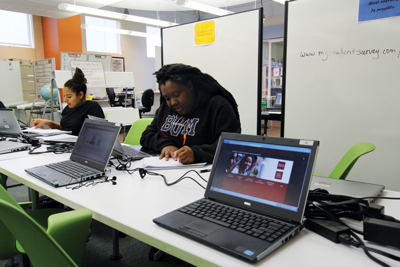
They sit in bright color-coded sections of the large room organized by the subjects they need to master: sleek yellow and orange chairs for math, blue chairs for English. Green designates the catch-all of science, government, economics, visual arts and history, and a couch area is reserved for foreign language. Each area has its own teacher, five in total.
With few exceptions, students do their work on a laptop largely by themselves. Most of the courses are animated, with punchy visuals and sound effects not unlike a 21st century update of Schoolhouse Rock. In a Biology I course, the heavy material is explained by video of a teacher — a balding, energetic guy with a squeaky voice and a white lab coat — discussing the difference between a hypothesis and a theory.
Sixteen students at the academy finished enough course work using these programs during the fall to graduate before Thanksgiving. In total, as many as 60 students attend each semester, and another dozen are nearing graduation.
This is the utopia of what "credit recovery" means for officials at Metro Nashville Public Schools, a school system with 86,000 students enrolled. Many of them are poor; many others will run into trouble a time or two, fall behind and need a way to catch up.
"It's just a huge deal for them and just a huge deal for our society as a whole" to earn that diploma, says Carmon Brown, principal of The Academy at Opry Mills. "It's unfortunate they have to grow up a lot faster than a lot of us did."
If this scenario is the gold standard for how students can make up failed credits, what's happening throughout Metro's traditional high schools is the knockoff version. Teachers say the credit-recovery system undermines their authority, weakens students' learning and cheapens the meaning of a Metro diploma.
The school system currently finds itself under investigation by the state after reports by WTVF-Channel 5 that schools may have tried to reclassify students to boost test scores. But teachers who spoke to the Scene on condition of anonymity, for fear of losing their jobs, say the real story is credit recovery.
Goosing the numbers is symptomatic of a larger problem, teachers say: an obsession with test scores and graduation rates that pushes schools and teachers to funnel as many students through the system as possible.
In reality, students have options when recovering credits from a failed course, according to Kelly Henderson, executive director of instruction for Metro schools. Students can either retake the course, complete a virtual class taught by a teacher, or take the class with a program called A+. Enterprising students can buy their credit from a private school such as Nashville Academy, which charges a fee and awards credits for the completion of a few workbooks. (See "The Replacements," June 5, 2014.)
Unlike in the classroom or at the school at Opry Mills, where students have access to a teacher in each of the core subjects who can blend computer work with face-to-face teaching, A+ computer labs at most Metro high schools are typically staffed by a single teacher with one expertise — math, for example — who is thus unequipped to help students struggling with other subjects such as chemistry or English.
The stale A+ computer program leans on rote memorization. It lacks the engagement found in CompassLearning Odyssey, the cartoon-like program that The Academy at Opry Mills piloted and decided to keep. Through the A+ program, district high-schoolers who need to make up credits are subjected to the equivalent of a dully didactic Wikipedia entry — a regurgitation of facts without the glue of good instruction, or even a quirky guy with a bald spot.
The courses themselves use a one-dimensional curriculum that relies solely on multiple-choice tests. While they're taking the test, students can refer back to their lessons. No essay questions, research projects, presentations or group work are needed here, although all are either encouraged or required for Metro school teachers to score a passing grade on teacher evaluations. In addition, the tests can be retaken again and again.
Teachers say the system degrades the culture in their classroom, to the point where students contend they don't need to do the work to pass their classes — they can just retake it in A+.
"It's one of the poorest decisions that the district has ever made as far as children are concerned," says one teacher who left Metro to teach at a private school. "It's wrong what they're doing."
Students take credit recovery after failing a class, but can take it concurrently with the next advanced class. For example, a student who fails the fall semester of English I would get out of taking the state standardized test for English freshman year, postponing it until the summer or fall. Meanwhile, that student can take the A+ class in the fall at the same time they take English II.
"I'm sure there are students who would rather sit in front of a computer all day," Brown says, when asked what he thought about the difference between passing a class given by a teacher or a computer program. Some students would rather have a teacher, he says.
Yet for Jessica Silva, it's easier to take a class without the distractions of other students, she says. With small star tattoos behind her right ear, the 19-year-old former Glencliff High School student with a baby on the way is on the brink of graduation.
Silva started studying at The Academy at Opry Mills last spring when it was apparent she wouldn't graduate on time. She had the choice of taking Odyssey or A+; she opted for the latter, which she knew from her days at Glencliff. She's about to finish her fifth A+ class — a biology course — after having wrapped up economics, two sections of world history and a Bio I class.
"I think it's easy if you're into it," she says. "But if you're not doing it often, it takes time to finish."
Metro Nashville Public Schools offers countless such credits to students in place of class instruction. Literally countless, because MNPS says it doesn't keep track.
The district says student transcripts lack any special notation to show whether classes were taken through credit recovery, according to MNPS spokesman Joe Bass. Tallying up the number of students taking the credit recovery course won't help either, he says.
"Looking through class rolls will not give us an accurate number, because credit recovery is generally listed as 'independent study,' and that is a listing that can be used for a number of different reasons," he says. "Some students take virtual courses or other forms of independent study under the same heading. So isolating cases of credit recovery that way is impossible."
MNPS says it cannot even track those credits through the program provider, because the district no longer has an active contract with the A+ program.
"That contract is now over, and we do not have access to the data that could tell us how many credits were earned in the time we used it," Bass says.
As a result, the district has no way to tell how effective the A+ program is at educating students. Henderson, who oversees credit recovery, says the program is acceptable to the district because it lines up with state standards — although current state standards are now up for review. The district is considering booting A+ and adopting the Odyssey program used at The Academy at Opry Mills, she says, although she is unsure when that would happen.
Teachers who spoke to the Scene, meanwhile, say they're demoralized that students can take lessons and multiple choice tests by computer in a subject they failed to grasp, and be awarded credits that will help march them through the system toward graduation day. They wonder why the district is willing to ask so little of students, even as it increases its demands on their instructors.
Students decide for themselves how to make up the class, Henderson points out, and it's on the students to get something out of it. Not every student comes in wanting to learn, she says, but it's the district's job to find a way.
Email editor@nashvillescene.com
Clarification: A previous version of this story gave the analogy of a student failing the spring semester of English I, which would put off the state exam. It should have said the fall. We regret this error.



