
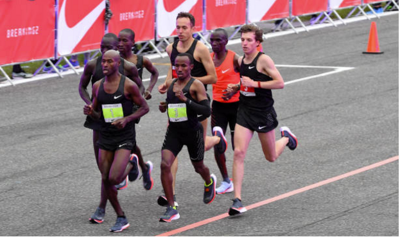
Tennessee has never seen a high school runner like Andrew Bumbalough, a ten-time state champion in track and cross country who graduated from Brentwood Academy in 2005. After running for Georgetown in college, Bumbalough signed a pro contract with Nike, moving to Portland, Ore., to pursue his dream of becoming an Olympian and competing against the best in the world. But on Saturday morning in Monza, Italy, instead of competing against East Africans, Bumbalough teamed up with them as one of 18 athletes (and only one of only two non-African-born runners) rhythmically holding 4:35-miles ahead of Kenyan Eliud Kipchoge as the latter attempted to run faster than two hours over the 26.2-mile distance.
“It was pretty out-of-this world stuff,” Bumbalough, within hours of his return to the U.S., told the Scene. “It was really cool to see an athlete like Kipchoge to be so relaxed and so comfortable and so confident about his ability to do it.”
Though Kipchoge would finish a heartbreaking 25 seconds off the mark, in two hours and 24 seconds, he still lowered the world record by more than a minute and a half. The event was a staggering accomplishment in athleticism, due in part to runners like Bumbalough for their work at the front of the pack. We caught up with the area native to talk about his experience leading the fastest marathoner in the world and what he learned by doing it.
When were you invited to take part in the Breaking2 attempt? It was about six or seven weeks before the event. They contacted my agent and put in the request to have me come.
Nike had been planning it for two years at that point. How did it feel to join the project? It was cool to get the call up for that. We’re all getting ready for our track seasons, so there was that to think about, but it being such a unique opportunity, I was happy to say yes, and Nike did a nice job of accommodating us with our training needs.
Running even one 4:35 mile sounds incredibly fast for the average person, but what does that feel like for a guy like you? The pace is amazingly fast for a marathon. I was in control, but at the same time, imagining myself running that tempo for much more than 13 miles, it’s crazy. The pace was two minutes faster than my half marathon personal best. An incredible performance by me would be essentially that pace for half of Kipchoge’s distance.
What was the spectacle like? On the ground, there was just this sense among the pacers that we all wanted to get it right. Normally, you go to a competition, and you’re competing against all of the guys you’re there with, whereas this was you were working together and trying to pull someone along to something amazing. It had a totally different team feel, almost like back to high school where you’re cheering on your 4x400 team to get enough points to win you the meet.
When you finished your last pacing section, Kipchoge had a little more than six miles to go and was still on target to break two hours. What was that last half-hour like? Kipchoge was still feeling pretty good at that point, and from what I heard, his coach was wanting to hold him back until the last two laps, just to ensure that he wouldn’t blow up — it’s just such a fine margin when you’re running that fast. There was a lot of buzz and excitement in the tent [where the pacers waited, near the finish]. With three miles left, you just saw the slightest chink in his armor open up, not quite being able to maintain the pace. But you knew, even with a mile to go, he was still going to crush the previous world best.
Did running in formation remind you of high school track relays? Exactly, and I think that’s a good example. Running is often times pretty basic. You’re not thinking too much about logistics. But when you’re on a relay team, you want to nail down the exchanges and make them as clean as possible. That’s the closest thing to what it was like, getting a rhythm with the guys.
You’ve already run a two-hour, 13-minute marathon. How do you think being part of Breaking2 will affect you going forward? I think the biggest thing is seeing Kipchoge’s demeanor. He has this very confident, quiet self-belief. As a professional, you normally don’t want to put anyone on a pedestal, because they’re your competition and that you can beat them. But to see his approach, I’m willing to say that I admire and look up to him a lot. I want to get in as good of shape as I possibly can, and then try to channel that belief that I saw from Eliud. Hopefully I can carry that forward with me.



