
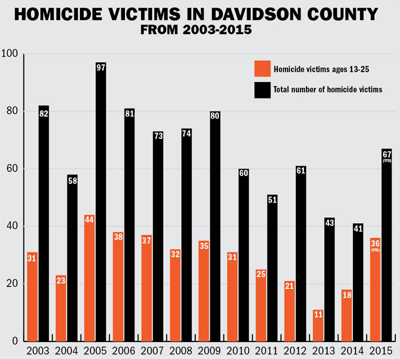

As of this writing, the toll from homicides in Nashville this year sits at 67 dead. Of course, 2015 is not yet over. That number could rise.
But even if the city is quiet for the next two weeks, this year's murder rate will represent an increase over last year and the year before it.
The increase is pronounced. Murders fell to historic lows in 2014 and 2013, with fewer than 45 killed each year. This year's rate is still well below Nashville's all-time high of 112 murders in 1997.
Even so, that statistic is cold comfort to the families of the slain.
"That's 67 people whose families will never see them again," Mayor Megan Barry said this week at a Youth Violence Summit convened at Pearl Cohn High School, which has seen its students on both sides of the violence. "That's 67 people who will never laugh again, and many of those 67 people were young. Thirty-six of them were between the ages of 13 and 25.
"Including Georgio Gray, who was shot and killed outside his apartment in East Nashville on Saturday. Georgio was 22," she continued. "Georgio was just the most recent young person who died violently this year. Treyonta Burleson lost her life to a bullet six weeks ago, a bullet that was fired in the street over an argument. She was 14.
"Cameron Selmon was killed early one October morning on a college campus, gunned down over a game. Cameron was 19. Brandon Williams was killed by gunfire inside a nightclub last spring. Brandon was 17."
She could read another 32 other names, Barry said. But another troubling statistic involves the people on the other side of the gun. Of those arrested for homicide in 2015, 17 were under the age of 19. The scourge does not afflict Nashville's citizens equally, according to Barry. Seventy-seven percent of this year's homicide victims — more than three-quarters — were African-American.
The summit is a direct effect of Criminal Court Clerk Howard Gentry's mayoral candidacy. Although Gentry fell short of the runoff, he was the first candidate to begin speaking about violent crime, particularly among the city's youth, on the campaign trail. He called for a forum to bring together community and government leaders to address the problem.
Gentry sat on one of two panels Monday night — the first on economic opportunity and family support, the second on environment, mental health and well-being. Panelists discussed everything from the impact of absent fathers to a criminal justice system that needs reforming "from stem to stern."
The speakers were joined by Hillwood High School senior Daquan Summers, a voice for the city's youth, whose comments at the open and close of the summit were met with applause from a nearly full Pearl Cohn auditorium.
"I've had the odds stacked against me since I was born, all right?" Summers told the crowd. "I was born to a single mother, she had two of us before she was 18, I had my first felony at age 12, OK? I had no positive role models in my life, growing up."
Having overcome those circumstances and since been accepted to, among other schools, Morehouse College, he said he wants to be one of those role models now.
Barry said she wants a "concrete action plan" by early March, one that includes "accountability measures for outcomes." The summit was just the beginning of a series of future discussions that she said must result in action — a point few made more clearly than Pastor Frank Stevenson of St. Luke Primitive Baptist Church.
"Six weeks ago I got a call and went to the hospital, and when I got there Treyonta [Burleson]'s mother, Rita, of the 14-year-old that was murdered, said, 'Pastor, my baby is back there, will you go back there with me?' " Stevenson told the room. "We walked back there and I looked and saw the lifeless body of this 14-year-old. Hair braided, sweatshirt, innocence. And I thought to myself, the cemetery is stealing the value out of so many that have so much to offer."
Collaboration, the pastor said, was crucial. If any child dies, the burden can't just fall on one family or one neighborhood, Stevenson said: "It falls on all of us."



