
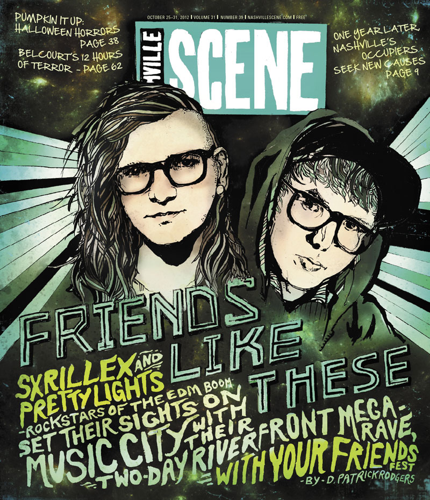
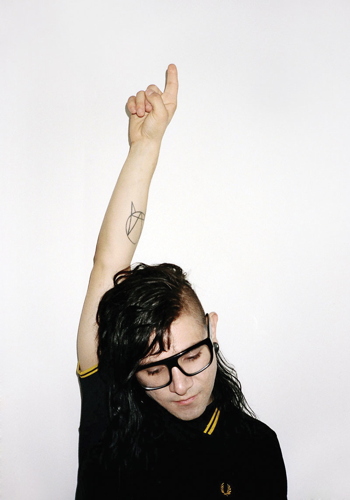
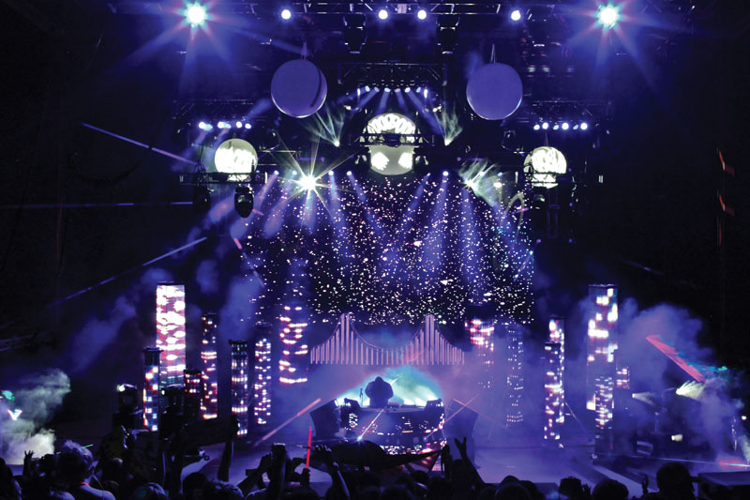
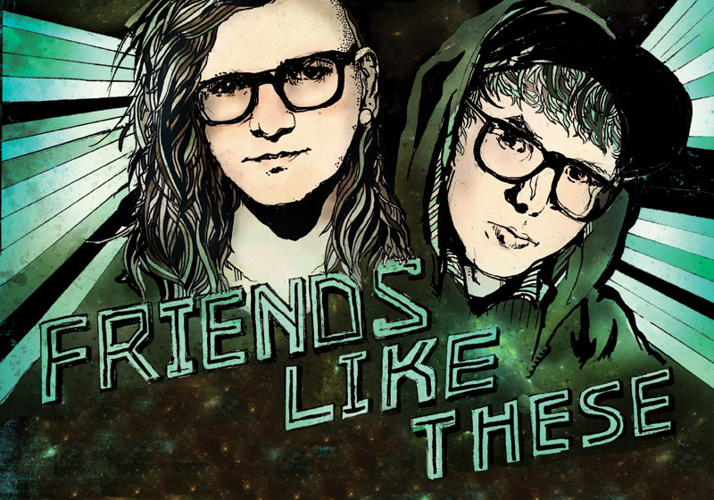


Saturday night at Bonnaroo 2012 — or technically, early Sunday morning — an asymmetrically coiffed, boxily bespectacled 24-year-old by the name of Sonny Moore sits in the wings at Which Stage, as thousands of 'Roosters seethe with anticipation. Placed center stage is a DJ booth designed to look like an interstellar spaceship. Behind that, a countdown ticks away on a large video screen.
Moore — known to most by his stage name, Skrillex — extinguishes his cigarette (five!). He skitters clandestinely onto the stage (four!), crawling into his spaceship (three!) via a concealed access point (two!) in the back (one!).
As the countdown rolls over to zero, Moore bursts into the control booth of his vessel. The mothership unleashes a concussion barrage of pulsing, gut-rumbling sounds, a cacophony of bass tones, synthesizer hooks and samples. To the untrained ear, it probably sounds like a dentist's drill harmonizing with a blender. The more you listen, though, and the more you catch its rhythmic current, there's something beguilingly catchy about its hypnotic clatter.
In front of him, jets of icy gas explode from cannons. Behind him, visuals straight out of an H.R. Giger fever dream flicker and flash, illuminating the sea of elated faces looking on from that Tennessee field. As far as the eye can see, hands lift skyward, jaws drop, waves of undulating, contorting flesh crash and crest.
As far as Moore is concerned, the audience's reaction is every bit as vital as his presence in that cockpit.
"It's not so much about, 'Look at me,' " Moore later tells the Scene. "It's about how you can feel like you can take someone into a world, you know?"
These legions of kids — many locked in amorous embraces, others experiencing one sort of psychedelic experience or another, all of them a part of the world Moore is creating — aren't leftovers from the raves and warehouse parties of the '90s electro boom. Mainstream festivals like Bonnaroo, Coachella and Lollapalooza feature more and more electronic dance music (or EDM) performers as headliners. EDM-focused fests like Electric Daisy Carnival have swelled to become among the largest music events in the country, with attendance at this year's Carnival reaching over 300,000. And EDM tours and one-off events — curated by guys like Moore and his fellow EDM superstars Pretty Lights and Bassnectar — have popped up in markets all over North America.
The latest of these is Music City, where, bolstered by a burgeoning local scene, the aforementioned superstars can and frequently do attract sellout crowds at large venues. These artists, whose throbbing, alien sounds are a far cry from the organic creations being played by Broadway buskers or even the garage-dwellers of Nashville's budding rock 'n' roll scene, are hosting massive parties while the rest of the city sleeps.
This weekend, Skrillex and Pretty Lights will curate and perform at With Your Friends Fest, a two-day EDM event featuring fellow electronic artists 12th Planet, Dillon Francis, Michal Menert, TOKiMONSTA, Eliot Lipp and Two Fresh, as well as indie-electronic darling Santigold and hip-hop heavyweight Nas. But they won't be doing it in the steel-and-concrete bowl of Municipal Auditorium (which Pretty Lights commandeered last Halloween), or even in our friendly neighborhood enormo-dome, Bridgestone Arena (which Bassnectar has claimed as his New Year's hub two years running). They'll be doing it right out in the open, at Nashville's new outdoor event space The Lawn at Riverfront Park, with the Music City skyline at their backs.
Electronic dance music? In the heart of Nashville's honky-tonk district? The gall! And yet, the closer you look at the current EDM boom and its emerging heroes, there's a sense that were he a 20-year-old to whom electronic and social media are as natural as oxygen, Hank indeed might've done it this way.
Named the young leader of the "new rave generation" by Spin magazine in 2011, Moore serves as something of a mascot for the resurging electronic dance music landscape. Though EDM has evolved, mutated and shape-shifted for the past three decades, in the States, it has remained on the fringes of the mainstream. Always present and always boosted by a thriving underground scene, EDM's breakout artists were typically European house, techno, big beat and IDM architects like Daft Punk, Aphex Twin, The Chemical Brothers, Fatboy Slim and Prodigy.
But with the arrival of diverse, multi-genre-utilizing, party-centric artists like Skrillex and Pretty Lights, North American electronic dance music is seeing its first wave of true rock stars. They're the figureheads of what can still be called a niche market, but the niche is the biggest it's ever been.
Drew Mischke, general manager of local venues Mercy Lounge and Cannery Ballroom, has long been a connoisseur of dance music in all its forms — the word "DISCO," as a matter of fact, is tattooed across the inside of his forearm. A Middle Tennessee native, Mischke has seen crowds wane with the rise of download culture over the past decade. He admits that, thanks to audiences' seemingly insatiable appetites for nostalgia, cover bands like locals Guilty Pleasures, My So-Called Band and The Long Players always sell tickets.
But when it comes to original music, he says, there are two kinds of shows these days that bring out crowds in droves: the sort of folk music Mischke refers to as "new-mericana," and dance music.
"It's either Skrillex or Mumford & Sons," Mischke says. "Anything they touch turns to gold. It's either this kind of cleaned-up, more polished version of Americana stuff, or a more polished and palatable version of dance music that's doing really well. And your indie-rock stalwarts are no longer the big draw that they were four years ago."
Mischke attributes the ongoing success of performers like these to their ability to connect with fans in a visceral, memorable manner. "The value of music in and of itself as something that people will pay for has obviously declined tremendously," he explains. "So for a live music experience or concert or event experience, it has to be more than just music. And that's either, you know, a punk-rock band like Monotonix setting drums on fire, or incredible, transcendent performers like Bruce Springsteen or U2 that just put on this incredible show every single time, or a retarded amount of money spent on production that's well done and is mind-blowing. And then the songs are a lot different and the experience is a lot better than what I can hear on Spotify for $10 a month."
But more than just the spectacle and production, whether it's Skrillex's spaceship or Pretty Lights' brain-melting array of color-coordinated lights, the artists themselves see their live events as a sort of populist party, complete with a "communal" atmosphere that the fans have a hand in creating as much as the performers.
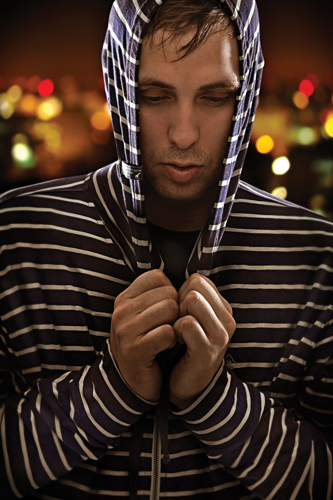
"What really sets [a live EDM event] apart is that people become part of it," Derek Vincent Smith (aka Pretty Lights) tells the Scene via phone from New Orleans, where he's putting the finishing touches on his next release. Self-described as "electro hip-hop soul," Smith's smooth, mid-tempo grooves frequently utilize live instrumentation and familiar soul and R&B samples from artists like Lyn Collins and Etta James — as opposed to Skrillex's adrenaline-pumping compositions, most typically made up of waxing and waning synthetic sounds. "People come [to an electronic event] and they reach this level, and everyone is connected and really getting into it. The music has so much power to really move the audience. And once everyone's sort of on that wavelength, it creates a different kind of event. You're not an observer, you're part of it."
Maybe it sounds counterintuitive that a musical genre founded on cold technology is bound by an organic, flesh-on-flesh sensibility. But Moore sees the value in creating a communal atmosphere at any live-music event.
"When there's an event or party or show or any type of thing and you walk in and, regardless of what type of music it is, when you see everyone on the same level, that's the magic," says Moore. "That's where you want to get to. And whatever that is, that runs through punk rock and electronic music and rock music and everything. As long as that synergy is there, that's the real magic, I think."
The Ecstasy-fueled rave boom of the '90s familiarized many an American with the stylistically misguided electronica-fan archetype: arms encased with rows of neon beads like a pair of orthopedic casts, pants flared to hoop-skirt radius, head sporting a beret and neck hung with a pacifier (all of which goes for both males and females, of course). Ask John "12th Planet" Dadzie, a Skrillex collaborator and esteemed Los Angeles producer/DJ, and he admits "colorful, fuckin' fuzzy-boot-wearing people" are indeed still a part of the EDM scene.
But lately, more and more serious music listeners — listeners who came up on rock, pop or even country — find themselves enamored with electronic performers. Especially in a live setting.
Twenty-six-year-old Nashvillian, Belmont graduate and music fan Dave Henton grew up on the Britpop and indie rock of the '90s. A fan of Nirvana, Pavement and Blur — not to mention Aughts indie followers like The Walkmen and Deerhunter — Henton has long attended what most would consider, as far as instrumentation and presentation go, conventional rock shows. Recently, however, he's become drawn to performers like Pretty Lights, Brazilian electronic artist Amon Tobin and British trip-hopper Bonobo. Henton's boots are conspicuously fuzz-free, his pants of a fairly traditional fit. As a music enthusiast, though, he sees more merit in the new crop of EDM stars than the prototypical rock snob's knee-jerk reaction might allow.
"Sure, there are plenty of knobs and lasers," Henton says, "but it's lazy to cast [the average electronic music show] as soulless, especially without having experienced EDM with an open mind, in a live atmosphere. The live show is a pretty integral part of experiencing the music. Also, I don't know that there's anything inherently more legitimate about live instrumentation.
"Most importantly, this is about having fun. Going to live shows doesn't always have to be about experiencing art in a serious way. That's something that's often lost on the indie-rock crowd."
The big-tent, all-listeners-welcome attitude that now exists in the world of EDM is the sort of phenomenon you might not have seen very often before the days of the Internet. Via his label, Pretty Lights Music, Smith makes all his releases — as well as many releases from labelmates such as Michal Menert, Paper Diamond, Gramatik, Eliot Lipp and Break Science — available for free download. It's a remarkable business model, one that threatens to shovel another layer of dirt onto the casket of the old major-label model.
Where the traditional music industry blanches at the thought of giving away something for nothing, Smith sends all of his EPs and LPs out into the ether without charge. While watching them spread by word of mouth (well, word of keyboard), he makes his money via ticket sales and festival guarantees, donations, even iTunes downloads. Some downloaders, it seems, never got the memo about all of Pretty Lights' music being free.
But that's precisely the point. With every offshoot of EDM leaking into every corner of the Internet, all kinds of listeners and participants are joining the fold. For a generation of consumers who balance social-media profiles and music-downloading platforms as naturally as they brush their teeth, the Internet has become both a limitless library for ambitious listeners and a playground for producers and creators of all sorts.
"It's so easy to share music and to find out about new things and to get a glimpse of something else," Smith says. "Whereas maybe 10 years ago, 15 years ago, you got into hip-hop, and that's all you heard. You heard hip-hop because that was the scene you were in, and that's what you listened to, and in order to buy something else you would've had to have purchased the CD. Or you would've had to hang out with somebody from some other clique and actually heard their music collection. ...
[page]
"I think people are being exposed to these different things and realizing that it all goes back to the same thing — it all goes back to the fact that we're humans, and we're drawn to create, and we wanna make things that are beautiful that move ourselves and move other people. ... It's not, 'Dubstep is good music.' It's not, 'Electronic is good music.' It's fuckin' 'Good music is good music.' "
Through his own label, OWSLA, Moore offers downloads of Skrillex tracks as well as those of OWSLA signees Dillon Francis, Hundred Waters, Skream and more. And while Moore — unlike Smith — doesn't give his entire catalog away for free, he's but one of thousands of EDM artists eager to make their music as accessible as possible, erasing the boundaries between the creator and the listener.
"Pretty Lights put out records — how many years ago? — free online," says Moore. "He could have been some guy giving out free CDs, but because the Internet's there now and everyone's gotten all this attention and all this traffic, it gives an opportunity for the real new up-and-comers to just do it themselves. It's also growing because people do see it as a market, so you're going to have a lot of people just going for it, because it's — in a sense — a market that's just exploding."
On their YouTube channel, fraternal comedy-video producers the Fine Brothers host a series by the name of Elders React. A recent installment sees a gaggle of senior citizens responding to a succession of Skrillex videos; as of press time, the video had over 7.5 million views. To Skrillex, the elders react with a bevy of descriptors, from "electronic nonsense," "psychotic," "violent," "dark," "unidentifiable," "heavy metal gone awry," "a bunch of crap" and "a jackass in a bottle," to "with-it," "very, very clever" and a very matter-of-fact "techno dance music with someone screaming every once in a while." While many of the elders see this music as a way for kids to rebel against their parents, one self-professed child of the '60s goes so far as to say, "I would rather have my kid or grandkid listening to this than Justin Bieber or Britney Spears."
Indeed, Skrillex's music is made up of a divisive array of sounds. There are clear-cut melodies and hooks, and some of them are stirringly catchy, to be sure. But they're also ensconced in grating, tooth-rattling tones and backed by a spine of compressed kick and snare samples. "Is it called something?" the former flower child asks. The Fine Brothers' response: "Dubstep."
But that isn't entirely accurate. Though dubstep has become something of a slapdash label applied to every laptop-toting youngster with a funny haircut, its influences are rooted in an organic subgenre of reggae known as "dub" that was pioneered by '60s artists like Osbourne "King Tubby" Ruddock and Lee "Scratch" Perry. Arriving in late-'90s London, the term "dubstep" came to represent music that adheres to a fairly specific set of rules.
Like most dance music, dubstep is in a 4/4 time signature. More often than not, the tempo clocks in at 140 beats per minute — but delivered in halftime, giving the tempo a feel of 70 bpm. Then there's dubstep's characteristic "wobble bass," in which bass tones are rhythmically manipulated, typically via what's known as a low-frequency oscillator.
"I think when something is new and there's so much focus on it, after it becomes a cliché," Moore says. "People will call anything that sounds like noisy electronic music 'dubstep.' It's actually very specific technical classifications of what makes dubstep. Even just from the tempo. But at the end of the day, people are making electronic music in so many different ways, even in bands. ...
"The platform is what's so exciting about it. You can be so creative without having much. And I think that's just going to continue to grow. I think the significance isn't in dubstep. The word could've been 'electro.' That could have been the word of the year, you know?"
While some of the music Skrillex, Pretty Lights, 12th Planet and their fellows make can indeed be labeled "dubstep," many of their tracks can be called anything from house to trap to a 110-bpm variant known as — brace for impact — "moombahcore." But that's really just an offshoot of moombahton, which derives from reggaeton, which ... well. As with any niche musical movement, you can split hairs, split them again, and split them some more until your head spins.
"I'll tell you straight-up," says 12th Planet's Dadzie. "Twelve years ago, you could totally tell the difference on what was what. But now everything's just kind of, like, borrowed from each other. ... The artist can create fuckin' whatever they want. Like, you listen to a Skrillex EP, it has multiple different genres on it. Twelve years ago, I think artists couldn't go outside of their genre and stuff. I think that's a testament to everyone collaborating and borrowing from each other, making it new."
That all-embracing quality has brought an audience boom in Nashville. On Halloween of last year, Pretty Lights brought his "Illumination" extravaganza to Municipal Auditorium, attracting just shy of 8,000 attendees. Two months later, fellow EDM heavyweight Bassnectar played Bridgestone, drawing 9,673 fans to the arena on New Year's Eve; he'll do the same for NYE 2013 — only this time, he'll debut a brand-new 360-degree rotating stage setup. While Skrillex hasn't played a proper Nashville show in roughly two years, his December 2010 appearance at Mercy Lounge was an easy sellout. (According to Mercy Lounge's Mischke, as a result of Skrillex's onslaught of sub-bass that night, "a glass shelf full of bottles at the back bar shattered.")
In part, that's a reflection of Nashville's omnivorous musical tastes, which tend to surprise many visitors. Thanks to rock stars like Jack White, The Black Keys and Kings of Leon claiming Nashville as their hometown — not to mention local rock 'n' rollers-made-good like JEFF the Brotherhood, Those Darlins, The Features and PUJOL — the rest of the country is beginning to accept Music City as a hub for indie, punk and garage rock.
But as we grow accustomed to our identity as a hotbed of rock, pop and country, artists of innumerable genres and modus operandi surge all around us, thriving in scenes of their own making. Prolific MCs like Dee Goodz, Stix Izza and Openmic boost the local hip-hop scene, while DJs such as Wick-It the Instigator and KDSML make names for themselves within both the hip-hop and EDM worlds. If the world is growing accustomed to Music City being more than just country, there's no reason Nashvillians shouldn't embrace the idea of music that is more than just, y'know, dudes with guitars.
"Nashville — that's where the industry's at," says Dadzie. "You've got country and Western on lock, and, like, hip-hop and gospel and all kinds of markets, you know? It might not be the biggest in terms of straight-up dance music. But in terms of music in general, Nashville is Top Three. Between L.A., Nashville and New York, you've gotta make it in one of those markets, for sure."
Moore, a longtime Angeleno, and Denver native Smith have more connections to Nashville than you might expect. Eight years ago — before Skrillex was a household name, and long before Moore had won three Grammys, co-scored Harmony Korine's upcoming Spring Breakers and voiced his cameo as a DJ in Disney's new animated film Wreck-It Ralph — he was a 16-year-old touring as the lead vocalist for an emo outfit called From First to Last. At a tour stop in Charlotte, N.C., he found himself in need of deodorant. Someone steered him to an 18-year-old by the name of Robert H. Dyar Jr., who was working security.
Dyar — who prefers the nickname "Road Hog," though "R.H." is also acceptable — lent the young man a stick, and the two became fast friends. Road Hog would go on to serve as From First to Last's tour manager, and later as the T.M. for Moore's solo project, Sonny. But when Moore moved on from the world of the guy-liner'd mic-swingers and on to his electronic material, he and R.H. lost touch.
Until, that is, a serendipitous run-in in Paris brought the two back together. After some coaxing, Road Hog — by then living in Nashville — was convinced to return as Moore's tour manager. Shortly after, Skrillex's career soared into the stratosphere. Now that hulking, bearded, blue-eyed farm boy you see looming a full foot taller than Skrillex everywhere he goes, pulling Moore out of moshpits gone awry in YouTube clips, is Road Hog.
"I think Nashville's got a great scene, and I think that it's growing," R.H. says. He points to guys like Jeremy Todd (aka COACH), host of The High Watt's weekly Y2K dance parties, and Joseph Howard (aka Fan Fiction), creator of the EDM blog Nashville Nights, for growing the city's EDM scene. Also worthy of "big ups," he says, are venues such as 12th & Porter, Mai and Mercy Lounge, which host EDM events "when it's been cool and popular, and when it hasn't been, just because they love the music." If not for their efforts, he says, an event like With Your Friends Fest wouldn't be possible in Nashville.
"You can't just bring big electronic shows into a city that has no scene and expect it to just make sense," R.H. says. "It's the same way with a lot of good music in this city, whether it be, like, a Fly Golden Eagle or a James Wallace and the Naked Light, or going to see PUJOL play or whatever. It's just music, it's good times. When people have a good attitude about it and they're doing what they love and they're having a good time, that translates."
"Ever since I started touring a few years ago, that part of the country has shown mad love to the electronic shows," Smith says of Nashville. He too has professional connections to Music City — namely, via booking agent Hunter Williams of the Nashville-based Progressive Global Agency.
"It's always been packed-out, and it's always been hyped — like, super-hyped," Smith says. "Some markets, some cities will sell out an electronic show, but it won't be as energetic as another city or whatever. So I've always thought of Nashville as, like, this super-hyped-on-electronic-music — on the new North American movement — city."
The idea to team up for an outdoor gig came after the success of a post-Lollapalooza Skrillex-Pretty Lights package show in Chicago in August 2011. Both Skrillex's and Pretty Lights' camps agreed on Nashville, and Moore and Smith met up to discuss the details while playing Full Flex Express, Skrillex's cross-Canadian summer 2012 train tour, a sort of EDM take on the Grateful Dead/Joplin/Band Festival Express tour of 1970.
Smith pushed hard for Nas to play With Your Friends, while Moore was gunning for an appearance from Santigold. Both artists happened to be available, and the lineup was filled out with Pretty Lights Music signees (Eliot Lipp, Michal Menert), an OWSLA signee (Dillon Francis) and close friends TOKiMONSTA, 12th Planet and Two Fresh. Also featured will be art installations and, naturally, a carnival ride.
Skrillex will headline With Your Friends on Friday night, with an opening set from Pretty Lights. With his mini opening set, Smith promises to play the sort of "chill, down-tempo hip-hop" he doesn't typically feature in his full sets. On Saturday the two will flip-flop, with Skrillex planning to feature some of the "unreleased techno and stuff" he's recently been working on in his opening set.
For hip-hop fans, Nas will perform his Saturday set with help from a nine-piece band. While both Smith and Moore remain tight-lipped about the details, VIP ticketholders are promised "something so special" for the post-show festivities.
Moore and Smith see it as their responsibility to open their young fans' minds to a broader scope of music with events like With Your Friends. Smith even admits that some Skrillex diehards might think Pretty Lights "sucks," and vice versa. But he hopes that will change.
"As the music gets more popular," Smith says of the growing wave of EDM, "the crowd gets younger. And if the crowd gets younger, they're not as exposed to different genres of music. So it's almost our responsibility to expose people to different genres and whatnot. ... And I feel like we are trying to be ambassadors of that — opening your mind and just being like, 'This is what good music is.' "
But even more than being ambassadors for musical open-mindedness, the pair reiterates again and again the theme that drives them as artists: inclusion.
"If you create an atmosphere — especially for young kids — they have that memory of being on the side of the river and like, 'Michal Menert was there, TOKiMONSTA was there, and these really diverse things,' " says Moore, his voice full of earnest excitement. "You want to have a good effect on people."
And yes, he intends to bring his spaceship.
Email editor@nashvillescene.com.



