
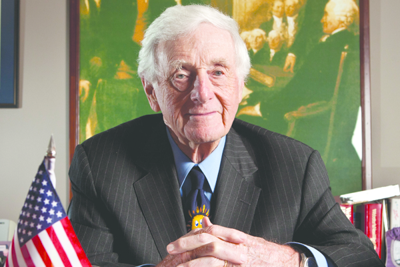
John Seigenthaler bought his ink by the barrel, and he goes to his grave having exercised more unrivaled power — and having carried a broader portfolio — than any other single figure in the past half-century of this city. After a long fight with cancer, the former Tennessean editor and publisher died today. He was 86.
During his glorious run at the morning daily — and while serving in the Kennedy administration in the early 1960s and at the First Amendment Center later in his life — Seigenthaler carried both a Machiavellian hammer and an Irish poet's pen. He was more capable of bare-knuckled political street fighting and bold confrontation than most. But all of that was tempered — if not guided — by a keen humanitarian instinct, a Catholic morality and an Irishman's passion for words, all of which served as polestars throughout his life.
The trajectory of his career — if one were to try to sum it all up — begins as a cub reporter at The Tennessean not long after World War II, proceeds to his successful civil rights activism in the Kennedy administration, courses back through the newsroom at 1100 Broadway where he seemingly masters the city, and then finally arrives in 1991 at the First Amendment Center, where he puts the cherry on the cake of a lifetime advocating for free speech. In the arc of a lifetime, it was an astounding biography.
For someone who wielded so much public and private power, there were inevitable flubs and blemishes. But Republicans, unions, the FBI and countless others took him on to relatively little effect. Decades ago, the noted investigative reporter Seymour Hersh told me that he had evidence Seigenthaler was involved in an attempt to assassinate Fidel Castro. Seigenthaler got wind of it and called me during a rain delay while he was playing golf at Belle Meade Country Club. Famed attorney and Watergate prosecutor Jim Neal was in the foursome. "Bruce, you run that, and Jim here says I have a good libel suit," Seigenthaler said. We never ran the story. The point is this: Attempts at criticism didn’t stick. The narrative was so strong as to sustain overwhelming adulation for the man.
If there was any single era when Seigenthaler had the most impact, it was his long reign as kingmaker at 1100 Broadway. As editor and publisher, at a time when daily newspapers hadn't abdicated their agendas to focus groups and suffered enormous revenue declines, he fully exploited his position every day to shape the city's politics, its social concerns, its literary and intellectual life, its vision of itself. The power was immense.
There was the unflagging progressivism of the paper on issues of race and equality. There were the challenges into voting rights, investigations into the Klan, exposés of union corruption. These were the stories we read, day in and day out. But it was often in the margins of the stories — where endorsements were made, stories got shaded, and alliances were created and destroyed and re-created again — where Seigenthaler's artistry reigned supreme.
His was journalism of the old-school partisan variety, promoting friendly issues for his allies and throwing sharp elbows at those who were not. Seigenthaler became the man from whom candidates and elected officials alike dutifully sought regularly scheduled papal blessings. Broadway might have run right past his newsroom, but the truth was that all roads in the city ran through his office.
Undimmed and unabashed, Seigenthaler was an utter master at steering the city's conversation towards the outcome he favored. Seeing his newspaper's agenda spill forth on Page One was a delight.
A frequent topic of conversation among the city's power elite, after they'd read the paper, was trying to figure out precisely what Seigenthaler was up to. Canny, shrewd and brilliant, Seigenthaler and his journalism were multidimensional. Beneath the story was a backstory. And beneath that backstory were countless layers to the onion, informed by peerless institutional memory of the city.
As a humble night reporter at the Nashville Banner for many years, I would often be on duty at the city desk when I would poke my head across the hall towards midnight, and see Seigenthaler reading — and editing, and adjusting, and tweaking — the stories soon to appear on the streets. It was his paper, his voice, his crusade. And even though he was publisher, he really didn't care about the money side of his operation. To him, it was all about the words.
Seigenthaler's was a life of job choices perfectly made and causes well chosen. Before his long reign at the paper, the Nashville native aligned himself with the clarion moral crusade of the day, the civil rights movement. On assignment for U.S. Attorney General Robert Kennedy, Seigenthaler was clubbed with a pipe while escorting Freedom Riders in Alabama, which earned him near-saintly bonafides.
Upon returning to the newspaper, Seigenthaler was named editor at the tender age of 34 by publisher Amon Carter Evans. It was something of a golden age of journalism for the paper, with reporters of this era including people like Bill Kovach, Fred Graham, Jim Squires, David Halberstam and others who would go on to national acclaim. From the heartland of the South, The Tennessean under Seigenthaler's direction emerged as one of the shining lights of journalism in Dixie.
In addition to the national political connections Seigenthaler made during his time working for the Kennedys, he was also intimately clued into state and local power as well, pulling levers all the while. It was a time when the morning paper was Democratic, the afternoon Banner was Republican, and competition was fierce. A nucleus of powerful local Democratic leaders would band together around Seigenthaler, in contrast to the mostly Republican businessmen who formed the secret Watauga society. Seigenthaler's allies included politician and businessman John Jay Hooker, attorney Bill Willis, Court of Appeals Judge Gil Merritt, attorney George Barrett, former Sheriff Fate Thomas and others.
When The Tennessean was sold to Gannett, and the mother corporation decided to launch the national daily newspaper USA Today, Seigenthaler was recruited to serve as its first editorial page editor. After leaving the day-to-day grind of daily newspaper work, he created a sort of government in exile at the First Amendment Center. Surrounding himself with former reporters and editors with whom he had worked throughout his career, he took on the noble role of undertaking First Amendment research and promotion. The center also gave Seigenthaler a venue at which to moderate discussions, give talks, further shape the agenda and throw some of the most lavish cocktail parties known to man.
John Seigenthaler changed the lives of people he'd known since childhood and people he will never meet. He's the reason many people came to Nashville — among them, me. People told me he had the best paper in the South. And so I drove here, wanting badly to work at his paper. Turned down, I later helped start this newspaper, the Scene, where he was of enormous help. Which is all by way of telling a story.
I had been given some information about something — I will be vague — that concerned the city's print media. The information made one person look particularly bad. I knew that only one person could confirm what I had. That person was Seigenthaler.
I was young then. As I dialed his number, I felt like I was calling God.
He answered the phone. I told him what I had.
"Listen," he said, "I'm headed up to New York for the Democratic Convention. Can you come meet me in the lobby of the Roosevelt Hotel day after tomorrow?"
Well, sure, I can do that. I was headed there, too.
We sat down in two old winged chairs. I had already written the story. I gave it to him. He read through it, and he changed a couple of commas, rearranged some syntax. Nothing major.
"Run it," he said.
I said, "OK, thanks."
He said, "But you need to insert a paragraph. You need to say that Seigenthaler was asked to comment, but he declined. And you need to take a shot at me."
I said, "You want me to be critical of you?"
"Yeah," he said. It took me a while to figure out what was going on. But it dawned on me. If I described him negatively, nobody would think he had helped me with the story. I thought about how to describe him. He was waiting for me to fill in the blanks.
"How about I call you 'the aging hack of Nashville journalism?' "
Seigenthaler exploded in laughter.
"Oh, that's good," he said.
So the story ran. Thus did John Seigenthaler's influence in the city both appear, and vanish, at the same time.
I'm sure Seigenthaler did this dozens, hundreds, maybe thousands of times. That was how he rolled.
In his heyday, Seigenthaler played the print game at a time when comma by comma, and word by word, the papers told stories of the world we saw, and the world we dreamed of becoming. It was hard work — dirty work, actually. But as if by magic, the world appeared anew every morning, carried by the sentences and paragraphs and quotations and photographs and headlines that John Seigenthaler oversaw. He not only brought the city to us, but he brought us its benevolent interpretation, ever goading us to a better place.
In the process, John Seigenthaler very much became a story himself — one with a strong lede, a marvelous plot, heaps of delicious conflict and an ending that would honor any man. He is why newspapers mattered. He is why newspapers might remind themselves that they matter still.



Post a comment as anonymous
Report
Watch this discussion.
(0) comments
Welcome to the discussion.
Log In
Welcome to the discussion.
Keep it clean. Please avoid obscene, vulgar, lewd, racist or otherwise abusive language. Comments featuring hate speech or threatening or violent content will not be tolerated.
PLEASE TURN OFF YOUR CAPS LOCK.
Be truthful. Don't knowingly lie or mislead.
Be proactive. Use the “report” link on any comment that violates our comment policy.
Share with us. We'd love to hear your feedback.