
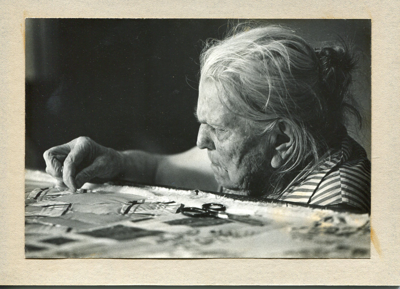
When I was still a teenager, a junior at Vanderbilt in 1969, I first met Miz Bet Kelly, the gentle guiding spirit of the land that I am now a part of. Several of my professors had gone in together and bought an isolated weekend retreat in northwest Maury County that fall — 27 acres and a house, for $3,000. The only way to reach their land was to drive through the rest of Kelly Holler. On their first trip to the farm that late fall, the professors had invited a dozen undergrad and grad students (including me) to help them christen their new land. I was very happy to accept.
My girlfriend and I came out late. After leaving the paved road and fording seven creeks — none with bridges — we arrived (we dearly hoped) in Kelly Holler. Sitting on her front porch, Miz Kelly waved at us, and so I stopped to make sure we were still on the right path. This granny woman, then 85, was sitting in her rocker. On a small bench beside her, whittling a hammer handle from heartwood hickory, sat her husband Bud — the only male child of Bullhead Kelly, and the youngest of 12 when he had been born 90 years earlier in that same cabin.
My girlfriend and I were unaware that we were just the latest in a continuous microbus convoy of long-haired collegians who asked Miz Kelly for directions that day. Even so, she seemed genuinely happy to meet us, we young'uns from "Vandy-vilt" who had come into her quiet holler that day representing another world that was only 30 miles north but at least a century removed from her reality.
Unlike all of the professors and most of the students there that cold late November day in 1969, I did not yet smoke pot. So while everyone else sat on the porch playing music and passing joints, I asked if there was any work that needed doing before dinner. I set about the business of slowly, steadily clearing the cabin's side yard with a sling blade until it was time to eat. For that small favor, I kept being invited back by the professors, back into Miz Kelly's deep holler world.
With the professors and their wives, I visited Miz Kelly later that winter, admiring a quilt she was stitching in front of her Warm Morning wood stove, using the light that came in through her east-facing window to guide her gnarled but nimble hands. When someone asked whether she ever sold her quilts, Miz Kelly chuckled and said, "Why, honey, that's why I sew 'em. Between my quilts and Bud's handles, we get by." She motioned us to another room and to a rough shoulder-high cedar chest there.
There rested at least 40 bright, beautiful handmade quilts. That day I went home with seven of them, for family and friends and for me, sold to me (over my protests) for $10 apiece. "I set my price a while back, and I'm still satisfied with it," was all Miz Kelly would say. (We were later able to talk her into taking $25 for her quilts, but never any more.) I still sleep under the Dresden Plate quilt I bought that day, made with cloth scraps Miz Kelly's daughter had collected for her from a now-shuttered Columbia shirt factory.
As my first spring unfolded in Miz Kelly's holler, taking increasingly frequent weekend breaks from school for the sanctuary that this cradled land was becoming for me, I had the chance to do some small errands and favors for her. I expanded the daffodil carpet around her cabin, hauled drinking water for her and Bud from their spring, helped her rotate the quilting frame whenever she rang a school bell that we rigged for that purpose on her front porch. Those little favors earned me some of Miz Kelly's warmest smiles, and secured a place for me at her dinner table and on her front porch any time I could be still long enough to enjoy a visit with her.
Bud was mostly silent — he was almost completely deaf by then, from his lifetime as a logger. But Miz Kelly was always happy to visit with me, to answer my questions about her land and her families' links to it, about the lives they had been allowed to live there. Miz Kelly's people, the Stanfills, had lived at the south end of the mile-long holler, and so her married life had involved simply moving two cabins deeper into that same holler. She and Bud raised eight children and several sets of grandkids in their cabin, one set (three young girls and a boy, none yet 9 years old) who were there that first spring to help me plant Bud and Bet's garden, then my own. As she became my other grandmother, I came to learn that Miz Kelly's motherly instincts had always included others like me, others besides her own blood kin. For most of her life, Miz Kelly had been the area's most trusted midwife — birthing almost 500 babies, losing only one.
Miz Kelly welcomed and molded the parts of me that belonged in that holler. She did not rush her teachings, nor ration them or her affections for me. She did, however, continually mangle my proper name until she could replace it with her own nickname for me: "Tent Boy." It reflected the summer I camped out in an old canvas tent underneath a massive black walnut tree close by her cabin, near the intersection of three farm creeks, beside the gourd spring. That is how Miz Kelly introduced me to others from that summer forward, calling me over one day to her front porch when three other country midwives had come to visit her. "This here is Tent Boy," she said, smiling at me. "He's good people."
Miz Kelly lived to be two weeks shy of 99 years old, and all but her last two years were spent living in her deep holler. During her final years, I pursued grad school and a series of challenging jobs around the country, but Miz Kelly knew (much better than me) where my home really was. So she waited, happy to see me on my occasional fly-by visits to the holler, always asking when I was coming home — to stay. That happened in 1981, when I moved back into the professors' abandoned cabin (which by then I co-owned) after a stint in the Carter administration and at Stanford, calmly encouraging the squatters I was surprised to find there to relocate.
When I was 30 and she was 97, Miz Kelly and I had one more spring together in the holler that year, one more spring of gardens and daffodils and water hauled from her spring. As summer came, I believe Miz Kelly became convinced that I was finally home to stay. Without saying a word, she handed off the reins, the responsibility and the rewards of appreciating her home — her land — to me. She left the holler to me with her blessings, and she moved in with her oldest daughter in a house closer to town — a house with running water, an indoor toilet and electric heat, but with enough room for her quilting frame to be re-hung near a different east-facing window, where her work would be illuminated again by the same old sun.
Ever since we lost her in 1983, the spirit of Miz Kelly and the life lessons she still shares with me in my sleep are allowing me to grow old here in our holler too. Miz Kelly opened her heart and her Middle Tennessee home to me, and for that I remain grateful each and every day. By the random and senseless grace of our shared Goddess, Miz Kelly became my granny woman and I became her Tent Boy. With those lucky enough to have passed through her holler, she shared gifts both seen and unseen that changed people for the better. I'm glad that when I was a young man prone to a young man's distractions, I had the good sense to stay a while.



Post a comment as anonymous
Report
Watch this discussion.
(0) comments
Welcome to the discussion.
Log In
Welcome to the discussion.
Keep it clean. Please avoid obscene, vulgar, lewd, racist or otherwise abusive language. Comments featuring hate speech or threatening or violent content will not be tolerated.
PLEASE TURN OFF YOUR CAPS LOCK.
Be truthful. Don't knowingly lie or mislead.
Be proactive. Use the “report” link on any comment that violates our comment policy.
Share with us. We'd love to hear your feedback.