
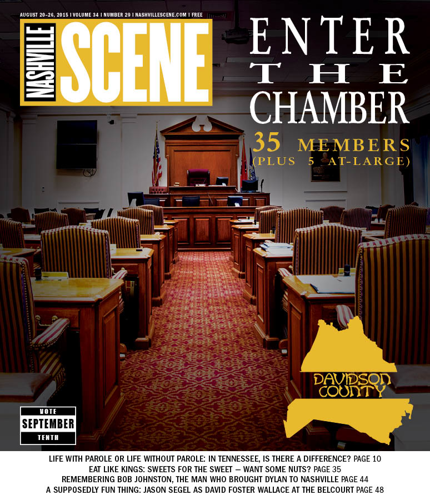


Voters may have soundly rejected changes to term limits and the size of the Metro Council in the recent general election. But that doesn't mean the council won't look significantly different after the runoffs Sept. 10. With several veteran council members seeking to step up from district representation to countywide at-large seats — and a variety of newcomers competing to replace them — the body famously described by former Mayor Beverly Briley as "40 jealous whores" is facing enormous turnover.
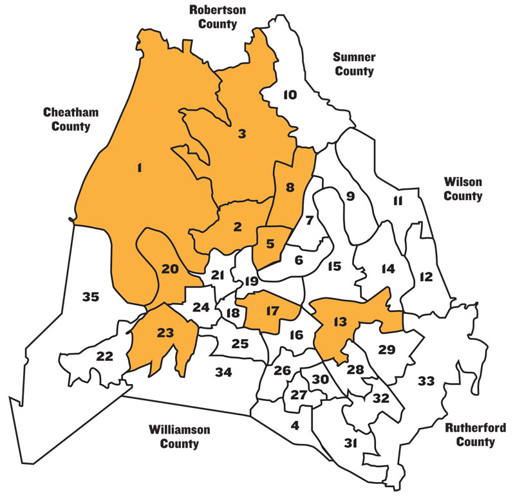
Will voters re-elect familiar faces and shore up the council's institutional knowledge as the new mayor takes office? Or will they choose to wipe Metro's slate and start with new ideas and new representation? As the choice comes to a head, here's a look at the nine district runoff races, with an overview of the 10-candidate at-large race.
District 1: Bridging the needs of city and countryside
The largest of all 35 Metro Council districts, District 1 in North Nashville encompasses the area's rural past as well as its increasingly urban future. The district includes Joelton and parts of Whites Creek, Bells Bend, Bordeaux Hills and Buena Vista. Some residents spend their days on farms, while others dwell in incredibly dense neighborhoods. Above all, it's a prime area for growth that hasn't been mined as heavily as downtown and East Nashville.
A sea of eight ran in the general election in District 1, and the two biggest vote getters, Nick Leonardo and Loniel Greene Jr., advanced into the runoff with 33 and 31 percent of the vote, respectively. The candidates grew up a mile apart in East Nashville (although they never met back then) and moved to District 1 later in life.
Both say the diverse district needs a clear plan for growth moving forward. Both are also hearing that their community wants more input and more community meetings concerning development in the area: Leonardo and Greene say voters have told them that they often don't realize a project is happening until construction starts. Because of the district's diverse nature, the candidates agree that regardless of who wins, development must respect the unique characteristics of urban and rural areas.
"And that's something I'm really hoping to create solutions to," Leonardo tells the Scene. "If I'm elected, we will have a hand and voice in the growth of District 1 so that big development doesn't win out." Leonardo, a 39-year-old attorney and legal analyst for Channel 5, says that while he and his opponent have much in common, he's set apart by his lack of political aspirations outside District 1.
"If it's not good for District 1, I don't even go to the next level to see if it's good for Nashville," says Leonardo, a single father to a 4-year-old. "I truly don't have political aspirations beyond helping District 1, and that really sets me apart."
Greene, an Army veteran and attorney, says his military background has taught him to come together with people of different mindsets to achieve mutual goals.
"Our district is going to grow," says Greene, 34. "But I want to look at how we can get in front of that. I want the right kind of development that considers whether it benefits everyone in our community. And I think I have the ability to unite everyone under one banner." —Amanda Haggard
District 2: Battling crime and poverty on the same front
District 2, in northeast Nashville, is heavily residential and includes parts of Metro Center and Germantown while bordering Salemtown. Previous council members have fought attempts to expand a rock quarry that raised alarm with residents in recent years. Poverty and gentrification are now the pressing constituent concerns facing Robert "Bobby" Stockard and Decosta Hastings, the challengers engaged in the runoff.
Stockard, 67, is a third-generation Nashvillian and a retired United Auto Worker. He's lived in District 2 more than 50 years, he says.
"I've lived and raised my family here," Stockard tells the Scene. "I want to make sure seniors, veterans and low-income individuals understand that there are other options, they don't have to be moved out of their homes and communities."
Decosta Hastings, 37, is an investment adviser who deals in insurance and helps families manage their income and become financially independent.
"It sets me apart because every day I teach to income levels that have not ever seen their kids go to college or even thought of creating an emergency fund," Hastings says. "That's the key to making District 2 better — education, and showing people the opportunities that are out there for them."
Five candidates were vying for the District 2 council seat. Hastings took in 39 percent of the vote in the district, while Stockard came in behind him by about 100 votes, garnering 35 percent.
Whoever wins in the runoff stands to inherit the third-highest violent crime rate among all 35 districts, according to 2014 Metro data. Hastings says many in District 2 are impoverished, which contributes to the amount of crime in the area.
"You tend to find that's where the biggest gaps in crime all over the county: when individuals cannot make it because there are no jobs that pay enough," Hastings says. "Those individuals who engage in crime are sometimes looking to do whatever they can to sustain life."
Stockard says that in his view, crime is up in Nashville overall because of rapid growth in the city. According to U.S. Census data, the city grew by more than 200,000 people between the 2010 and 2014 counts.
"I've been going to [Metro police] precinct meetings, and I think the key in District 2 as far as crime goes is figuring out what police need from council," Stockard says. "When you get a city growing so fast, you're going to have crime, so I'll build relationships between communities and the police to help with that." —Amanda Haggard
District 3: New blood vs. an old hand
The county's second largest district — and often one of its most overlooked — District 3 is home to old barns gazing over lush, rolling hills north of the city, and graveyards with bodies laid to rest during the Civil War. While quiet and rural, this area is also home to Fontanel, which attracts some 200,000 people a year touring the mansion or attending a concert in the nearby amphitheater.
It's "somewhat country with a city flair," says Brenda Haywood, 64, a retired Metro teacher who made her life's work reaching out to kids caught up in the criminal justice system. In the August general election, she came within 65 votes of avoiding a runoff and winning an open seat representing District 3 on the Metro Council.
After receiving nearly 48 percent of the vote when she needed 50 percent, Haywood now seeks final voter approval in the runoff. Instead of running against three candidates, she'll face off against Terry Clayton, a personal injury and bankruptcy lawyer with a political background who came in a distant second place with 27 percent of the vote.
Whoever inherits the district from current Councilman Walter Hunt, who did not make the cutoff in his own at-large bid, will represent an area stretching from parts of White's Creek and Joelton up to the county line and as far east as I-65. Issues vary throughout the district by community: creek drainage problems in Parkwood, young families wanting parks in suburban Quail Ridge, Joelton's desire for more sidewalks. But underpinning all these is a desire to maintain the integrity of the land's rural nature.
An associate minister at St. John Missionary Church in Clarksville, Haywood also conducts a ministry via her Saturday gospel radio show on 760 AM, Treasure Chest of Wellness. She also founded Royal Heirs Youth Academy for at-risk kids and organizes meetings at Olivet Baptist Church and the East Nashville Police Precinct to bridge the gap between officers, families and youth.
Clayton, 57, who briefly worked for Nashville District Attorney Glenn Funk, wants to improve infrastructure and investment in a district he says has been neglected in favor of shiny downtown projects. The former National Guardsman argues he can tap his past experience in state government and Democratic politics to effectively build coalitions to steer legislation to the mixed urban and rural district. From day one, he says, he'll know how to file legislation and tackle zoning problems.
"I think I can provide the leadership necessary to convince other members of the council to spend tax dollars in District 3," Clayton says. —Andrea Zelinski
District 5: Change, or stay the course?
In the political battles that raged throughout East Nashville in the general election, there was no shortage of sides to pick. Even so, voters on the west side of Gallatin Road still haven't decided whom they'd rather send to the Metro Council.
On one hand, they have the incumbent, advertising salesman Scott Davis. On the other, there's YWCA manager of advocacy and outreach Sarah Martin.
Voters leaned toward Davis, 36, an assistant publisher of The Nashville Pride, the newspaper founded by his father and run by his brother. He sells ads for the paper and other African-American publications across the country, a job that he says offers him the flexibility to participate in Metro government. He emerged from the Aug. 6 election with 40 percent of the vote — a tally that made him the front-runner, but a far cry from the majority needed to secure the seat.
"I'm not perfect, I have my faults. I'm getting the job done," Davis says. "Let me finish my term so I can help more people."
But Martin, a Cleveland Park community activist with a message stressing community involvement, says his time is up. She trailed by 105 votes, or about 5 percent, and she believes she can catch up.
The debate over the East Nashville district's changing character and tilting fortunes is more complicated than just gripes about hipsters, tall-and-skinnies and $8 microbrews. Certainly longtime residents worry that rapidly rising property values, ruthless development and house-flipping will force them out. And yet many others say they enjoy seeing young families walking down streets that are safer than they used to be, past better-kept homes.
"It's a very vibrant district that is going through a lot of change right now," Martin says. "Some are happy, some are not."
Both say virtually the same thing — almost verbatim — about the need for affordable housing in the district: People are scared and don't want to lose their homes. But the biggest wedge between the candidates is their view on community engagement. Both say they are accountable and accessible in the community, but Martin says constituents should know what their council member is going to do — an implied dig at Davis without mentioning his name.
Davis counters that he's constantly reachable, whether in person at community meetings at least once a week or by phone, night or day. In the past four years, what's different? More sidewalks in 2011. The opening of The Pharmacy in 2012. A recent rezoning on dozens of acres on Dickerson Road.
"If it's not broke, don't fix it," Davis says. —Andrea Zelinski
District 8: Bring on the development
"Development is not a dirty word" in District 8, according to its would-be council representative Nancy VanReece. The district starts just before Rivergate and goes almost all the way to Trinity Lane, the west side of Gallatin Pike and the east side of Dickerson Pike. Ellington Parkway runs right through the middle of the district, which contributes to the area's diverse neighborhoods.
To this constituency, VanReece tells the Scene, she hopes to bring more jobs and businesses. In the northeast corridor, the 51-year-old communications professional explains, the biggest issue looming is business going to Hendersonville rather than Madison or Rivergate.
"I think that clear communication strategies are key to any successful endeavor," says VanReece, who has worked in Christian music publishing and with nonprofits ranging from The Brooks Fund and the Nashville Shakespeare Festival to the Transit Alliance of Middle Tennessee. "And that's like breathing to me. I don't want to be a fire hose of information, but I also want our neighborhoods to be informed and feel inclined to be engaged. I want to give them the microphone, not just be their voice."
Her runoff opponent, Chris Swann, a 52-year-old clinical specialist for health care company Olympus Corp., says he decided to run after watching the area change over the past decade.
"I'd like to see a renovation instead of changes for the worse in the area," Swann says. "We went from family-friendly to a title-loan mecca. I'd like to see Madison — which is actually represented in part by five districts — how it used to be back in the '50s and '60s, which is an area people enjoyed going to, shopping and eating at."
According to Swann, the strength of District 8 lies in the diverse neighborhoods making up the area. "We have a lot more to offer than payday loans," he explains. "There's a distinct flavor in the district." He also hopes to hold the Metro Council to a "fiscally responsible" standard.
VanReece brought in nearly 40 percent of the vote in District 8; Swann came out considerably behind with 25 percent. They were among six running in the general election. VanReece said the interior core of District 8 is full of working-class neighborhoods, which she hopes she can work to preserve as a councilwoman.
"I looked at houses in East Nashville after we sold our first home around 2000, and we just couldn't afford it or fathom the lack of yard space we might have over there," VanReece says. "Staying in Madison was the best decision we ever made." She adds that while District 8 has seen immense growth recently, it is still full of "somewhat affordable homes."
VanReece ran an unsuccessful race for Metro Council in 2011. She thought she was running for an open seat, but because of redistricting she ended up running against a strong incumbent, current at-large candidate Karen Bennett (see the article here).
"Suddenly, I was running against an incumbent, and we still brought in nearly 44 percent of the vote against Karen Bennett four years ago," VanReece says. "And that told me that change was coming and that I needed to stick with it. So I did." —Amanda Haggard
District 13: A push for better transit and better schools
When incumbent Josh Stites announced in February that he would not be seeking re-election, it meant not just an open seat in airport-area District 13, but the absence of one of the few "No" votes on the slew of corporate tax-incentive deals that have breezed through the council in the past four years.
The runoff to fill his seat pits Holly Huezo, a human resource manager for Transfare Inc. at the Nashville International Airport, against Mark Cole, an assistant general counsel for the Tennessee Department of Health, after a mere 121 votes separated them in the general election.
Cole tells the Scene he had considered running before, but it took a challenge of sorts from his wife to motivate him to go for it this time around. He was complaining about the state of politics in Nashville — a big town still reliant on small-town-caliber public transportation and other features — when he says his wife stopped him and asked him why he didn't do something himself. Then again, when he told her later he wanted to run for council, he says she responded with a question he's heard from others: "Are you nuts?"
But now that he is running, Cole is clear about why he's doing it. A regional transportation solution is important, he says, but in the short term the existing bus system isn't reliable for his would-be constituents.
"A regional train system would be wonderful, but that's something that's going to happen way down the road," he says. "But you know, we can fix the bus system right now. Run more buses, run them on time, make them clean and efficient."
Also on his list is education.
"We're paying for two competing school systems," he says. "We've got to do better with our public schools." As he went around getting signatures for his petition to get on the ballot, Cole says, he repeatedly met people who told him, "We'll sign it, but we're planning on moving to Williamson County or Wilson County."
Huezo, who finished first on election day, did not respond to emails and voicemails from the Scene by press time. Her website boasts an endorsement from the Fraternal Order of Police, and it promises that she'll be accessible to constituents. It also features an acoustic campaign song: "With a heart to serve, she puts the community first/That's why my vote is gonna go, for Holly Huezo." —Steven Hale
District 17: Beyond the Fairgrounds fight
Metro political observers know District 17 best for the 117 acres of contested land in the middle of it. Four years ago, the Tennessee State Fairgrounds, and a fight over its future, riled up the district and ultimately the city beyond. An election cycle later, its effect on city politics still reverberates.
But the district has more going for it than that, and more challenges to address — as both candidates vying for its open Metro Council seat can attest.
One is Colby Sledge, a public relations pro at McNeely Pigott & Fox and a very visible player in that fairgrounds fight (on the side of Mayor Karl Dean's redevelopment plan). Sledge says the district is "a pretty good microcosm of what's been going on" across the city, with some neighborhoods looking to control development and others looking to attract it. As a result, he says, the next council representative won't be able to come in with one "district-wide vision."
His opponent, longtime social worker and 12South Neighborhood Association president Paula Foster, concurs that the district spans the economic spectrum, from the wealth and economic vitality of the 12South strip to areas of abject poverty in and around the transforming Chestnut Hill neighborhood. The key, both agree, is to create affordable housing throughout the district.
How to do that? Sledge points to a draft inclusionary zoning policy due back from Metro's Planning Department early next year, saying he's eager to support the recommendations "if they're appropriate for the city." Foster says inclusionary zoning is one tool, but that she'd draw on experience in social work and strategic planning to bring people together and find other solutions.
Listing other goals, Sledge says he wants to recruit more small businesses to the district, in part by expanding on the small-business incentives program passed by the council in response to the large incentive packages frequently offered to big corporations. He also says infrastructure improvements — from the bus system to sidewalks — are a priority, noting that busy thoroughfares 12th Avenue, Eighth Avenue, Fourth Avenue and Murfreesboro Road all run through the district.
Speaking to the Scene after a mayoral candidates forum last weekend hosted by the faith-led coalition Nashville Organized for Action and Hope, Foster says the issues NOAH has helped bring to the fore — criminal justice, affordable housing — are the reasons she decided to run in the first place.
"As a social worker for 29 years, I've dealt with the impact of public policy on people's everyday lives," she says — then adds, "I didn't go to school to learn how to communicate with people, I went to school to learn how to listen to people." —Steven Hale
District 20: As The Nations go, so goes Nashville
If there's a microcosm for Nashville's growth — and the tensions created by it — it's District 20. The booming development in The Nations neighborhood, the portion of the district that gets most of the attention, has led to an unusual demographic mix described by candidate Mary Carolyn Roberts as "mostly millennials and long-term residents."
Yet the 20th also includes the neighborhoods of Croleywood, Charlotte Park and "The Squeeze," the mix of homes and apartments on Cabot Drive squished between I-40 and the river, where the massive influx of new residents hasn't hit (at least not yet).
With incumbent Buddy Baker term-limited, the initial race was between real estate agent Roberts, 47; Metro schools behavior specialist Marisa Frank, 31; and music industry professional Frank Stabile. The Candidates Frank are vice president and president, respectively, of The Nations Neighborhood Association. Roberts narrowly lost the seat back in 2011 to Baker (who endorsed her this time around). In August, Roberts took 42 percent of the vote and Marisa Frank 37 percent. Unsurprisingly, given his public clashes with Frank, Stabile quickly endorsed Roberts, who also has the SEIU, FOP, Nashville Business Coalition and Central Labor Council endorsements.
Both candidates more or less agree on the issues facing the district: balancing growth and preservation.
"The new residents are mostly concerned with cultivating 51st Avenue and bringing new businesses to the area, where the long-term residents focus more on staying in their houses and preserving the character, charm and the reason they bought in this neighborhood from the beginning," Roberts says. Frank, nodding to her job, extends her answer to include education.
"We need careful thought on rezoning as well as infrastructure improvements like greenway connections and sidewalks to connect neighbors to our schools, parks and local businesses," she says. "Like all of Davidson County, we need solutions to start getting our residents around Nashville more efficiently. And especially as new young residents move to our district, we need strong public schools to provide our children with the best education possible."
Across Briley Parkway, priorities shift. Frank says people there are concerned about traffic generated by the Nashville West retail development — a situation that will become only more pressing as the last swath of open land in The Squeeze will soon be home to 400 apartment units. Roberts says she values the people west of Briley because many of them have families that go back generations, families who have seen boom and bust and boom again. But because many of them are older, she notes, they prefer human or phone contact rather than computer.
In the general election, Frank made hay by pointing out she was the only candidate with no connections to real estate — a zing then aimed primarily at Stabile, who owns a handful of rental properties. She's sticking with that tack now that she's facing Roberts directly.
"I think it is important to have council representation that is financially independent from the real estate business," Frank says. "While I am a career educator, my opponent is a real estate agent. I believe this puts me in a better position to more objectively guide development as it comes our way."
Roberts points out that she only just become a real estate agent this year — she previously ran a ride-sharing service — and touts her age and experience.
"Two-thirds of our council is going to be brand-new," she says. "We need someone with age, experience and the ability to forge relationships to take West Nashville off of the back-burner and to get the amenities that other areas have been enjoying for years." —J.R. Lind
District 23: Smart growth, but protect the old schools
With incumbent Emily Evans term-limited, District 23 — which includes all of West Meade and parts of Belle Meade — will no longer be represented by one of the few Metro Council members who occasionally pushed back against the executive. Three candidates appeared on the ballot in the general election: Mina Johnson, a longtime neighborhood activist who, among other things, fought against a landfill related to the failed May Town Center project in West Meade and served on the Mayor's Citizens Advisory Committee for the AMP; Jim Roberts, an attorney and West Meade Park Neighborhood Association president who served as legal counsel for Stop AMP; and Timothy Lee, a paramedic.
A fourth candidate, Thom Druffel, general manager of the Holiday Inn Nashville-Vanderbilt, was forced to enter as a write-in after forgetting to qualify in time. Druffel put up a strong challenge, but he still finished third behind Johnson and Roberts, who earned 43 and 31 percent of the vote, respectively.
Johnson, who was endorsed by Evans, emphasizes that while the district has a NiMBY reputation, she's in favor of smart growth that involves the neighborhood. As an example, she points to the successful negotiation with Harding Academy regarding the private school's athletic fields on Highway 70.
"We must strike a delicate balance to retain the characteristics of our established neighborhoods, while allowing for new development where appropriate," she says. "I understand many residents in my district are worried about high-density infill development encroaching into the heart of the established neighborhood.
"However, most of our neighborhood areas are very well protected from out-of-character multi-family development by our base zoning, as well as the West Nashville Community Plan. As the council has ultimate authority on zone changes, I am committed to preserve and protect our neighborhood from out-of-character development."
Johnson is also concerned about the future of education in the district — and the future of the properties — should old schools such as Hillwood High School be closed.
"If the school board decides to move our high school to Bellevue, I will support the community plan for this property," Johnson says. "I believe the best use will be to continue using the facility as a school, whether it remains a high school, or changes to an elementary school or some other school choices.
"If these options are not viable, the community plan specifies it as a community center and park. I do not support selling the property and redeveloping as infill development. I believe MNPS will need to consider both short-term and long-term plans regarding the many proposals under consideration — Bellevue, Hillwood and West Meade."
Roberts — who was issued a rare public censure by the Board of Professional Responsibility for personal criticism of a judge in a legal argument, and had a suspension of his law license upheld by a Davidson County chancellor — received the endorsement of the FOP and the firefighters' union. He also held a fundraiser hosted by state Sen. Steve Dickerson, former state Sen. Douglas Henry and former Gov. Winfield Dunn. He did not respond to the Scene's requests for comment. —J.R. Lind



