
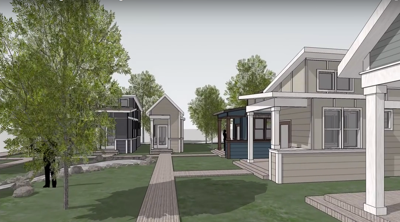


A rendering of the Village at Glencliff, a potential 22-home micro-home village at Glencliff United Methodist Church.
At Glencliff United Methodist Church on Sunday, some folks who live in the neighborhood decided to protest the church service because the church is, well, acting like a church.
GUMC is slated to open a micro-home village of 22 homes on its property for people experiencing homelessness — a project put together by Open Table Nashville, a nonprofit focused on housing, poverty, homelessness and community education around those issues.
Homeowner Dwight Laughlin, who lives near the church and came to protest on Sunday, told NewsChannel5: “We don’t know if the residents that are going to come into this neighborhood are going to be criminals, people that can’t do for themselves, or won’t get a job.”
According to a story from The Contributor, another homeowner just flat said "not in my backyard":
Pat Neil, 57, is a lifelong resident of the neighborhood. She said the project has her scared for her safety, and she fears it will result in an overflow of people experiencing homelessness into her community.“I’m afraid that these homeless people are going to bring their friends and they’re going to end up in my backyard,” she said.
“I think that there’s plenty of areas in Nashville that it could be built instead of in our backyard.”
Here's the thing: These folks are already in your backyard. Thousands of people who are homeless live in this city, and more than 80 died on our streets this past year. Not seeing them walk right in front of you does not mean they don’t exist.
Open Table has already said there will be an application process for these homes. People can’t just walk in and go into one of the tiny homes, and there will be security at night and on weekends. This isn’t like the Nashville Rescue Mission, where people can come in and out. The people who end up getting the homes will not be allowed to have guests overnight, and they’ll be required to sign an agreement stipulating they won’t drink or use drugs on the property. The nonprofit will also have a coordinator on the 6-acre property to help people get set up with necessary services — like treatment for mental health and other health issues.
We hear so often that in lieu of government support, people should turn to their churches and to nonprofits and to their community and to their neighbors for help. Is this not the very example of doing that?
In essence, these protesters are saying: Get help, just not near where we live, where we can actually see homelessness.
Sometimes a community's biggest struggle is when people who are largely invisible become visible to them.



