
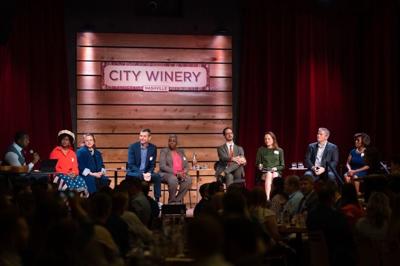


Mayoral candidates at May 23 forum
In just one of many events bringing candidates for mayor together this month, eight contenders for the job spoke Tuesday to representatives from the architecture, engineering and construction sector gathered at City Winery downtown.
The event was hosted by the Society for Marketing Professional Services Nashville, and topics included historic preservation, infrastructure, transportation and housing.
Permitting and Regulations
One of the reasons people are considering leaving Nashville, Metro Councilmember Freddie O’Connell said, is because Metro has not effectively responded to growth. “Even little things like permitting are beyond our grasp,” he said, in part because the city has been focused instead “on stadiums and racecars” and not on the nuts and bolts of governance.
State. Sen. Jeff Yarbro touted his involvement at the state legislature with legislation allowing for private codes inspections for some building projects, a move seen as loosening permitting backlogs in the growing city.
Metro Councilmember Sharon Hurt said she “would go to the experts who already know what needs to be done and the processes” in order to “get this backlog out of the way, then we can pause and assess what’s working, what’s not working.”
Republican strategist Alice Rolli said Metro needs to “completely revise” the zoning code because “it has not kept up, it’s been tinkered with on the margins, it’s become more cluttered.” That clutter, Rolli said, is “getting in the way for us to get housing built.”
Housing
Hurt said she loves “what it is we’re doing with MDHA.” She added that transient residents like college students or temporary workers should be paired up with older residents in a shared housing situation that would provide affordable living for the worker and companionship and income for the older resident.
Retired business executive Jim Gingrich said the “only way we’re going to solve” the housing situation is by bringing in private capital and offering “creative financial incentives.”
Davidson County Property Assessor Vivian Wilhoite said public-private partnerships are the solution for affordable housing and that the city should offer its own vacant land to affordable housing developers.
Transportation
Rolli said the city should continue to invest in cross-town buses and building housing along transit arteries “so it makes sense for people to use the bus.” But, she added, Nashville is among “the most car-centric markets in the country,” so we should also work on improving our traffic signal technology. She added that the city should explore options created under the recently passed “choice lane” legislation for possible deployment at the local level.
State Sen. Heidi Campbell countered that Nashville should not “concede that we’re a car-centric city.” She suggested the possibility of moving freight rail operations out of the county as a possibility.
Yarbro said traffic must be dealt with regionally, rather than only on the Metro level. Additionally, he said, the city should explore the possibility of a public-private partnership for a dedicated highway lane to the airport.
O’Connell said, “There’s no need to reinvest in planning fatigue,” as the city has in recent years put out several good plans. “Transit is a pathway to affordable housing,” he said, and the two issues should be linked together. He suggested it’s time for a renewed conversation about dedicated transit funding.
Wilhoite suggested working on expanding Interstate 840 so that trucks avoid the Nashville loop.
‘Growth’
“I’m not anti-growth, but we need to make sure we’re focused on people who live here,” said Campbell. “Growth and focusing on Nashvillians are not mutually exclusive. We can do both.” She suggested that smart cities infrastructure and a bold vision would be necessary to achieve that.
Gingrich said the city needs “a plan and a purpose to benefit people who live in Nashville” and that city leaders should be “laser-focused” on managing growth rather than a new stadium. “When you have a city that’s experiencing unrestrained growth and we don’t have a plan for how to manage it, you may end up in a place that you don’t like,” he said.
“Growth is important, growth brings about jobs, better education, it touches everything,” Wilhoite said. “With growth comes the pain. We must be prepared for that.”
Yarbro said he would have a dedicated senior staffer focused on growth. Still, he said, the “pessimism is unfounded” when it comes to growth. “The problems that we’re facing right now are problems we went after and attained,” he said. “We have the problems of a city that has been successful.” Yet it is important to “take those problems seriously,” he added, and remain focused on affordability, mobility, livability and quality of life.
Rolli reiterated her call for a simplified and rewritten zoning code. She said that a smaller Metro Council of 20 or fewer members could create a new opportunity to reset the conversation about managing growth.
O’Connell said, “Great growth is the kind of growth people get excited about, not frustrated by,” but the city has not focused enough on the former.
Hurt said we need to “make sure we are inclusive for all people.”
“We have not done the job we should have done” when it comes to planning for growth, Gingrich said.
Natisha Brooks, a retired educator, said “hashtag fix the potholes” and the city should “take taxes back to where they were pre-COVID.” She also noted an interest in trade schools.



