
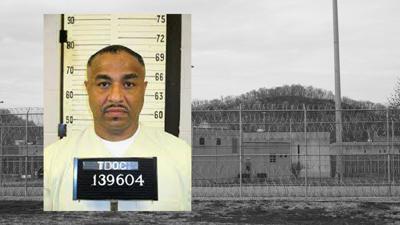

This story is a partnership between the Nashville Banner and the Nashville Scene. The Nashville Banner is a nonprofit, nonpartisan news organization focused on civic news. Visit nashvillebanner.com for more information.
“If these murders don’t qualify for the death penalty, then none ever will,” then-prosecutor Bobby Carter told the jury, according to a report in the Commercial Appeal. “If you want to know or have an idea what it’s like to suffocate, just hold your breath for 30 or 45 seconds. We can never know how Delois and Marcellos and Frederick felt.”
After deliberating over what another prosecutor had described as “horrible, almost unmentionable, haunting facts,” the jury gave Montgomery and Carruthers three death sentences each.
But in the decade that followed the trial, as post-conviction litigation played out in the courts, testimony from other forensic experts cast serious doubt on those supposed facts. Now, with the state set to execute Carruthers on May 21, his attorneys are arguing not only that forensic testing might prove his innocence, but that his death sentence was based on an inflammatory falsehood.
“The notion that the victims were buried alive is false and a myth propagated by the state at trial to secure a conviction at any cost and the most harsh punishment possible,” Amy Harwell, one of Carruthers’ attorneys at the Federal Public Defender’s office, tells the Nashville Banner in a statement.
“Since those myths have been debunked and the truth has come to light,” she adds, “two jurors have said that had they known that the victims were not buried alive they would not have voted for death.”
Still, the idea that the victims were buried alive has continued to be printed in court filings and news stories related to the case.
It’s part of what attorneys have portrayed in court filings and a clemency petition presented to Gov. Bill Lee last week as a perfect storm all but guaranteed to produce unjust outcomes. Carruthers’ profound mental illness, they’ve said, led to him running off six attorneys ahead of his trial and then presenting a disastrous defense when he was forced to represent himself. His co-defendant Montgomery was granted a new trial in 2000 after an appeals court ruled the two men should have been tried separately. He pleaded guilty in exchange for a 27-year sentence and was released from prison in 2015. But Carruthers remained on death row.

The only woman on the state's death row bases challenge on the U.S. and Tennessee constitutions and her ‘unique medical conditions’
Harwell argued to a judge in Memphis in March that Carruthers is gripped by psychotic delusions about his case and so mentally ill that he is not legally competent to be executed. The judge ruled that he is, and the issue is under appeal. Meanwhile, the American Civil Liberties Union is arguing in state and federal courts that fingerprint and DNA analysis on previously untested evidence could prove Carruthers’ innocence. The original trial did not include any physical evidence connecting Carruthers to the murders.
In a clemency presentation to the governor’s legal counsel last week, Harwell’s case for mercy touched on those issues but also sought to emphasize the reasons to believe that Carruthers’ conviction and death sentence resulted from a fundamentally unfair trial. One of those, according to Carruthers and his attorneys, is the state’s reliance on a witness who later recanted his testimony and was recently revealed to have been a confidential informant.
Another is the narrative that the victims were buried alive. In Carruthers' clemency petition, his defense team explained its significance. In the Tennessee Supreme Court’s analysis of the proportionality of Carruthers’ death sentence in 2000, they wrote, the court used the phrase “buried alive” three times.
But at a post-conviction hearing in 2005, Dr. Cleveland Blake testified that he’d reviewed the evidence from the case in 1996 at the trial court’s request and concluded that the victims were dead before they were buried. He had been available to state that during the trial, but Carruthers — representing himself and focusing on the case for his innocence — never called him to testify.
“That is, the mentally ill defendant who was sanctioned with the loss of counsel, was then faulted for failing to understand that Dr. Blake’s testimony could save his life,” Carruthers’ defense team wrote in the clemency petition.
Blake’s conclusion was echoed by Dr. George Nichols, another forensic pathologist, who testified that he found no evidence to show that any of the three victims were alive when they were buried.
Then, in 2007, the medical examiner who had originally introduced that idea — the late O.C. Smith, whose career had ended in a bizarre scandal years earlier — filed an affidavit in court stating that he could no longer stand by that opinion. He added that he believed his reassessment had led to the plea deal that got Montgomery off of death row.
Despite all that, news stories published as recently as last week have stated as fact that “all three victims had been kidnapped, shot and then buried alive under another person's grave.” Recent court filings from the Tennessee attorney general’s office have done the same, albeit with a footnote citing evidence presented at the original trial. Asked why the state continues to include that dubious detail, AG press secretary Phil Buehler points to a district court’s opinion stating that “Smith’s affidavit does not demonstrate that the testimony was either false or not Smith’s opinion at the time when it was presented.”
It was nevertheless presented, however, to the jury that sentenced Carruthers. And two of those jurors have since said it was the main factor in their decision.
“Had I known that the victims were not buried alive,” one said in a signed declaration, “I would have not voted for a death sentence.”
This article first appeared on Nashville Banner and is republished here under a Creative Commons Attribution-NoDerivatives 4.0 International License.



