
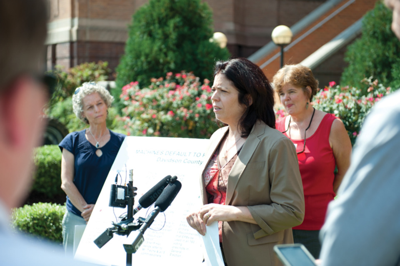

The Tennessean caught Tennessee Democratic Party Chair Mary Mancini saying something a lot of people wouldn’t think was controversial: Tennessee is a racist state.
The recently re-elected party chair made the comments at multiple recent meetings with county parties, according to the newspaper.
“We have a little bit of a problem in this state, and I’m just going to say it outright,” she said at one event. “This is a racist state.”
In another, she added “very.”
Mancini quickly apologized, going so far as to tweet a preemptive statement before The Tennessean had even published the story.
"In the heat and the frustration of seeing and hearing the constant drumbeat of bigotry, misogyny and homophobia coming from the Republicans at the state legislature, I used a poor choice of words and vented my frustration and I apologize," Mancini said. "My statement is not representative of how I or the Tennessee Democratic Party view the people of our state."
Her Republican counterpart, Scott Golden, called her statements disappointing.
One fellow Democrat, Sen. Raumesh Akbari of Memphis, offered a pragmatic approach when asked about the drummed-up debate.
“Are we perfect?” Akbari asked reporters at the Capitol. “No, not even a little bit. If you look at our horrific history, from the massacre of soldiers at Fort Pillow to the assassination of Dr. King, we live in a state that has tremendous racial issues, many of which are felt on a daily basis by African-Americans and people of color across our state.”
But, she said, the conversation should be civil.
“I don’t think we should attack, even though we are often attacked,” she said. “Those who are oppressors never willingly concede to those who are oppressed, so it has to be a two-way conversation. It cannot be someone who feels disenfranchised making that move; it has to be a meeting at that table.”
Meanwhile, a bust of Nathan Bedford Forrest, the Confederate general who directed the Fort Pillow massacre, remains prominently displayed just outside the House chambers, and Tennessee teachers recently asked students to imagine how they would punish slaves if they had them.



