
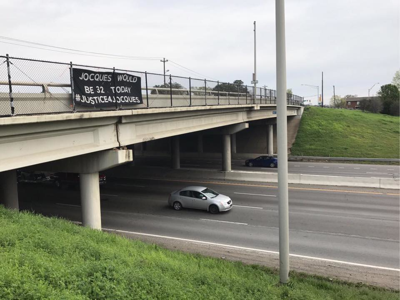


#Justice4Jocques coalition members hung this sign over the interstate today, marking Clemmons' 32nd birthday.
Nearly two months after a fatal police shooting that put the Metro Nashville Police Department under intense scrutiny, the department has refused to bow out of the case, putting it at odds with state law enforcement officials called in to investigate the incident.
Less than a week after Metro police officer Josh Lippert shot Jocques Clemmons dead in a James A. Cayce Homes parking lot as the allegedly armed Clemmons fled a traffic stop, Davidson County District Attorney Glenn Funk announced that he had called in the Tennessee Bureau of Investigation to take over the investigation. But MNPD’s investigation of its own officer never ceased. Emails obtained by the Scene show the TBI and MNPD butting heads over the matter, with Funk caught in the middle trying to get Metro Police Chief Steve Anderson to agree to an arrangement that the DA had already announced publicly. The agencies came to such an impasse that the TBI was close to walking away from the investigation and expressed doubts about its willingness to participate in similar investigations involving MNPD in the future.
The unresolved conflict could lead to a situation in the coming days where two separate investigative files are delivered to the district attorney.
A divide between the three entities was visible from the beginning. At the Feb. 16 press conference where Funk announced that the TBI would be investigating the Clemmons shooting and all future so-called “officer-involved shootings,” Anderson was notably absent. That left Funk and others to deflect questions about whether the chief was on board. When the MNPD did release a statement from Anderson, semantic differences were evident. While Funk and Mayor Megan Barry’s office used words like “taking over” and “independent” to describe the TBI’s investigation, Anderson said he welcomed their “involvement” and that his department would be “working with” the TBI.
In an email to Funk six days later, on Feb. 22, Jason Locke, deputy director of the TBI, informed the DA that there was a problem.
“Through conversation with the Metro PD Cold Case Unit, as well as through e-mails exchanged with command staff, the directive to the Cold Case Unit from their supervision on this case and all future cases is to continue as normal with their own investigation, in spite of your request for an independent investigation by TBI,” he wrote. “With this in mind, it will be impossible for TBI to conduct an independent investigation while another agency simultaneously conducts the same investigation, potentially interviewing and creating multiple statements from the same witnesses, which is contrary to standard practices of investigations.”
At Funk’s request, Locke shared the details of the TBI’s agreement with the Memphis Police Department in March 2016 as to how a use-of-force investigation there would be handled. Funk shared those details with Anderson, writing to the chief that “now that the DA’s office will be calling the TBI to conduct independent investigations, these issues must be resolved immediately.”
Five days later, Anderson responded, saying he believed “we can work out procedures, suitable to all, for parallel, but separate, investigations. Obviously, this will require a cooperative effort. We are prepared to do all that is necessary to accomplish this.”
Memphis, he wrote, “is a different city with different issues” and he “would not find that agreement an acceptable template on which to initiate our discussions. We should start from the beginning and come to an agreement that best fits Nashville.”
The group set a meeting for Friday, March 3, to further discuss the matter.
But on March 9, Locke emailed Funk again to notify him of continuing problems with the parallel investigations. He shared with Funk an email exchange between MNPD investigator Jason Reinbold and TBI agent Russ Winkler.
By that point, the TBI had identified and interviewed the passenger who had exited Clemmons’ car just prior to the shooting. Reinbold emailed Winkler looking for contact information for that passenger so that MNPD could interview him. After failed attempts to set up a phone call, Winkler emailed Reinbold to explain that he couldn’t share that information.
“I am unable to provide you with that information at this time,” Winkler wrote. “TBI does not normally discuss ongoing case information in use of force investigations with the local agency being investigated. To deviate from that procedure could call into question the independence of all of our officer-involved use-of-force investigations.”
He went on to add that “this is the first instance that TBI has experienced a situation where the local agency has continued to conduct their own investigation after we have been requested to investigate independently.”
MNPD’s Reinbold replied, still to ask for information about the passenger.
“May we acquire an audio recording of your taped interview of the passenger (sanitizing the identity of the passenger of course) or may we interview the investigator who interviewed the passenger (as your investigator has pertinent information to our investigation)?” Reinbold wrote.
That prompted Winkler, the TBI agent, to repeat himself: The TBI would not share case information with the agency it was investigating, and this was the first time the TBI had experienced a situation in which a local agency insisted on continuing its own investigation.
The following week, Anderson offered proposed a Memorandum of Understanding, a draft agreement that reflected his view that the two agencies should conduct parallel and cooperative investigations. Locke’s response a day later, couched in statements explaining his respect for and faith in MNPD’s investigators, outlined why the TBI would not agree to such an arrangement.
He reiterated that this conflict was a first for the TBI and stated that “[f]or TBI to remain effective in its mission, we cannot portray even the slightest appearance of collaboration, however innocent, with an agency where we are sent to independently investigate.”
“We have already experienced some of these issues within the current investigation of the death of Jocques Clemmons and the lack of a clearly outlined MOU between our agencies,” he wrote. “Because TBI was called in to that case several days after the incident occurred, TBI was not able to participate in the crucial first key steps of the investigative process, to include the crime scene investigation and initial interviews. Being aware of the judicial pitfalls of taking multiple statements from the same witness, we were placed in a position to rely on initial statements taken by MNPD.”
Later on, he wrote that “[t]here is no doubt that inconsistencies between two separate investigations will eventually be played out in a courtroom, other public forum, or the news media. Those inconsistencies could easily become a detriment to either the prosecution and/or the defense, depending on who benefits from the differences, not to mention the issues it could bring to either department where one agency discovers evidence that the other may not.”
Locke attached his own proposed MOU and said that without agreement to that arrangement, the TBI could not “effectively complete its mission as an independent investigator of the facts.”
Three days later, after reviewing both proposed MOUs, Funk emailed TBI officials, Anderson and the mayor. Anderson’s proposal, he wrote, “does not establish a clear line of demarcation wherein the TBI alone will conduct the criminal investigations into these incidents.” Under that scenario, he wrote, there could be no independent investigation. He requested that “all parties immediately sign the MOU” proposed by the TBI.
But in an a March 20 email, Anderson had still not done so. Although he offered concessions — such as amending his proposed MOU so that “TBI would provide no information to the MNPD and the MNPD would not have access to any information gathered by the TBI until the report is submitted to, and released by, the DA” — he said he remained “convinced that there can be separate, parallel and independent investigations.”
“More importantly,” he added, “I cannot look the other way or turn a blind eye when something of this magnitude occurs in Nashville.”
In a response sent the same day, Locke said “it appears we may be at an impasse.”
He explained that TBI had conducted several independent investigations in Memphis without any trouble, and noted that after a Tennessean report revealing MNPD’s intent to search Clemmons’ social media history, TBI had been inundated with questions about MNPD’s involvement in the investigation.
“In the interest of justice and the promotion of a smooth judicial process, one of our agnecies must step aside to ensure there is no ambiguity in the investigative process as well as the public’s perception as to how that process works,” Locke wrote. “As we offered at our meeting on March 3, TBI will again offer to step aside, pending approval by the District Attorney, so that one agency can complete this investigation and present its findings in the most efficient way possible.”
But the impasse remained. Several days later, Funk emailed the chief, the mayor, TBI officials and Metro Legal Director Jon Cooper this week’s meeting.
“I understand that the TBI wants to withdraw from the current shooting investigation and not participate in future investigations as long as the MNPD continues to conduct criminal investigations into officer-involved shootings,” he wrote. “It is also clear that Chief Anderson insists upon the MNPD conducting criminal investigations into all officer-involved shootings.”
A TBI spokesperson declined to comment on the ongoing case, and the MNPD’s spokespeople did not immediately respond to a request for comment Thursday evening.
In a text message to the Scene, Funk confirmed the parties met yesterday.
“On Wednesday morning I met with the mayor, Chief Anderson and the TBI Director in an effort to establish an MOU providing for independent investigations by the TBI on any future officer involved shootings,” he says. “I hope we will be able to reach an agreement.”
Update 3/31 (10:50 a.m.):
Mayor Megan Barry has released a statement on the rift between the TBI and the MNPD. She says "an independent investigation is important for maintaining the public's trust and confidence in the result" and that she is "confident an agreement will be reached."
This has been a learning experience for all parties involved, as this is the first officer-involved shooting in Nashville that the TBI has been asked to investigate. When General Funk made the decision to ask the TBI to investigate nearly a week after the shooting, a large portion of the criminal investigation had already been undertaken by the MNPD. Following General Funk’s decision, the MNPD immediately provided all available evidence to the TBI as they started their own investigation.There are two separate issues outlined in the emails provided by General Funk to the media: the investigation into the shooting of Jocques Clemmons and a Memorandum of Understanding on future investigations of officer-involved shootings that result in a death.
On Wednesday, March 29, I met with the TBI, MNPD, and District Attorney to discuss these issues. At that meeting, the TBI expressed full confidence in the progress and integrity of the ongoing investigation in the death of Mr. Clemmons. Throughout the investigation, both the TBI and MNPD have been committed to finding the truth and have been vigilant in collecting evidence and information that will be presented to the District Attorney in the shooting of Mr. Clemmons by Officer Lippert.
The MNPD and TBI are still working on language for a Memorandum of Understanding for future investigations. I am confident that an agreement will be reached that will establish a process for a full and independent investigation by the TBI into officer-involved actions that result in the death of another person. While we all agree that the MNPD is fully capable of conducting a thorough and fair investigation into an officer-involved shooting, an independent investigation is important for maintaining the public’s trust and confidence in the result.
I will continue working with Chief Anderson and General Funk to ensure an MOU is established for any future officer-involved shootings resulting in a death, while also hoping there is not a situation in which it would be needed.
Update 3/31 (4:50 p.m.):MNPD spokesman Don Aaron sends this statement:
The TBI is continuing its investigation into the Clemmons matter. The MNPD provided its work/information to the TBI, as this department had done a lot during the seven days prior to the TBI being asked to conduct an investigation independent of the MNPD’s.This police department welcomes TBI investigations into officer-involved fatal shootings, and agrees that the TBI would be the lead investigative agency. However, the MNPD does not believe that the Memphis MOU signed by entities in Memphis and the TBI is in the best interest of Nashville. It is essentially that MOU that has been proposed in Nashville.
We do not believe that the MNPD can simply walk away from a significant event such as this and not have continuing detail with which Chief Anderson and police department leaders can make any necessary decisions about personnel, policy, etc. As you know, TBI investigative information is confidential by statute. It could be weeks or longer before any of that investigative information could ever be disclosed to the police department’s leadership.
This police department also believes that the Nashville community leaders and the public at-large should be able to receive the initial details of a case such as this, and periodic updates.
There are differences of opinion presently with the TBI. Chief Anderson has the utmost respect for Director Gwyn, professionally and personally. He remains optimistic that a solution agreeable to both entities can be reached in regard to the MOU issue.



