
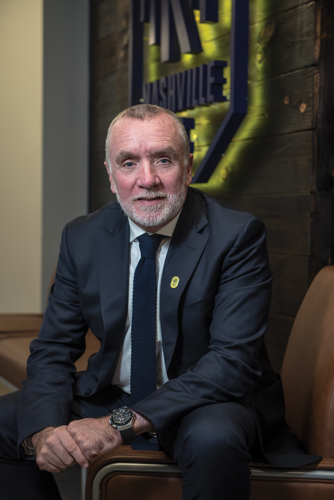

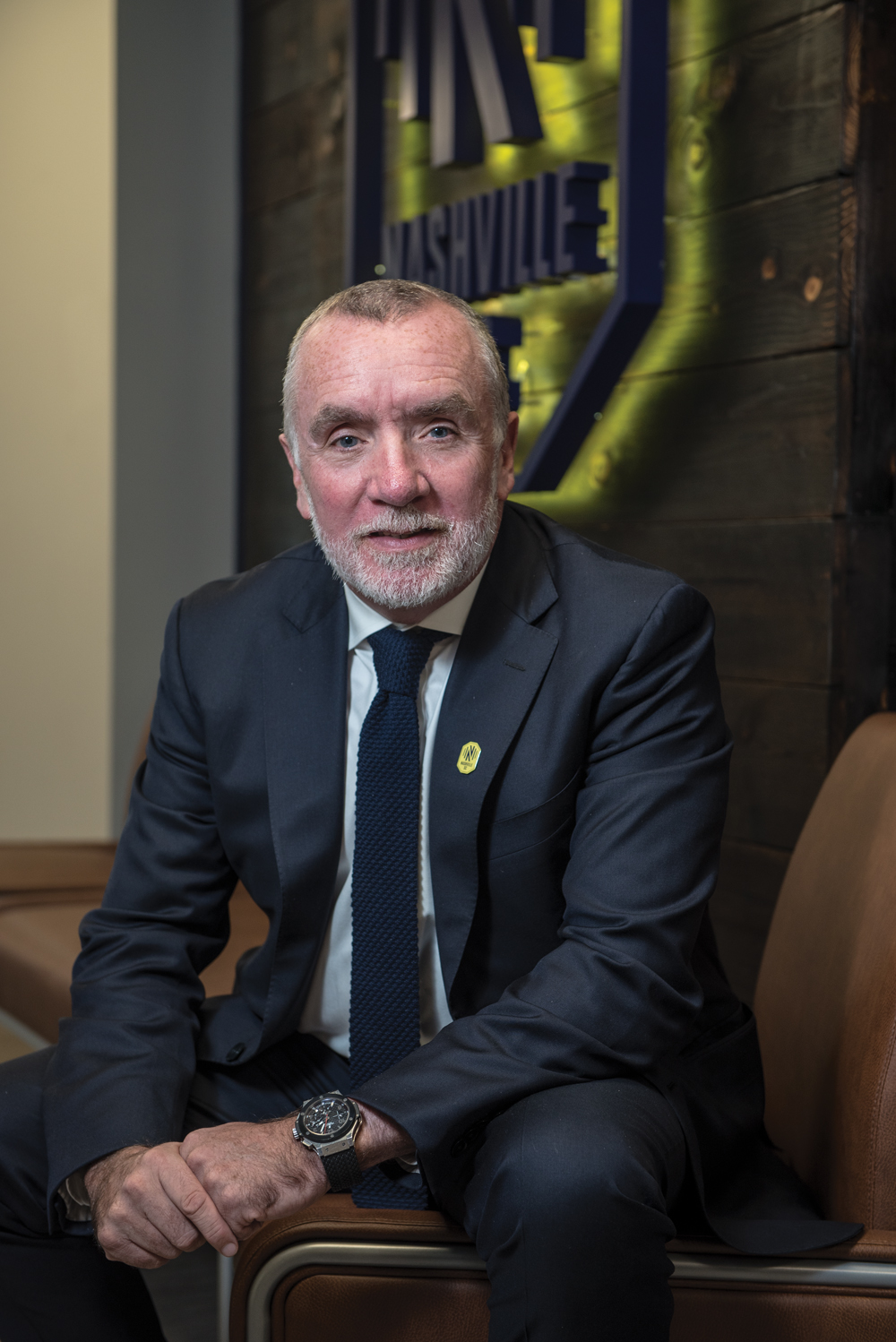
This week's Scene cover story takes a look at Nashville SC in two parts — the forthcoming stadium, and the team itself. Ahead of tomorrow's inaugural game, we also sat down with team CEO Ian Ayre. Have a look at our conversation below.
You're new to MLS and the U.S. What have been the major differences you've seen so far in coming into soccer here?
I actually wonder how long I'll be new for. I've been here nearly two years now. But I think a few things stood out in the process of building. One is obviously the way you compile a roster in MLS is very different to the way you compile it in Europe. Although, England's not in Europe anymore, so I should say England. But it was when I was there. That's probably the fundamental difference, in terms of the team, is that you have very specific budget constraints, and then, you have segments within those budgets. So that was a learning curve and was a big part of the importance of choosing the right person when I chose Mike [Jacobs] as our GM, as somebody who knows this market inside-out, and has worked at all sorts of different levels, from MLS to USL, to college soccer. That was a big change.
And I've personally learned over the time that, I think a lot of that makes sense, in terms of a growing and developing league. And as much as MLS is striding forwards, I think some of the methodology in there, I think's been really important to protect the league and players in terms of the growth — so the players weren't getting dragged off too easily, and are more committed to the league. I think that's a moving target, but that's a big difference.
I think the other big fundamental difference — for me, again personally — is that I went from running, in Liverpool, a team that's 127 years old, and I always described it like the supertanker of soccer. It's like, trying to change course in that thing is really hard, because it's hard to not make a difference, but it's hard to make change. Change is very difficult to come by, because it's an established, historic juggernaut of soccer. [Nashville is] new, so we're not really trying to change anything, but I love that MLS almost embraces change when it's needed. It brings new things to the game, it brings new ideas. It's always willing to take on a new idea. I seen something recently about trying to speed up the game and have these stands at the side of the goals where the balls will be, so when the ball goes out of play, the goalkeeper can get the ball. And I think there are things they'd love to change in some other leagues around the world. But effecting change, as you see — [video assistant referee] is an established, and I feel, well-run product in MLS. VAR in the Premier League is an unmitigated disaster at the moment, it feels like.
I want to talk about fans and how you acquire fans and ticket holders as a new franchise. How do you approach doing that? How do you tap into what may naturally be there, versus expanding that into what you guys hope is going to be a big season ticket base?
It's been a process, and I think it will continue to be so. And the process starts with, I guess, the start of professional soccer two years back in Nashville, where the initial base of people that come to it are obviously the core soccer fans that love the game. They're either people who were supporting other teams in the U.S., or amateur teams, or overseas teams, or whatever. So in relative terms, they're kind of the easiest to capture, because they just love the game and the fact that professional soccer is now here. And for this year, the fact that the top level of professional soccer is here. They're the low-hanging fruit, so to speak. And we were very lucky in that in USL we established a good base there, and we built on that base. That's really the bedrock. It's kind of like the sort of central piece of what you're trying to create. And then, from there, being very thoughtful about going out and building from there.
So you're then looking for people who may be soccer fans who haven't come at USL, and see MLS as a bigger, higher bar. And then, you're looking at people who are kind of on the periphery of that, who are [maybe] latent soccer fans. It's like an ever-increasing circle. And then the next layer is sports fans. I would categorize myself as that. Since I moved to the U.S., I've watched a ton of football, a ton of hockey, a ton of baseball, which I never really — I watched a little bit of football when I was overseas, but I'm just a sports fan. If the sport's on, I'm in. And if there's an opportunity to go, I'm in. I think there are a lot of those type of people in our market, and that's the next base.
And then the final part, I guess, is the civic-pride people. The people who just love Nashville, or people who love what's going on in Nashville and want to be part of it.
Is it going to be hard to do that in a stadium that's not yours to start?
It is. And I think we'll do our best with that, but it's why I say that it's easy to try and judge too early. It's a marathon, not a sprint. And I think best example in that regard in recent times is probably Minnesota, who — them and Orlando both — followed a similar challenge. There was a couple of years in a football stadium, and then moved to their own specific stadium. And you look at Minnesota last year — sold out, big crowds, great energy. I went up there. The stadium's fantastic. They've got that whole "Wonderwall" thing going on.
But there were a lot of people, and obviously I had to research all this stuff when I arrived. There were an awful lot of people judging Minnesota early on, and that's fine. That's life.
Product on the field didn't help.
Yeah. And that's right. But at the end of the day, it was the same. They will have their own plan, and product on the field is the hardest piece to get right, because there's every other team in each conference trying to win as well. But I just think that that's an important point, that of course, we're so grateful that the Titans and them welcome us into their venue, but it's not a soccer venue, and it isn't ideal for soccer. But it is what it is, and it's what we have to work with. We're very grateful, and we'll make the best of it, but it won't be the finished product until we unwrap our new home.
Serious but non-serious question: How long did it take you to make the transition to saying "soccer" regularly, instead of "football"?
You know, I think I did really well. I've going to give myself an A-plus. The worst thing that's happened to me so far is, I went home to England — I went to a Liverpool game. I was in England for a couple of meetings, and went up to see my mom at the weekend. I managed to go catch a Liverpool game, and I was talking to somebody in a lounge at the game, and I kept talking about soccer, and they're all just laughing at me.
That's funny. Let's talk about the kind of on-field piece of it. There's a couple of things that sort of strike me. Coach Gary Smith seems like a continuity piece. Was he always going to come up with the team from USL, or was there an evaluation made?
Yeah. There was an evaluation. When I arrived, obviously Gary was already here, Mike was already here. Yeah. I can't comment on why he was picked for the USL team, because I wasn't here and I wasn't involved in that. What I would say is, when I arrived, obviously I had like 20 years experience in this sport, but zero experience in MLS. I felt, in order to do my job correctly, I had to consider all commerce. So, I sat with Gary very early on. I did similar with [general manager] Mike Jacobs, actually. And I said, "Look, you absolutely will be in the mix," this was to Gary, "for the coaching job for MLS, but so will a bunch of other people, and I want to be that open and honest with you, because I'm going to go and interview people. I'm going to consider people, because that's the right thing to do." I had a very clear set of criteria in my own mind of what we were looking for. And as we went through that journey, and I'm not going to say who the other people were, but they were from far and wide. Again, there were domestic coaches, there were international coaches, there were MLS-experienced, non-MLS-experienced, and there was Gary.
And it got to a point, probably when we got down to five, six coaches, where you have to value. ... Gary was valuable in his own right, but you have to value the opportunity of continuity as well. And I said to him at one point in the journey, "This is yours to lose, right? Because you've got" — this was in the second season of USL. It was critical being able to see Gary — and I've been around a lot of coaches, some pretty big-time coaches over my time — getting to see them and the way they operate, and the way they work is so valuable. And that obviously isn't possible with some of the others, not to the same degree. Over time, it was easy to see that Gary, he puts the teams together that are very difficult to beat. He's good with the players, he's not afraid of having difficult conversations with players, and that seems like an obvious thing, but I've seen and been around coaches who struggle with that. He's very honest, in the sense of, if you get beat, he'll tell you why you got beat. And if he feels he's culpable in that defeat, he'll tell you that. Doesn't make excuses. And got Nashville in the playoffs two years in a row from USL. He's won the league, won the MLS cup before.
There's a tremendous amount of data that's available on players now. What do you know about a player before you would sign them now, versus, say 10 years ago?
What I'd say first is that you're absolutely right. It's moved significantly. It's also one of the areas where Mike Jacobs would say is, "It's one of the areas where I felt, from day one, that we could make the most difference." When I talked about those margins of difference, being really, really well-equipped to do really effective recruitment was one of the areas we invested right from the get-go. And it's a combination of systems and people. And as you say, the amount of data. ... The fundamental difference, of course, between this sport and other U.S. sports is, you're fishing in a global pond for talent.
If you're going to go and find a wide receiver for your football team, you kind of know where you're looking, right?
Right.
Which country you're looking in, pretty much. Whereas the best 21-year-old winger for soccer for Nashville could be anywhere, literally, in the world. So, it's impractical to think that you can do that, like the old-school days where you sent your scouts out looking. And there's still an element of that, but you've got to be able to refine the data to the core of what you're looking. The systems now are so complex that, you build out all of the tags and elements that you're looking for, this age, this profile, this passing accuracy, this, this, this, this. And then, you refine that down. Is he an international player, or a domestic player? Because you have limits on your team. What age group do you want him in? What sort of physical profile are you looking for? What experience do you want him to have?
And little by little, that process and the systems within it refine. ... You might start off with 1,000 players that hit, and then, you start to refine those things and you get down to a very small group. And then, you start the human part of it, where you've got scouts going out, whether there our employed scouts, or kind of retained scouts in other markets, and they're doing match reports on players, and you get a closer. ... You're literally sifting down until you get to a handful, and then, you're going out, at the highest level, whether it's Mike or Chance [Myers], or Ally Mackay, the core of our recruitment team. They're then going out and, A) watching the player. And then, when you get down literally to the last few, you're then trying to find out who the human is behind the player, because we've been big on our values as an organization, but also in assembling our roster that, again, look across teams where big, disruptive, albeit fantastic players, can be fantastic on the field, but can be very disruptive to what happens off and can tumble things down.
Toronto and several other clubs over the past few years have invested heavily in the analytics department. Is that something the club here is going to do?
We have it, but that's what I'm talking about. We've had that since three weeks after Mike was appointed. We started that process together.
How many folks?
We have a bunch of folks in it, but I would say that, in Oliver Miller-Farrell, who heads that team up for us, Opta is probably, I would say, the preeminent data specialist in this sport. Oliver was the lead person for MLS for all the teams. He's our head of analytics. So we went and got the best guy, in my opinion, in the U.S., in the best organization for analytics in the U.S., and he was our first appointment in that space. And I think that speaks volumes about how much value we put in this. I loved reading, in the last couple of days, that we were, I think, ranked bottom or second-to-bottom in the league, depending which sort piece of information you read about how we'll do this year. I love that, because it's like, how anyone can work that out, based on nobody having kicked the ball yet, is incredible. We'll take the underdog every time.
Let me ask a couple things about style. I mean, Americans tend be very score-oriented. Do you think it's important to score goals?
Definitely.
I know what you mean. I mean, I think it's an interesting, because of course, you want to go out and score lots of goals. I think, of course, you want to go and win a lot of matches. But I think when push comes to shove, you want to have more points on the board than everyone else, and how you get to that outcome will be a combination of high-scoring games and low-scoring games, and draws, and losses. I think that if you look at our evolution in USL, in our first year we played, we were difficult to beat. We played a lot of counterattack, and it wasn't maybe the most exciting that everybody wanted. In our second year in USL, we really focused in that offseason — Mike and his team focused on finding real firepower. We wanted to add more goals, and we knew we were strong defensively, but we added there as well in bringing in Jimmy Ockford and Forrest Lasso. So we kind of strengthened them both. And that learning curve last year, about you'll have some people who'd say, "Oh, Gary Smith, defensive coach." We think Gary Smith builds great teams that are hard to beat, but he also proved last year that if you're arming with the right offensive players, then, well, we can go score goals as well, and we did. And we have the same plan.
You mentioned players, and budget, and sort of where it meets up. The big question for any franchise is when you're looking at designated players, because the role of that in the MLS is such an outsized piece. If the club were to go out and look at another designated player, what would the criteria for that be? I'm sure it's on field, but a lot of clubs have used designated players to sell tickets, or they have used it as kind of a lure for a certain fan base.
Yeah. Look, I think if we were going to go out and buy players to sell tickets, we'd have done that way before now, right? We're like 26 days away, or something. I think, in general, our view is that we want — as I said earlier — we want to sign players that make a massive contribution on the field. Of course, we want to sign great humans who make a contribution off the field as well. I think, as a natural process of looking for the right players, I'm not saying that we won't find a player at some point, whether it's this season or in the future, where we go, "Oh, we'll sign him. And guess what? He's this big name." And for whatever reason, that all fits together. But we're not actively looking for brand-ambassadors-type players that move that needle in that way. ... I've been around more of those players coming this way, the most having been in Premier League. And I just think that, taking a player, for instance, let's use our current DP in Hany [Mukhtar], taking a player who is young, dynamic, exciting, got a lot to prove for himself.
So here's the player. If he comes and lights it up in MLS, then who knows where his career goes, whether it's at Nashville or wherever? But that, for me, smacks of this city of the energy and this growth. And they're the types of players I think our fans will want to see out there — somebody that excites them, and they feel like he can be here for however long he wants to be here, and can kind of grow with our team. I think aging, older stars, it works for some people. I don't know many teams that win, like really win, with those types of players. I mean, there's been some incredible moments around some of the players, but not a lot of success in terms of overall success. I think there's a place for both. I think it works in some markets, it works for some teams. It's not something we would say we'd never do, but I don't think it would be the lead on our recruitment. It wouldn't be, "Let's go find somebody who's just a big name, and we'll sell tickets for this market or that market." ... We want to have great soccer players who massively contribute.
Can you add that level of player, another DP, and not be in your own stadium?
Yeah. You could do it. Of course you can. Because at the end of the day, whether we're selling tickets for Nissan Stadium, or our new stadium, we're just selling tickets, right? We want as big an audience as we could get. For me, I just think it's a short-lived value proposition, and we're not, as I said right at the start — this is a marathon, not a sprint. We're not trying to be flash. Nashville is not flash, right?
I think that's pretty accurate.
But in a short period of time, it's like, flash doesn't really work. And I'm not saying our fans wouldn't love us to go out and have Mo Salah turn out for us next week, but I get it. But if that player who comes is older, has less to contribute, versus a Randall Leal, or as I say, a Hany Mukhtar, or others that are in and around there — if you take Atlanta's huge success, which we have massive admiration for, when Josef Martínez and Almirón turned up, nobody was really going, "Oh my God, they've signed —" And now, for a couple of years there, they were the golden children of MLS, right?



