

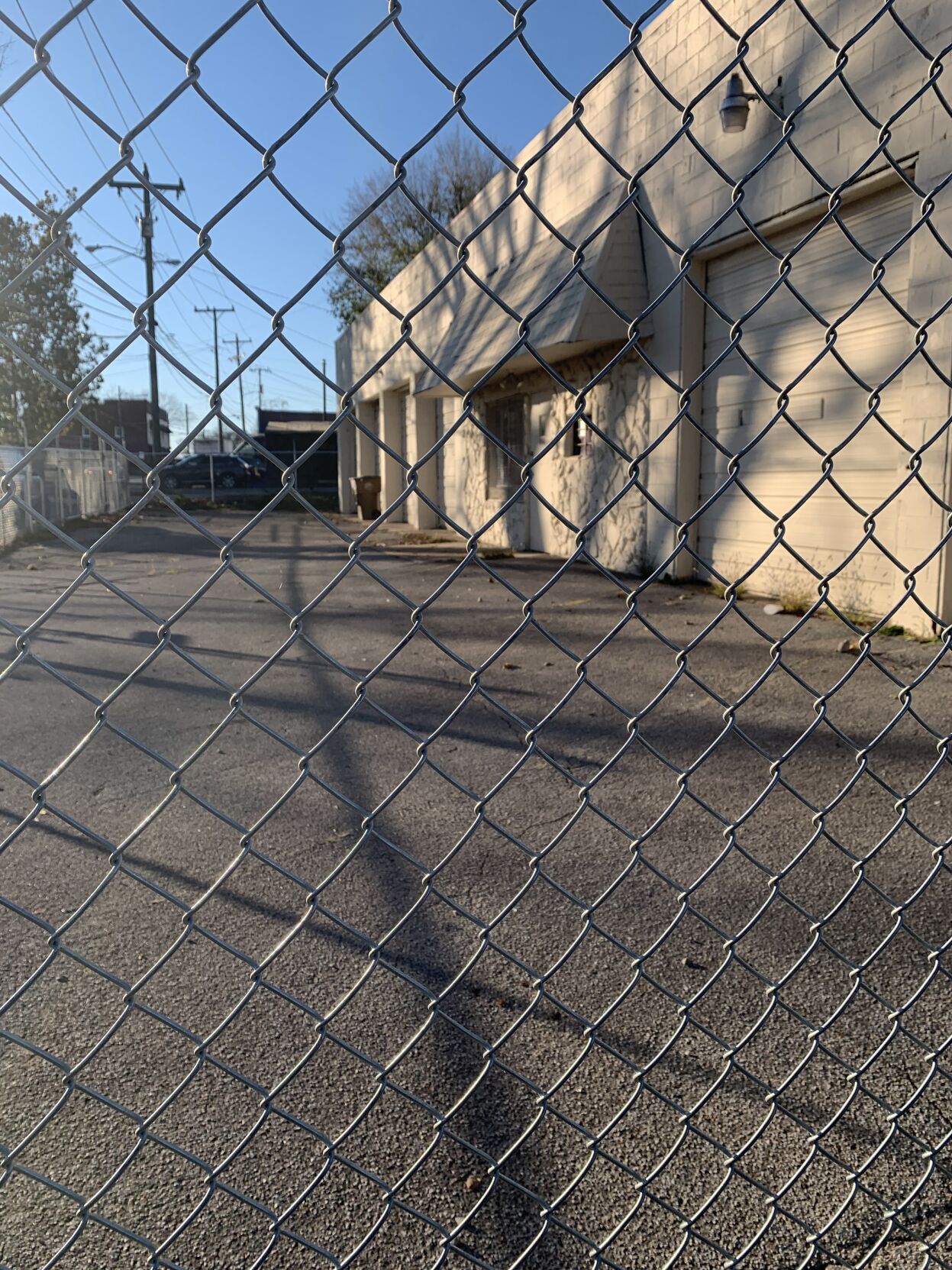
A garage at 1700 McDaniel St.
If you go down to Pulaski and know where to look, the building where the Ku Klux Klan was founded is still standing. There’s a plaque on the building that memorializes it as the birthplace of the Klan, but you can’t read it anymore. That's because, after racists started making pilgrimages to the site, the owner of the building turned the plaque over so now all that’s visible is a blank sheet of metal, like someone attached a cast-iron cookie sheet to the wall.
I have been thinking about that building and whether it is right to preserve it. I don’t know. When I think about the enormous amount of evil that transpired in this country because of decisions that were made in that building, I kind of think we should burn it down and salt the earth where it stood. But I’ve also been a white person my whole life, and I know how we are, and I know many of us would view the destruction of that building as a way to conceal our country’s crimes, as a way to pretend that the past didn’t happen and doesn’t affect us.
There’s something powerful and important, I think, about being able to point to that place and say, “All that evil is real, and here is where one iteration of it started.” But you can’t control people’s thoughts about a place. What some folks view as accursed, others view as blessed. Leaving it up but not acknowledging it seems like a reasonable, if unsatisfactory, compromise. I guess. I have mixed feelings.
I bring this up because I now know the location of a garage here in town that was a Klan hangout in the 1950s and early 1960s. It is likely that our unsolved integration-era bombings were planned there and that the Hattie Cotton bomb, at least, was constructed there — at 1700 McDaniel St.
The garage itself isn’t much to look at, at least from the outside. I haven’t been inside and I don’t know if I’d want to visit. But it’s still there. Every time I drive home out Clarksville Pike, I catch a glimpse of it. I just didn’t know it had any significance.
Some things that are interesting about the building you don’t need the actual building to appreciate. You don’t need to go see it to know that McDaniel Street is deep in North Nashville, and that you wouldn’t expect a Klan hangout within walking distance of Ed’s Fish House. Just looking at it on a map told me that my belief that Nashville was always as deeply residentially segregated as it is now was wrong. And looking at the old deed told me that there was a good decade or more when there was something peculiar about the ownership of the building. Every 18 months or so, it would pass into the hands of another racist here in town.
One of the guys who briefly owned the building was also running around committing insurance fraud by burning down homes he owned in the area. One newspaper article reported that one house was a complete loss because the Joywood firetruck broke down on its way to fight the fire. This struck me as odd at first, since Joywood is clear across the river, the area around Tom Joy School in East Nashville. But at the time, 1700 McDaniel wasn’t in Nashville. The city limit was Clay Street. There were Nashville firehouses closer, but that was the closest Davidson County firehouse.
But I have found going to see the building and standing outside it to be really important for my understanding of these terrorists. When they stepped outside for fresh air or to have a smoke, they saw the Jewish cemetery. They encouraged each others’ antisemitism across the street from those graves. If they ever looked over and saw grieving families burying their loved ones, it didn’t move them to feel empathy for those people. It didn’t stop them from aiding in the bombing of the Jewish Community Center.
And driving from Z. Alexander Looby’s house to the garage — seeing just how quickly a bomber aligned with the Klan could be out of town and tucked away behind a garage door — is bone-chilling, but also very clarifying.
And who knows what the inside might tell a trained investigator?
I believe in historic preservation. I think keeping and reusing old buildings is vastly preferable to tearing them down. I also think that we don’t even know what these old buildings might tell us — and if not us, then future historians. And I know, just by driving around that neighborhood, that 1700 McDaniel is in grave danger of being sold off and torn down and replaced with something else.
Is it worth trying to save it? We’ve done a really shitty job as a city preserving our positive landmarks of the civil rights era. I wouldn’t want to expend more effort on preserving a KKK hangout than on, say, Robert Lillard’s house. I’m not really worried about revealing the location of the garage, because I doubt current-day racists have much interest in coming into a very Black neighborhood in order to mill about outside the fence around a plain-looking garage. But like I said, changes are happening to that neighborhood, and leaving it up could make it a draw for racial terrorists.
I can’t think of another Nashville landmark that was preserved because of its importance to the terrible side of our history. Yes, we have our share of antebellum houses, but they were preserved under the premise that they were homes of great people, not sites of racial atrocities. We’re still struggling to get those stories told in those places. There are some Civil War sites that remain, but we don’t keep them only to grieve and try to come to terms with evil.
Frankly, I’m not sure we’re capable as a city of setting apart a place where great evil was done and understanding and acknowledging that when we visit. I’m not sure how many people would find that to be something they wanted.
But I also think of how few of the white people who opposed integration in the city are known to the city. We keep pretending as if they can’t be known, as if it was too long ago and the past is just too hazy. But here’s a place where racists congregated and plotted against the city. Still standing. For now.
Should we make any efforts to keep it that way? I don’t know, but I feel like it’s a choice we should make as a city and not have it made for us.



