
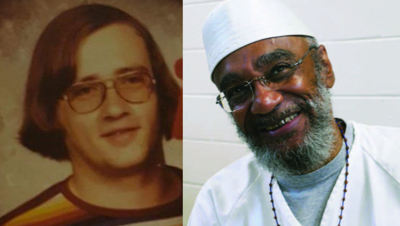


Sedley Alley (left), Abu-Ali Abdur’Rahman
To believe in the death penalty — not as some hypothetical moral issue but as it is actually practiced — one must buy into the idea that a criminal justice system that is inarguably flawed and corrupted in myriad ways is suddenly above reproach when the stakes are life and death. Its failures, like the 166 death row exonerations that have occurred nationwide since 1973, must only be the exceptions that prove that rule. If not that, one must have the stomach to ignore the death penalty’s failings and to resist any effort to expose them.
Such is the devotion of Tennessee officials to the killing of condemned prisoners. It's not so much a matter of policy to them, it seems, but rather a matter of faith. They conform to its will as if it were a god.
Two death penalty cases being contested in Tennessee courts right now reveal this obscene dynamic. One is the case of Sedley Alley, who was executed at Riverbend Maximum Security Institution on June 28, 2006. The other is the case of Abu-Ali Abdur’Rahman, who the state is seeking to execute in that same death chamber on April 16.
Alley’s case was brought back to the fore in May, when attorneys and Alley’s daughter, April, announced they were seeking DNA testing in an effort to confirm what they believe: that Tennessee executed an innocent man 13 years ago. In a court filing in Shelby County and a letter to Gov. Bill Lee, they asked for DNA testing on evidence taken from the crime scene where Suzanne Collins' body was found in 1985. In particular, men’s red underwear that the police believed were worn by the murderer. Such testing had been blocked by the courts — despite a recommendation from Tennessee's Board of Probation and Parole — before Alley’s execution, but the Tennessee Supreme Court ruled in 2011 that they’d been wrong to do so.
Even in the immediate aftermath of Alley's execution, his attorneys were vowing to seek the truth.
“God help the people in this process if the DNA proves he didn’t do it,” Kelley Henry, an assistant federal public defender who represented Alley, was quoted in The Tennessean as saying after the execution. “We will test the DNA.”
Alley had confessed to the rape and murder of Collins, but his attorneys say his case had all the hallmarks of a false, coerced confession. They point to parts of his confession that matched police theories at the time, but ended up being false. Alley told his daughter before his execution he did not remember committing the crime.
Shelby County Criminal Court Judge Paula Skahan heard arguments Monday morning about whether that testing will happen, and a prosecutor was on hand to argue that it should not.
From the Memphis Commercial Appeal:
Steve Jones, assistant district attorney, argued that Tennessee law guarantees a right to post-conviction relief for "a person" who has been convicted or sentenced. In this case, the petition was filed by the estate for Sedley Alley, not the person, he said.He also argued that the circumstances under which the Tennessee Supreme Court ruled on post-conviction DNA testing were different than Alley's case.
"He would not be entitled to post-conviction DNA testing if he were alive today," Jones said.
It’s not clear yet what position state officials higher up the ladder will take on the case. But for now, the fact is simple: DNA testing could answer the question of whether Tennessee executed an innocent man 13 years ago. A representative of the state stood in court Monday morning and argued that we should not find out.
Meanwhile, state Attorney General Herbert Slatery is fighting to make sure that Abdur’Rahman, a black death row prisoner from Nashville, is executed next year despite clear prosecutorial misconduct in his 1987 trial, including racial discrimination in jury selection.
Abdur’Rahman has been on death row for 32 years, since he and an accomplice were convicted of killing Patrick Daniels and stabbing Norma Jean Norman during a robbery. Norman survived, and her two daughters — both of whom were in her home during the attack — were in the courtroom in August when Nashville District Attorney Glenn Funk submitted a proposed order vacating Abdur’Rahman’s death sentence and replacing it with a life sentence. They later told reporters that they believed it was a just result, and that Zimmermann should be disbarred.
“Overt racial bias has no place in the justice system,” Funk told the court, adding that “the pursuit of justice is incompatible with deception. Prosecutors must never be dishonest to or mislead defense attorneys, courts or juries.”
You can read more details about then-Nashville prosecutor John Zimmermann’s conduct during the trial. But suffice it to say that it was blatant and clear enough that the city’s current elected district attorney took the remarkable step of agreeing with Abdur’Rahman’s attorneys and telling a judge to spare his life. And the judge agreed.
But several weeks later, Slatery announced that his office would be fighting that agreement in court, arguing that it was “unlawful.” On the same day, his office filed motions with the Tennessee Supreme Court seeking execution dates for nine more death row prisoners.
Slatery has declined to be interviewed about these decisions but his absolute faith in the death penalty is illustrated by his deeds. In his press release announcing that he would challenge the decision to drop Abdur’Rahman’s death sentence, Slatery did not address or refute the claims of serious misconduct by the prosecutor in the case, except to wave them away by claiming they had already been litigated.
Even still, the effect is the same.
“When the appointed attorney general is appealing this decision, he is not representing the state of Tennessee,” Henry, the assistant federal public defender, said during a press conference at Christ Church Cathedral last week. “The state of Tennessee has been spoken for by the duly elected district attorney general, who was given the authority by the Constitution and the statutes of Tennessee to do justice in this case. No, instead, the appointed attorney general is defending the rogue prosecutor’s racism and deceit. That’s what he’s standing up for.”
Later, Abdur’Rahman’s attorney or more than 20 years, Bradley MacLean, questioned what master Slatery was serving.
“The AG claims he is upholding the ‘rule of law',” MacLean said. “Our question is what rule of law is he talking about? Is he talking about a rule that says it’s OK for a racist prosecutor to use race in jury selection? Is he talking about a rule that says it’s OK for a prosecutor to be dishonest? Is he talking about a rule that says our criminal justice system cannot correct a grave error? Is he talking about a rule that says it’s OK to inflict cruel and unusual punishment? Is he talking about a rule that says a district attorney general is not to gain justice, but rather he is to pursue a victory at any cost? Those are not our rules of law.”
MacLean went on to note that two judges have set aside Abdur’Rahman’s death sentence, something that has never happened before in a Tennessee death penalty case. He also emphasized that every judge and court that has reviewed the case acknowledges that Abdur’Rahman’s trial lawyer failed to provide him with an adequate defense.
MacLean quoted four judges in different courts lamenting the problems with Abdur’Rahman’s case. Among them was Sixth Circuit Chief Judge R. Guy Cole Jr.
“The prosecutor desecrated his noble role,” Cole wrote. “He failed grossly in his duty to act as ‘the representative of a sovereignty whose interest in a criminal prosecution is not that it shall win a case, but that justice shall be done.’ Abdur’Rahman may face the ultimate penalty as a result; Justice will bear a scar.”
As it stands, some of Tennessee’s most powerful officials would rather sacrifice Sedley Alley and Abu-Ali Abdur’Rahman on the altar of the death penalty, preserving their faith in it at all costs — lest they be forced to truly reckon with the failures of the system they oversee.



