
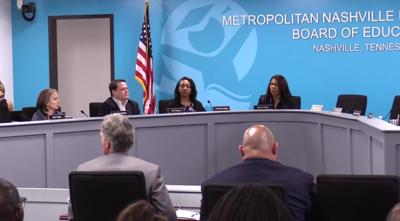


The Metro school board approved a buyout agreement Tuesday night with Metro Nashville Public Schools director Shawn Joseph. The agreement terminates Joseph's contract and brings an apparent end to months of enmity between the board and Nashville's first African-American superintendent.
Under the agreement, Joseph will be relieved of his duties as schools director on April 12, but he will continue to receive his salary until July 31. At that point, MNPS will write him a check for $261,250. Joseph was hired in 2016 under a contract that ran until 2020.
On Tuesday night, the board appointed MNPS Community Superintendent Adrienne Battle the interim director of schools, making her the first African-American woman to hold the position.
Joseph released a statement after the meeting:
It has been my honor to serve as Director of Schools in Nashville. I believe much has been accomplished despite the pervasive challenges I encountered when arriving, and I am so proud of the tremendous work of the thousands of teachers and staff members who have helped to move the needle for our children.It is my hope that this momentum will continue to build. My life’s mission is to ensure equity and excellence for all children, and I will continue to be a vocal and action-oriented advocate for every child, family and employee in the school system.
Ahead of the board's 5-to-3 vote to approve the severance agreement, board member Amy Frogge argued that Joseph should be fired with cause and without any further payment. She ran down a list of recent controversies surrounding Joseph, including allegations that he mishandled sexual harassment claims against MNPS employees and illegally arranged expensive no-bid contracts for familiar vendors.
“Under these circumstances, I think it would be wrong to give the director more money,” Frogge said.
Joseph denied those allegations, and more, at a meeting last month. Although an audit initially appeared to clear the director, a revised audit released in March detailed nine violations of district procurement policies. The audit did not find, however, that Joseph and his staff had intentionally worked around policies to commit fraud.
The multiple controversies swirling around Joseph — aggressively covered and occasionally sparked by NewsChannel 5 — have quickly become fraught with questions about whether the first black leader of Nashville's schools is facing undue scrutiny. Board member Christiane Buggs expressed frustration about the appearance that issues raised by black teachers and district staff were being used as a cudgel against the black superintendent.
“It’s been frustrating to continue to have this race discussion where African-Americans are almost pitted against one another," said Buggs. "I will say again, we are not a monolith. We are not a monolith. So there may be African-Americans — better yet, there are probably several African-Americans — in the district who have had different issues. That’s been the case forever because they are professionals. They are entitled to be frustrated with their principal or to need more resources or to want to be paid more money. But again, I don’t think that that should discourage the idea that those issues were here before a black man got here.”
“I am frustrated by the laying of these frustrations at his feet,” she added.
Board member Will Pinkston, who abruptly announced his resignation last month — citing the treatment of Jospeh, among other things — defended Joseph and made an apparent reference to Frogge's case against him.
“I thought about trying to respond line by line to the litany of lies and half-truths that were laid out there a little while ago, but I’m not going to do it," Pinkston said. "What I’m going to say is I’ve sat in this board room for the past year, some meetings more than others, and listened to individual board members attack administrators in the school system, attack Dr. Joseph. And I would not feel good about myself if I didn’t leave this room before saying Dr. Joseph is a good man.”
He added: “He’s not perfect, none of us are, but he has been held to an impossibly high double standard that no superintendent in the history of the school system has ever been held to.”
Following Pinkston was board member Franchata Bush, who is one of three black women on the board. She pushed back forcefully against the idea that Joseph was being wrongly forced out.
“I understand that this has been a race war in this city," she said. "I am simply disturbed by some of the board members who have had a very personal relationship with Dr. Joseph and yet turned a blind eye to what was really, really right. Our teachers and our students were suffering, and they are suffering. And I want to know where the rallies are around them. I want to know where NAACP is around them when our first- through third-graders don’t have any support because Dr. Joseph decided to fire 87 of our reading-recovery teachers.”
During the meeting's public comment period, Keith Caldwell, president of the NAACP's Nashville branch, said, “We really are embarrassed by many of our school board members and their misbehavior and unprofessionalism, and we want to know what measures are going to be put in place so this never happens again.”
He praised Will Pinkston, saying, "History will record this school board, and they will know who were supportive of our schools and our director and who were vitriolic and practiced Jim Crow politics."
Nashville Democratic state Rep. Harold Love Jr. also lamented Joseph's treatment.
“We are a nation, state and city of symbols," Love said. "And whether you realize it or not, Dr. Joseph is a symbol. A symbol of a commitment of this city to say that we recognize that equity is important. Especially when 42 percent of our student population looks like the director of schools. When we tear down important symbols like Dr. Joseph, it can do harm that lasts for years and years.”
A particularly memorable point in the meeting, though, was when members of Nashville PROPEL — a group of predominantly black parents organized around demanding equity in Nashville's schools — addressed the board. Their comments brought to the fore deep frustration about inequality in Nashville that is evident in the city's schools.
Among them was Sonya Thomas, who spoke about discovering that her son was falling behind.
“I am a mother of four children," said Thomas. "I have always been at my children’s school, advocating for them. I’m a parent of a child who did not have a science teacher for fifth grade. And in recent years, I felt as though my son was struggling. His grades did not necessarily reflect my concerns, but my gut said otherwise. And so I moved them to another school, and in that school I found out that that school was low-performing.
"So this school year I transferred him to another school," she continued. "And during the first report card, I sat across from a teacher who looked at me in my eyes and said that my child was well-behaved, he’s prepared, he’s on task. But he reads at a second-grade reading level in the seventh grade. All the time, I thought that my son was not giving effort, and I thought that something was wrong with him. He’s not perfect, he’s a good boy, but come to find out he was doing his best and he was working hard, but all along he was going to schools where he wasn’t getting what he needed to get."



