
I’m not anti-tree, except for hackberries. I’m anti-hackberry. If you have a hackberry in your yard, go ahead and assume, no matter how healthy it looks, that the inside is rotted, just like its evil soul.
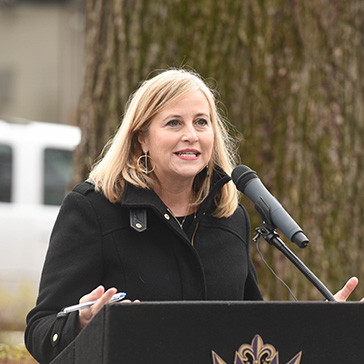
But in general, I like trees a lot, and I think they’re great. So on the one hand, I was excited when Mayor Megan Barry signed an executive order making trees a public utility. On the other hand, I made the mistake of reading through the master plan that led to this and I have some reservations.
I don’t find any mention of consulting archaeologists in the plan, for instance. I know this is a continuation of, “We refuse to learn any lessons from Fort Negley,” but leaving the trees on the hill was damaging the site. People pissed and moaned, but those people were wrong. A tree is a renewable resource. Historically significant sites are not.
There’s nothing in the plan that calls for any consideration of the history of the land. It just relies on a maxim that more trees are better.
There are also some sleights of hand with the truth in the report. In the history section, it reads:
The first known settlers in the area of modern Nashville were Native Americans of the Mississippian culture, who lived in the area from about 1000 to 1400 BC. They sowed and harvested corn, made great earthen mounds, and painted richly decorated pottery. They then mysteriously disappeared. Other Native Americans, the Cherokee, Chickasaw and Shawnee, followed and used the area as a hunting ground.Pre-European Davidson County was entirely forested with an Oak-hickory dominant forest type. Various species of upland Oaks made up two-thirds of the volume. Today trees cover 47 percent of the county. Eastern Red Cedar is the dominant conifer and makes up ten percent of the woodland both in pure stands and mixed with hardwoods. The pure stands of Red Cedar are typically on soils that are shallow over limestone or on limestone outcrops.
First, date for the Mississippian culture is A.D. (or C.E., depending on your preference).
People have lived in this area for 10,000 years, probably longer. I heard an archaeologist out at Bells Bend Park talking about how we’ve pulled and continue to pull so many significant Paleo-Indian artifacts out of Davidson County that if life were fair and archaeologists had realized it in the 1920s, we’d be calling “Clovis culture” “Nashville culture.”
I've written about this before, but the idea that there wasn’t anyone living here is just bullshit. The Shawnee had a small year-round settlement here where Peter Chartier was born that was just south of Jefferson Street, right on the river. Some Yuchi Indians have a tradition that they lived in small settlements on the east side of the river, but the constant warring over this area between the Shawnee and the Creek and the Cherokee made them decide they’d be better off to go live with the Creek. That was roughly 1715. But we know some small number of Shawnee were living here until 1756, because Peter Chartier came back to live among them. And then, of course, there were French fur traders here.
Also, that second paragraph makes it sound like Davidson County’s “natural” state was “entirely forested.” In other words, completely covered with trees. But anyone who’s ever seen a cow pasture knows that you can’t have both a fully forested county and places where thousands of ruminants are regularly hanging out — like all the salt licks and clay licks we have in the county that attracted everything from mastodons to bison to deer over the millennia. Also, you don’t have farming and mound-building in forests. There was cleared land here for a long, long time.
Two other things suggest Davidson County wasn’t “naturally” heavily forested. One, longhunters often gave directions or remembered where they camped from year to year by using trees as landmarks. And Davidson County’s oldest deeds had trees as markers for property lines —trees for markers even before the land had been cleared. If everything is forested, how is a tree a good landmark?
Second, Davidson County has iron. Not a lot. Nothing compared to farther west. But when the Robertsons were opening their iron furnaces, there wasn’t anyone else here. Why didn’t the Robertsons open their first furnace in what is now Davidson County? Probably for the same reason Montgomery Bell was fighting the Robertsons and Napiers in court a few decades later — because it was hard to come by enough trees to fuel the furnaces without people stealing yours.
The lack of any early Robertson furnace in Davidson County, where there is some iron, suggests we didn’t have enough trees to make a furnace work here.
Again, I’m not opposed to trees. It’s obviously too late to tell everyone to move away because we’re going to put some grasslands here, and trees do wonderful things that benefit us (though the report claims they fight crime, and I have my doubts about that).
We should plant more trees. But we should also be careful where we let trees grow. And we shouldn’t use specious claims of “naturalness” to make the past seem like something it wasn’t.



