

@startleseasily is a fervent observer of the Metro government's comings and goings. In this column, "On First Reading," she'll recap the bimonthly Metro Council meetings and provide her analysis. You can find her in the pew in the corner by the mic, ready to give public comment on whichever items stir her passions. Follow her on Twitter here.
At a meeting plagued by the unchillest of vibes, the Metro Council on Tuesday night approved a bill to redefine “family” in the zoning code, loosening restrictions on unrelated roommates. The body also finalized a specific plan rezoning request in Belle Meade, which you can read more about here.
Early-Onset Short-Timer Syndrome
With only six regularly scheduled council meetings remaining in this term, the vibes at the courthouse are getting chaotic. Tuesday night’s meeting felt like the beginning of the end. The second-term councilmembers are trying to finish out their service on a high note, and they’re running out of time to do it.
That feeling that a shift is coming, and we’d all better brace for impact, was palpable on Tuesday. Tempers ran high. Fuses were short. Patience was at an all-time low. Councilmembers got disproportionately salty about relatively inconsequential issues. Mini turf wars played out over straightforward rezoning requests. In sum, it was not a particularly fun time.
I spoke with several second-term CMs to get their insight on this phenomenon. One CM chalks it up to pressure to get legislation passed at the end of a term. And for those with reelection campaigns, the dual stress of running a campaign and being in office is just plain hard. There aren’t enough hours in the day, and nobody’s getting their beauty rest.
CM Dave Rosenberg describes it as a need among some second-termers to “accomplish as many goals as possible before the clock hits zero or a desire to influence the conversation as much as possible before time runs out.” They know they’re about to lose their seat at the big table, and they want to squeeze out every last drop of legislative juice.
Another CM calls it “Short-Timer Syndrome.” He says it started a little later last term, around June 2019, but it follows a familiar pattern. Once a person knows their time in a group is coming to a close, the incentive to build coalitions and foster positive relationships can start to evaporate. If you know you’re not going to need someone’s vote, and you never really liked that person very much to begin with, why bother with the niceties?
I suspect this year’s early-onset variant is borne of the sheer exhaustion from a brutal, highly unusual four years in office. The pandemic hit Nashville early on in this council term. The CMs barely had a chance to learn each other’s names before they were siloed in their bubbles, limited to virtual interactions. They missed out on the crucial little moments in the break room, building solidarity and understanding over a slice of lukewarm pizza; or sitting in the windowsill of the council chamber, pretending to laugh at each other’s jokes. That stuff may seem silly, but it matters to group dynamics. We’ve certainly seen that lack of togetherness play out in bitter legislative fights over the past couple of years.
Don’t expect any yearbook signings or graduation parties with this group.
Sean for Five
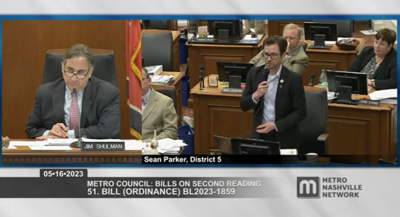
After seven deferrals and compromise upon compromise, CM Sean Parker’s bill to change the way we define “family” in the zoning code received final approval from the council. His work on the bill offered a glimpse into the kind of negotiating and iterative improvements we can expect to see from Parker if he’s reelected this summer. He even received kudos from CM Russ Pulley, who had worked to water down the proposal. Pulley — who is running for an at-large seat — is a former FBI agent who’s been on the opposite side of Parker on several big issues this term, but he’s often spoken highly of Parker’s commitment to passing good legislation and taking the time to get things right.
Responding to concerns from colleagues that five unrelated individuals in a single household could lead to overcrowding — a concern that is curiously absent from discussions of short-term rentals, which are typically capped at 12 occupants — Parker introduced an amendment that would cap that number at four for most houses, but increase the cap to five for houses with four or more bedrooms. And with that concession, he squeaked out a win. It was close — he needed 21 votes to prevail, and he got 22 — but a win’s a win.
Thanks in large part to preemption by the state legislature, Nashville remains severely restricted in our ability to address the housing crisis through more comprehensive means, like requiring affordable housing in exchange for increased development entitlements. So the city is going to have to keep searching for creative solutions to move the needle.
It’s budget season! With campaigns in full swing and second-semester senioritis hitting some CMs hard, I think we can expect minimal changes to the mayor’s proposed budget. You’ll get your chance to weigh in at a public hearing in June.



Post a comment as anonymous
Report
Watch this discussion.
(0) comments
Welcome to the discussion.
Log In
Welcome to the discussion.
Keep it clean. Please avoid obscene, vulgar, lewd, racist or otherwise abusive language. Comments featuring hate speech or threatening or violent content will not be tolerated.
PLEASE TURN OFF YOUR CAPS LOCK.
Be truthful. Don't knowingly lie or mislead.
Be proactive. Use the “report” link on any comment that violates our comment policy.
Share with us. We'd love to hear your feedback.