

@startleseasily is a fervent observer of the Metro government's comings and goings. In this column, "On First Reading," she'll recap the bimonthly Metro Council meetings and provide her analysis. You can find her in the pew in the corner by the mic, ready to give public comment on whichever items stir her passions. Follow her on Twitter here.
If you’re wondering why your district isn’t seeing as much investment from the latest capital spending plan as you’d hoped, look no further than the East Bank. Of the roughly $527 million in the latest CSP, $40 million is earmarked for East Bank planning and infrastructure.

Roadway improvements, juvenile center and general maintenance top latest capital spending plan
While the city is busy building up Nashville’s Next Great Neighborhood, councilmembers are lamenting what they see as a relative lack of investment in Nashville’s existing neighborhoods. The city is committed to putting hundreds of millions of dollars into infrastructure and development costs over the next few decades to turn a series of parking lots into a bona fide neighborhood. Funds that might otherwise go to projects outside the downtown core are being rerouted to meet the city’s obligations for the East Bank, and the pain could be felt for quite some time.
As is customary, the lion’s share of the CSP went to Metro Nashville Public Schools and the Nashville Department of Transportation. For the first time in recent memory, though, the amount allocated for NDOT ($103.6 million) exceeded the amount allocated for MNPS ($98.4 million). Nearly a third of NDOT’s funds will go toward East Bank infrastructure, with the remainder to be used for paving, sidewalks and signal upgrades throughout the county.
A Bridge Deferred Is Not Necessarily a Bridge Denied
Councilmember Tonya Hancock proposed an amendment to the CSP that would have funded a feasibility study and planning for a pedestrian bridge to connect Madison’s Peeler Park to the Stones River Greenway in Hermitage. Hancock has been working on getting this project funded since she was elected to the council in 2019, and it’s been at or near the top of the council’s priority list for years. Hancock’s amendment wouldn’t have funded construction of the bridge; she said “Nashville” U.S. Rep. John Rose promised he’d try to get federal funding for that piece, which could cost upwards of $30 million.
The mayor’s administration committed to working with Hancock to engage the community on this issue, but they were uncomfortable with the proposed funding sources for the amendment, which would’ve pulled from funding set aside for NDOT, Parks and the Office of Fleet Management. Councilmember Jordan Huffman was uncomfortable with the whole damn concept.
Huffman tells the Scene that his opposition to the pedestrian bridge is based on feedback from his constituents, who have no interest in “anything that connects us to Madison.” He describes the bridge as a “luxury item” that doesn’t address critical safety needs — like building sidewalks in high-traffic areas — for his community. The price tag is another pain point. “I could build another Strobel [House] for that,” says Huffman.
Hancock garnered some support for her amendment in committee, but opted not to offer it on the floor of the council Tuesday night. In a nearly unanimous vote, the mayor’s CSP was approved by the council without any changes.
You Can’t Please Everyone
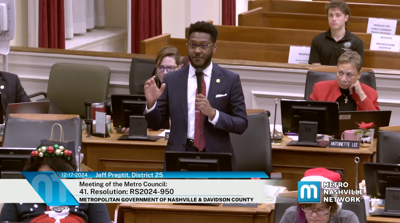
Earlier this year, Councilmember Jeff Preptit introduced — and subsequently withdrew — a controversial bill aiming to prevent the infiltration of hate groups and paramilitary gangs into the city’s public safety institutions. At the time of the withdrawal, Preptit vowed to continue working on the issue.

In her latest recap, @startleseasily reports on a strange public comment claim and a grant to outsource DNA testing
Tuesday night, Preptit was back with a resolution that asks the police department, the fire department, the sheriff’s office and the civil service commission to review their current personnel policies and, if necessary, enact new regulations to prohibit employee participation in hate groups and paramilitary gangs. The resolution also requests that the departments report back to the council on their findings by June 30.
“How can you be against a bill that doesn’t want hate groups involved here?” asked Councilmember Bob Nash during the Public Health and Safety Committee meeting. “I can’t be against that, surely.”
Narrator: Nash was, in fact, against that. He joined with several of his most right-leaning colleagues in opposing the resolution.
Nash’s major objection was that the departments “already have policies that address this,” so the resolution was attempting to “correct problems that don’t exist.” He also wanted it on the record that Nashville’s police have never turned fire hoses on residents, not even during the 1960s. “We saw police action, arresting people, there were some billy clubs involved,” said Nash, “but never did see a hose.” So there’s that.
To be crystal clear, all Preptit’s doing here is asking the relevant departments to review their policies and report back to the council on what they find. The police and fire departments keep telling us their policies already account for behavior like the type contemplated in Preptit’s original ordinance. If that’s the case, it should be simple for them to comply with the request.
Councilmembers Jeff Eslick and David Benton — both of whom, like Nash, have inserted their feet into their mouths already this term — expressed grave concerns over the “accusatory” and “inflammatory” language of the resolution. If you read as “accusatory” a resolution that simply asks a department to review its policies and cites issues in other cities as the rationale for said request, we must just have wildly different understandings of how accusations work.
Benton, a white man, also wanted Preptit to know just how difficult a topic this was to discuss. “I lived through the ’60s race riots; I’m that old,” said Benton, “and it really hurt to even think about it again.”
Man, I’m really sorry it hurts you to think about police violently assaulting Black people just for being Black. Maybe that’s a topic for therapy, though, not a committee discussion. And maybe, just maybe, continued inaction on this issue hurts Black Nashvillians more than talking about it hurts you.
Despite the misgivings of the Cop Caucus, the council approved the resolution, with 31 members voting in favor, five in opposition and Tonya Hancock recusing herself, seemingly randomly.



Post a comment as anonymous
Report
Watch this discussion.
(0) comments
Welcome to the discussion.
Log In
Welcome to the discussion.
Keep it clean. Please avoid obscene, vulgar, lewd, racist or otherwise abusive language. Comments featuring hate speech or threatening or violent content will not be tolerated.
PLEASE TURN OFF YOUR CAPS LOCK.
Be truthful. Don't knowingly lie or mislead.
Be proactive. Use the “report” link on any comment that violates our comment policy.
Share with us. We'd love to hear your feedback.