

@startleseasily is a fervent observer of the Metro government's comings and goings. In this column, "On First Reading," she'll recap the bimonthly Metro Council meetings and provide her analysis. You can find her in the pew in the corner by the mic, ready to give public comment on whichever items stir her passions. Follow her on Twitter here.
It was 8:02 p.m. on Tuesday, Aug. 20, 2024. The sun had barely finished setting, and against all odds, a Metro Council meeting was adjourned. Mark it down in the history books, kids. We’re not likely to see another one like it any time soon.
A magical confluence of events — one I won’t attempt to understand, lest I anger the gods with my curiosity — produced one of the shortest Metro Council meetings in recent memory. While all the cool kids were at the Democratic National Convention, a few lonely stragglers sat in the gallery watching the proceedings at the Historic Metropolitan Courthouse.
The lack of an audience isn’t normally enough to keep councilmembers from yapping the night away, but the promise of getting home early enough to see former President Barack Obama make innuendos? Well, that’s a different story.
I knew it was going to be a short one when the much-discussed East Bank Authority legislation came up for a vote. Councilmember Jacob Kupin, a loquacious freshman with energy to spare, gave a quick hat-tip to the mayor’s chief development officer Bob Mendes and moved for approval without fanfare.
Despite the early hour, no one else buzzed in to express their love for the Scene’s Best of Nashville 2024 Best Tall Guy (Writer’s Choice). Quite the departure from the odes to Bob that typically accompany legislation spearheaded by Mendes.
Very demure, very mindful.
Batting Average
Mayor Freddie O’Connell, bruised but not beaten, continues to take hits over his appointments to boards and commissions. At Tuesday’s Metro Council meeting, Julie Ryan Caputo, a nominee for reappointment to the Short Term Rental Appeals Board, faced opposition from some members of the council.
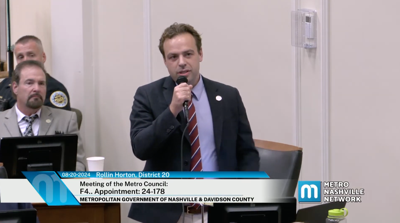
Councilmember Rollin Horton, expressing concern about Caputo’s decision-making process — which Horton said “has created the risk of a perception ... that similar cases are being decided dissimilarly” — brought with him the majority of his “Common Sense Caucus” to vote against Caputo’s reappointment.
Councilmember Sean Parker brushed aside these concerns as a function of the “sensitive or personal matters” considered by the board. Ultimately, Caputo’s appointment was approved by a vote of 27-4, with four councilmembers abstaining.
Disclosure: Because I also serve on the Short Term Rental Appeals Board, I won’t comment on my personal feelings about Caputo.
With other contested appointments on my brain, though, I wondered: How does O’Connell’s experience compare to his immediate predecessor, John Cooper? By this time in his term, then-Mayor Cooper had a perfect record with board and commission appointments. Every nominee he advanced to the council floor received unanimous support. It wasn’t until February 2021 that Cooper first encountered pushback from the council on any of his nominees.
All told, throughout Cooper’s four-year term, there were only seven contested board and commission appointments, out of 445 attempts. Two of those — a pair of failed appointments to the Fair Commissioners Board — were actually appointed by then-Vice Mayor Jim Shulman, thanks to Cooper’s consistent inability to fill vacancies in a timely fashion.
O’Connell hasn’t fared as well. In his first year in office, O’Connell has made 141 appointments to boards and commissions. Of those, eight have received at least one “no” vote or at least two abstentions. He’s courted controversy early, pushing forward with nominees even when he knows the vote won’t be unanimous. It’s an unusual strategy, indicative of an administration that believes it has political capital to burn, and then some.
O’Connell hasn’t lost yet. But every minute his legislative affairs director spends trying to count to 21 on a random board appointment is one minute he can’t spend lining up votes on the issues O’Connell got elected to accomplish.
Recordkeeping for Dummies
As I combed through the minutes of roughly 27,000 Metro Council meetings this week, I noticed something: The minutes kind of suck.
Even with the council’s online legislative system Legistar — introduced in 2020 and intended to solve all manner of recording and cataloging difficulties — there are still semi-frequent errors and inconsistencies that make interpreting the minutes challenging.
For instance, one set of minutes listed only 37 councilmembers as present, but zero councilmembers absent. In another set, the names of people voting “yes” and “no” were listed, but not the total votes. There are now fingerprints on my laptop screen from where I counted off the names again and again, trying to ensure accuracy in my records.
And don’t get me started on the pre-Legistar minutes. One such fossilized relic recorded all 40 councilmembers as both present and absent. A Schrödinger’s Council? Or perhaps a commentary on the ways the body may be present while the mind is absent ...
As you can see, reading this shit will make you go a bit batty.
The council is charged with approving the minutes of the previous meeting at each meeting. It’s obviously a perfunctory vote — no one ever actually reads the minutes — but damn if it wouldn’t be helpful to have a second set of eyes on these things.
In the Year of Our Lord 2024, we should be able to manage an accurate accounting of the important (and sometimes not-so-important) work our legislative body does.



