

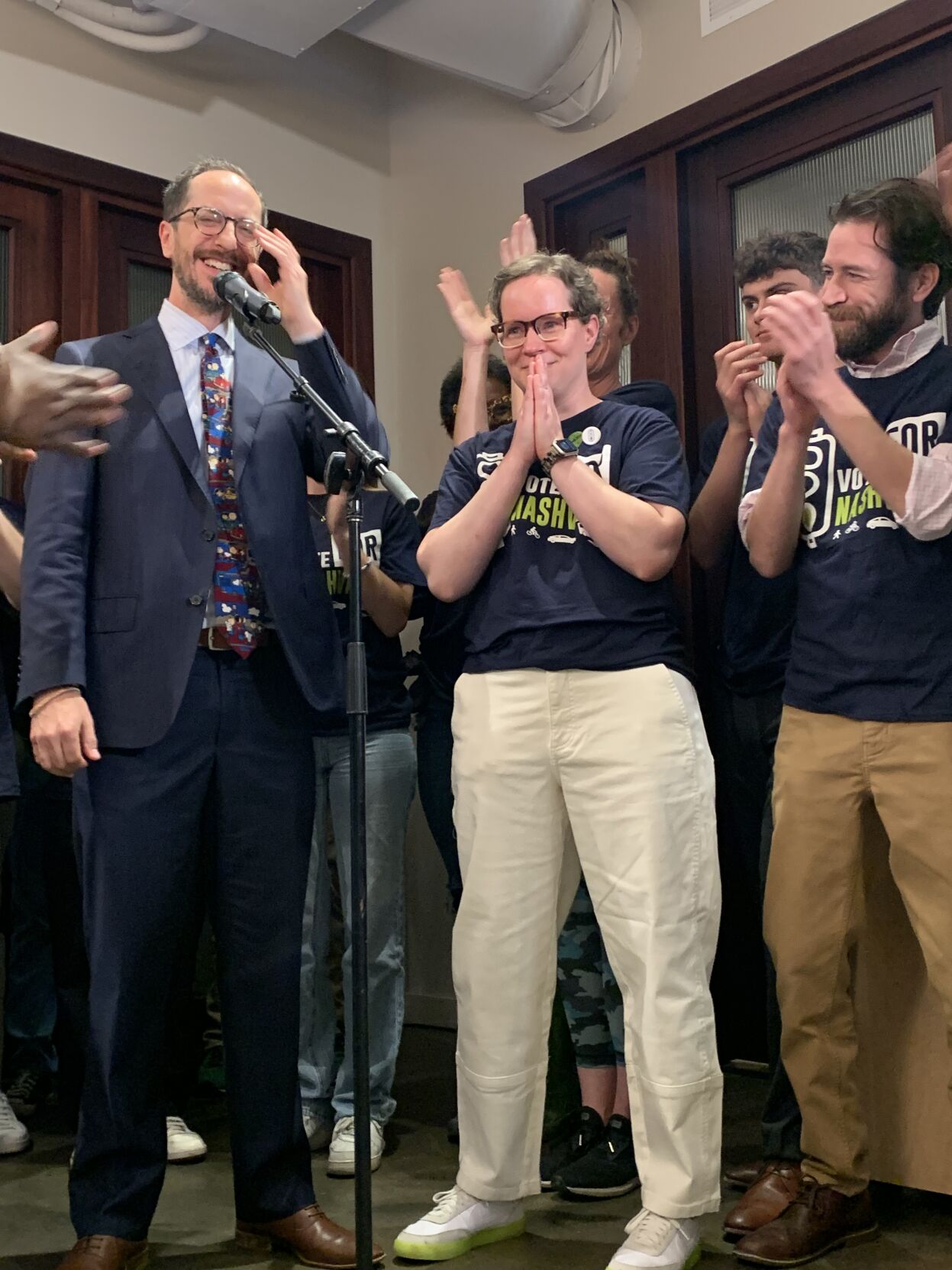
Mayor Freddie O'Connell celebrates his transit win at co-working space The Malin in the Gulch, Nov. 5, 2024
Mayor Freddie O’Connell laid out immediate steps in the city’s push to expand transit options less than 24 hours after polls closed on Election Day in Davidson County. In a rare Wednesday morning press briefing, the mayor announced a new executive position and told reporters that a Trump White House could hinder the project’s complex funding plan.
Voters overwhelmingly approved O’Connell’s transit referendum — which dedicates county sales tax revenue to expansive roadway and bus improvements — on Tuesday’s presidential ballot. The earmark will direct roughly $150 million a year for transit spending. Nashville expects another $1.4 billion from the federal government, including grants from the Federal Transit Authority, which will be contingent on a Trump White House. The city immediately announced a job listing for a chief program officer to oversee the plan’s implementation, a new advisory committee and upcoming procurement processes for $3.1 billion in planned capital spending.
“In calendar year 2025, WeGo will be able to have more improvements than they would have in any other year in recent history," O’Connell explained Wednesday morning from the podium. "We think in all three — sidewalks, signals and service — you’ll start to see improvements in year one. But I can’t tell you quarter by quarter or exactly what street would be first.”

Voters give mayor’s $3.1 billion plan the green light
O’Connell’s office designed the transit plan to leverage support from the Bipartisan Infrastructure Law and the Inflation Reduction Act — two major legislative packages passed under President Joe Biden. O’Connell is confident both will remain available. The plan also targets direct grants from the Federal Transit Authority and the Federal Highway Administration, both of which fall under the United States Department of Transportation. Trump has not announced his pick for secretary of transportation, the cabinet-level head of the USDOT currently held by Pete Buttigieg.
“If the money is not there, we wind up having to value-engineer some elements,” O’Connell said on Wednesday. “It probably means the most capital-intensive elements of the program would be reduced. But from a basic sidewalk-and-infrastructure level, we’ll get done what we need to get done. And we’ll get a jump-start while we know federal funding is available.”



Post a comment as anonymous
Report
Watch this discussion.
(0) comments
Welcome to the discussion.
Log In
Welcome to the discussion.
Keep it clean. Please avoid obscene, vulgar, lewd, racist or otherwise abusive language. Comments featuring hate speech or threatening or violent content will not be tolerated.
PLEASE TURN OFF YOUR CAPS LOCK.
Be truthful. Don't knowingly lie or mislead.
Be proactive. Use the “report” link on any comment that violates our comment policy.
Share with us. We'd love to hear your feedback.