
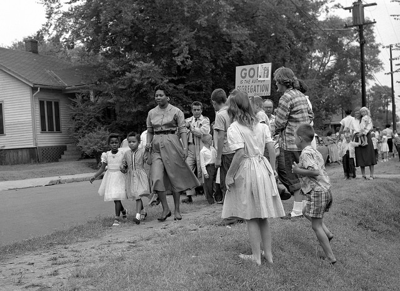

Mother leads children to school amid protesters, September 9, 1957
One of our most beloved myths as a city is that we peacefully integrated. The Frist Art Museum has a new exhibit of pictures from The Tennessean and the Nashville Banner of the Civil Rights Era in Nashville. Because of my day job, I’ve gotten to see some of the pictures the Frist is displaying, some of which never ran in the papers.
That got me thinking of the ways in which the local media shaped Nashville’s perception and therefore our memory of the integration era.
In my research on the bombings from that era, I came across what I think is the moment when the story The Tennessean told Nashville began to diverge from the whole truth — August 28, 1957.
This was right as the first black school children to go to formerly all-white public schools were registering for the first grade. Segregationists had been exerting enormous pressure on the families — both black and white — of first graders who would attend those integrated schools.
The Tennessean did report that black families had received threats that their children would be beaten or have acid tossed on them (which makes the throwing of bottles on the first day of school doubly terrifying).
But John Kasper, the leader of the racist segregationists, made a more explicit threat. The Murfreesboro Daily News Journal ran two stories about it, one on August 28 and the other on August 29.
Kasper told a crowd of his supporters in Nashville, “We’re going to talk to the niggers and tell them if they want to avoid the shotgun, dynamite and rope they had better get out of the white schools.”
That’s a pretty clear death threat, given with the support of a large, angry crowd.
Neither The Tennessean nor the Banner ran that quote. And without that quote, the tribulations of the black families seem like they’re caused by individuals working independently, not because of a concerted effort directed by Kasper and put into motion by his followers.
It also left the black families who would integrate our schools without a vital piece of information they might have wanted to know.
But I still can’t blame The Tennessean completely. It was kind of a relief to see that someone in a position to do something recognized that we were sitting on a powder keg, metaphorically, and tried to do something to keep folks calm.
As I’ve said before, integration wasn’t peaceful here, we just got very lucky no one was killed. The pictures at the Frist make that clear.
If you care about Nashville’s history — the truth of it — it’s worth going and looking at those photos and, in some cases, wondering why you’ve never seen them before.



