

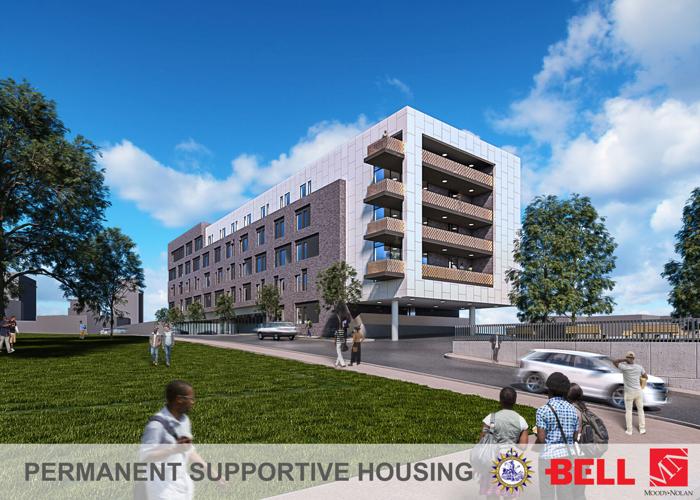


After two-and-a-half years, Nashville has officially begun construction on a housing complex that will benefit some of the city’s most vulnerable residents. The city broke ground Tuesday morning on a 90-unit permanent supportive housing center that, when opened, will provide homes and on-site services to people experiencing homelessness.
Speaking at the ceremony, Mayor John Cooper said the five-floor building will be a “fabulous site” that will include green space and essential services that will help people stay off the streets — services including case workers and supportive services for mental health and substance abuse.
Cooper said the development, located at 600 Second Ave. N., is a model of what the city’s commitment to a housing-first approach will look like. Housing-first models emphasize placing people experiencing homelessness into housing as quickly as possible, with few barriers to qualify for a unit and assistance provided on site. He also noted he is proposing to invest $50 million in federal American Rescue Plan funds toward the city's homeless services efforts.
Elizabeth Mallard also spoke at the ceremony, stressing the importance of having both housing and services readily available. Mallard was homeless for 10 years, often sleeping outside and, in her own words, self-medicating with alcohol to cope with her bipolar disorder. Eventually, she met members of Colby’s Army, a Middle Tennessee outreach organization, and was connected to a housing navigator. She says that in addition to finding a home, she received the support needed to build life skills and maintain her health and housing.
The people who helped her out “have become not just my housing navigator, not just some outreach people — these are my friends,” she said.
Mayoral candidate and District 19 Councilmember Freddie O’Connell also spoke at the event. O’Connell has criticized the administration for delays in opening the development, but at the ceremony thanked the mayor for his commitment to completing the project. O’Connell also stressed the importance of the groundbreaking, noting that 2021 was the deadliest year on record for people experiencing homelessness.
The permanent supportive housing complex has been anticipated for years. Former Mayor David Briley originally proposed the idea, and Cooper announced his intention to follow through in October 2019 — following a controversy in which it was revealed that the city had no cold-weather shelter plan in place. The complex was originally scheduled to break ground by the end of that year, but was delayed by redesigns. The new design includes the addition of a green space and reduces the number of units from 112 to 90.
The construction will be funded with $25 million from the capital spending plan, and the development is expected to open in the fall of 2023, per a release from the city. Sernorma Mitchell, a field office director for the U.S. Department of Housing and Urban Development, said at the groundbreaking ceremony that American Rescue Plan dollars would be used in funding the services.

On Thursday, just days before the groundbreaking, an out-of-state consultant released preliminary findings critiquing the city’s performance in homelessness outreach and housing efforts. Presenters from the Louisiana-based firm HousingNOLA recommended Nashville build 650 more permanent supportive housing units over the next five years to improve its efforts in reducing chronic homelessness. The U.S. Department of Housing and Urban Development defines chronic homelessness as occurring when an individual with a disabling condition has either experienced homelessness for longer than a year or experienced homelessness four or more times in the past three years.
The audit also found gaps in data regarding people currently receiving permanent supportive housing.
“Data … drives the machine,” Servais told reporters after the ceremony. Tracking that information will help show what is working and what isn’t, he said, and will also allow the city to access more funding for successful efforts.
Also speaking with reporters after the ceremony, Mallard said she is hopeful that more permanent supportive housing will be built.
“There's much more help that's going to be needed in the future, but facilities like this are going to make a world of difference.”



Post a comment as anonymous
Report
Watch this discussion.
(0) comments
Welcome to the discussion.
Log In
Welcome to the discussion.
Keep it clean. Please avoid obscene, vulgar, lewd, racist or otherwise abusive language. Comments featuring hate speech or threatening or violent content will not be tolerated.
PLEASE TURN OFF YOUR CAPS LOCK.
Be truthful. Don't knowingly lie or mislead.
Be proactive. Use the “report” link on any comment that violates our comment policy.
Share with us. We'd love to hear your feedback.